Newsletters


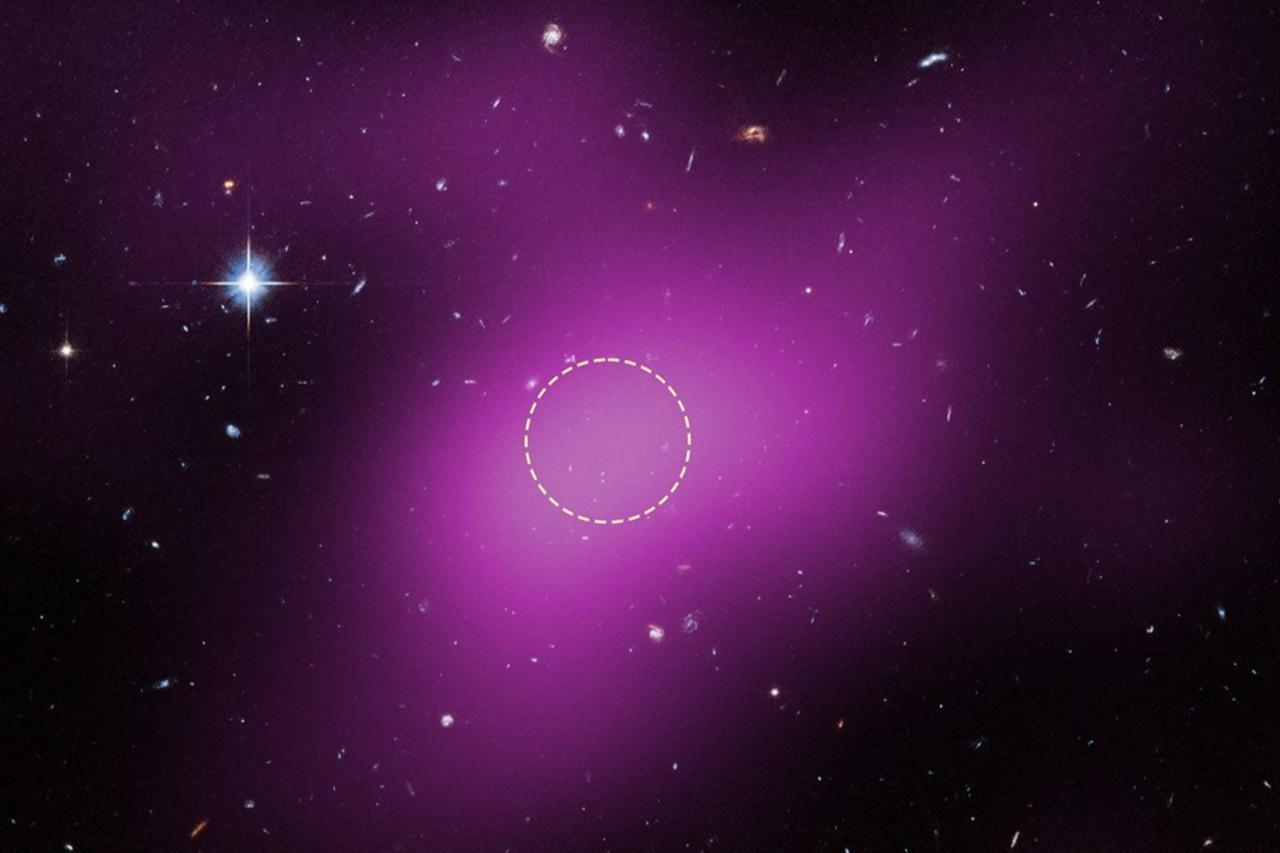


A team using the NASA Hubble Space Telescope has confirmed the existence of a rare and long-theorized cosmic object.
Known as Cloud 9, the structure is a gas-rich cloud dominated by dark matter that contains no stars. Astronomers describe it as a relic from the early universe and the first confirmed example of a Reionization Limited H I Cloud, or RELHIC.
The findings were published in The Astrophysical Journal Letters and presented at the 247th meeting of the American Astronomical Society. Researchers say the object provides direct evidence for a class of failed galaxies that formed dark matter halos and hydrogen gas but never ignited star formation.
“This is a tale of a failed galaxy,” said Alejandro Benitez Llambay of the University of Milano Bicocca, the program’s principal investigator, as reported by NASA. “Seeing no stars is what proves the theory right. It tells us that we have found in the local universe a primordial building block of a galaxy that never formed.”
Cloud 9 lies about 14 million light-years from Earth on the outskirts of the nearby spiral galaxy Messier 94. For decades, astronomers have predicted that many small dark matter halos should exist without visible stars, but none had been conclusively identified until now.
RELHICs are thought to be remnants from the period after cosmic reionization. These small halos managed to collect some neutral hydrogen gas, but not enough to trigger star formation. Without stars, such objects remain invisible in optical surveys and can only be detected through faint radio emissions from hydrogen.
Cloud 9 was first detected three years ago during a radio survey conducted with the Five-hundred-meter Aperture Spherical Telescope (FAST). Hubble identifies Cloud 9 as a ghost galaxy that never formed any stars. in Guizhou, China. Follow-up observations with the Green Bank Telescope and the Very Large Array confirmed the presence of a compact hydrogen cloud.
Before Hubble observations, scientists could not rule out the possibility that Cloud 9 was an extremely faint dwarf galaxy whose stars were beyond the reach of ground-based telescopes. That uncertainty has now been resolved.
“With Hubble’s Advanced Camera for Surveys, we can nail down that there is nothing there,” said lead author Gagandeep Anand of the Space Telescope Science Institute. “The cloud is truly starless.”
High-resolution radio data show that the neutral hydrogen core of Cloud 9 spans roughly 4,900 light-years.
The cloud contains about one million solar masses of hydrogen gas. By measuring the balance between gas pressure and gravity, researchers estimate that its surrounding dark matter halo has a mass of around five billion times that of the Sun.
That mass places Cloud 9 near a critical threshold for galaxy formation. If the halo were significantly larger, the gas would likely have collapsed and formed stars, producing a dwarf galaxy. If it were much smaller, environmental effects could have stripped or ionized the gas, leaving little neutral hydrogen behind.
Compared with hydrogen clouds previously observed near the Milky Way, Cloud 9 appears smaller, more compact, and nearly spherical. Subtle distortions in its gas distribution suggest a physical association with Messier 94 and possible interaction with the galaxy.
“This cloud is a window into the dark universe,” said Andrew Fox of AURA and the Space Telescope Science Institute, working for the European Space Agency. “Dark matter does not emit light, so objects like Cloud 9 allow us to study dark matter dominated structures through their gas rather than starlight.”
Cloud 9 offers scientists a rare opportunity to study a dark matter halo without the complicating effects of stars, such as stellar winds or supernova feedback. This makes it a clean test case for models that describe how small halos evolve and why some galaxies fail to form.
The discovery also helps address a long-standing gap between theory and observation. Models predict many more small dark matter halos than the number of dwarf galaxies that astronomers actually observe. Starless objects like Cloud 9 may account for part of that missing population.
Finding such systems remains difficult. Bright nearby galaxies and foreground stars can overwhelm their faint signals, while environmental effects like ram pressure stripping can remove gas over time. For these reasons, researchers expect RELHICs to be rare.
Even so, astronomers believe Cloud 9 is unlikely to be unique. Future deep radio surveys and sensitive optical observations are expected to reveal more failed galaxies in the nearby universe.


 Set as preferred source
 Set as preferred source



 3 min read