Newsletters




“Nope.”
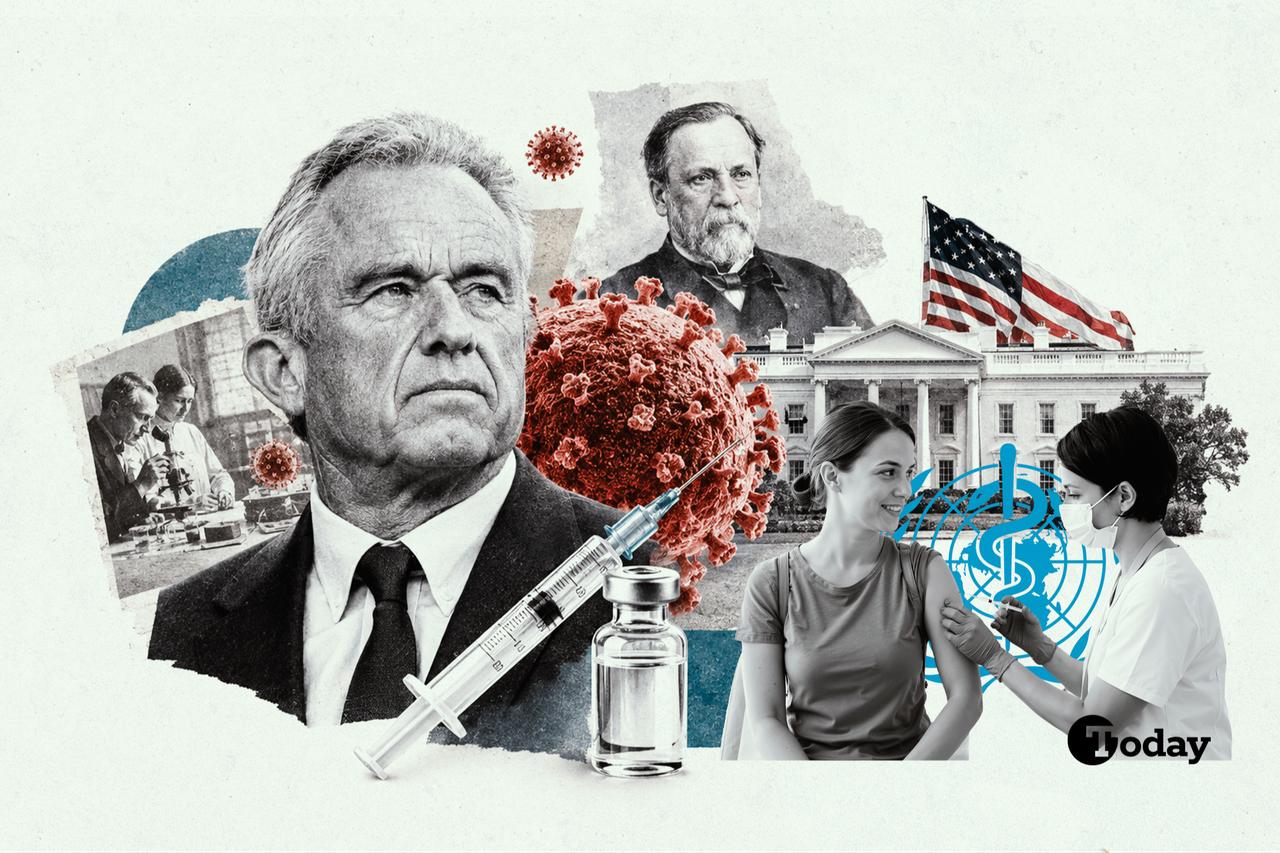
That was the word from World Health Organization headquarters in Switzerland some 48 hours after Donald Trump was elected president, when I asked about convalescing heroin addict Robert F. Kennedy Jr.’s extraordinary claims on vaccines and public health—and Trump’s decision to put him within reach of the levers controlling America’s public-health machinery.
The bureaucratic drawbridge was already rising over the moat, and Trump had not yet assembled the administration that would eventually hand America’s vast health bureaucracy to a man with an extraordinary medical resume of his own.
“I was a heroin addict for 14 years,” Kennedy has said. “I’m lucky to be alive.” He would soon be running the U.S. Department of Health and Human Services.
There is another reason Kennedy’s journey into the command center of American medicine has a peculiar resonance.
“I’m not scared of a germ,” Kennedy has said. “I used to snort cocaine off of toilet seats.”
I don’t require his recollection to appreciate the grim reality behind that line. It’s an image that never quite leaves the darkroom of memory—and one that makes Kennedy’s improbable arc from the bathrooms of Gotham to the Cabinet room of the White House considerably more than political biography.
Across Europe, the great temples of medical science at first had little appetite for joining an American political knife fight over Kennedy’s doubtful credentials.
At the Pasteur Institute in Paris, where Louis Pasteur helped lay the foundations of germ theory of modern medicine, the historical message needed no press conference.
“The microbes,” Pasteur famously warned, “will have the last word.”
The view from Türkiye is markedly less philosophical.
The Turkish Ministry of Health calls measles “extremely contagious,” estimates that 90% of nonimmune people exposed to an infected person will catch it, and says plainly that “the most effective method” of protection is complete and timely vaccination.
Türkiye also has receipts: the ministry reports that the five-year average for measles fell from 21,225 cases in 1980–84 to 713 in 2015–19—a 97% collapse after vaccination became routine.
And the virus has apparently found social media easier to penetrate than the old Ottoman walls: a 2025 Turkish study of 403 mothers found 17.4% had encountered misinformation claiming vaccines were unnecessary and 7.3% had encountered the debunked claim that vaccines cause autism.
The researchers concluded that negative vaccine attitudes were often associated with inadequate information and urged health professionals to counter hesitancy with scientific evidence.
Well, the microbes are talking again.
The difference is that RFK Jr. is no longer merely the famous American vaccine skeptic rattling around the international public-health establishment.
He is the U.S. Secretary of Health and Human Services, sitting atop the federal bureaucracy responsible for the CDC and much of American health policy.
And yesterday, he returned to Children’s Health Defense, the organization he once led, with a message for the vaccine skeptics assembled in Washington: “You have a strong and steadfast friend at the White House.”
Kennedy also vowed to “die with my boots on” pursuing questions about vaccine risks.
There it was.
The nightmare European scientists once contemplated from the safe side of the Atlantic had acquired a government office, a Cabinet title and a microphone.
Kennedy’s appearance was no seminar in epidemiological nuance. Mark Gorton, president of the MAHA Institute, reportedly called the success of the polio vaccine a “fraud.”
Andrew Wakefield—the former British physician whose paper suggesting a connection between the MMR vaccine and autism was retracted and whose conclusion has been contradicted by decades of subsequent research—also appeared at the conference.
Outside the hotel, meanwhile, measles was conducting its own peer review.
The U.S. has recorded roughly 3,300 cases in 2026, its worst outbreak in decades. Pennsylvania has reported four measles-associated deaths, including two infants, an 18-year-old and a 40-year-old woman; state officials have asked the CDC for emergency assistance while simultaneously fighting with Kennedy’s department over federal recognition of the deaths.
Microbes are notoriously indifferent to ideology.
They do not watch cable television. They have no donors, podcasts, or political action committees. Measles does not care whether you believe the pharmaceutical industry is corrupt, Washington is lying, the medical establishment is arrogant, or your neighbor’s cousin felt lousy after a vaccination.
It requires only susceptible lungs.
That was the brutal arithmetic underlying the silence in Europe when Kennedy first approached power. In 2023, measles infected an estimated 10.3 million people worldwide and killed about 107,500, mostly children younger than five.
WHO says vaccination prevented an estimated 60 million measles deaths between 2000 and 2023.
This is what gets lost when public health becomes political theater. Vaccine policy is not a theological contest between people who worship pharmaceutical companies and people who worship “freedom.”
Drug companies can behave badly. Regulators can fail. Scientific findings should be challenged, replicated and revised.
But challenging evidence requires evidence.
At Kennedy’s Washington homecoming, the line between legitimate scrutiny and long-discredited claims became difficult to locate.
The health secretary also promised investigations into electromagnetic radiation and “chemtrails,” the latter being the conspiracy theory that ordinary aircraft condensation trails contain deliberately dispersed chemicals.
Twenty months ago, European researchers could look across the Atlantic and wonder what Kennedy might do.
Now they can look at Pennsylvania.
Or Ankara.
That’s the connection between those nervous laboratories and the Washington ballroom. What had been treated as rhetoric on the political fringe has migrated into the executive branch while a vaccine-preventable disease is spreading through American communities.
Türkiye’s experience supplies an unusually stark control experiment. The country went from tens of thousands of measles cases to hundreds through vaccination—not alchemy, not ideology, not a podcast, but needles, surveillance and herd immunity.
Nelson Algren had a useful rule for dangerous propositions: never play cards with a man named Doc. His doomed character Frankie Machine supplied an even better epitaph for anyone wagering against biology:
“There’s people in hell who want ice water.”
Louis Pasteur might have understood.
Politicians get elections. Activists get conferences. Scientists get arguments.
The microbes get the last word.


 Set as preferred source
 Set as preferred source


 1 min read

 1 min read