Newsletters





Stifado arrives looking like something that has given up resisting gravity.
The onions gleam intact but morally defeated. The meat no longer remembers bones. The sauce is dark, sticky and smells of capitulation. It doesn't suffer a violent collapse but the slow, dignified ending of a snowman in March.
Stifado is claimed by those who cook it with a certain savagery. Yet strip away the theater, and you're left with a method so basic that it barely qualifies as a recipe. Take more onions than seems reasonable, small and whole, then cook them with meat until patience, fat and time broker a ceasefire. Add acid and spices. Then ignore it for several hours.
It is this patient neglect that defines the dish on both sides of the water. In a taverna off Monastiraki, in Athens, a waiter set down two bowls with the serenity of a padre distributing sacraments. Unprompted, he nods to its antiquity.
A few months later, in Cesme near Izmir, an identical bowl arrives with a similar sermon in the opposite direction. The sauce tastes the same, as does the certainty. The only thing both men would agree upon is that the other is a scoundrel.
Nobody fights this hard over food unless the resemblance is mortifying. The dish introduces itself via the Italian "stufato," which should already trouble anyone banking on immaculate Hellenic or Ottoman conception. Both claimants are arguing over a dish that has already told you, in its first syllable, that it belongs to neither of them.
The Eastern Mediterranean was never a heritage site. It's a thoroughfare, an assortment of shipping lanes with opinions, and on this occasion, views on onion stews. The closer the resemblance between the two sides, the more furiously they both ignore the Italian standing in the corner.
On the Turkish side, it gets filed under yahni, the way "things we stuff" organizes dolma. Acid is the grown-up in both kitchens, keeping the onions from cloying and the meat from dissolving in self-pity.
In Greek kitchens, it is traditionally supplied by wine, sometimes backed up by vinegar. In Ottoman and Turkish kitchens, wine was replaced by a rotation of substitutes: vinegar, pomegranate molasses, sour grape juice and occasionally yogurt. The stew equivalent of changing your name at the border but keeping the same job.
When I arrived in Cesme, the restaurant had been cooking since before anyone thought about lunch. The door was open, and the pot was on, lid ajar, the smell moving through the room the way winter light moves through a curtain—present without announcing itself.
The owner waved me in, said nothing about the stew, and poured coffee. We sat in the late morning lull, as he juggled his accounts and reservations books, and something irreversible happened on the stove.
That evening, the bowl arrived, the colour of dark wood, glossy, with a shard of cinnamon visible at the edge. The effect of stifado is identical to a roast dinner at a pub on a cold winter’s day: that punchy blend of comfort and serendipity; life at its most concentrated.
This sense of permanence isn't unique to the Turkish coast; the logic of the slow pot has a way of migrating.
The method travels easily. In Crete, they use rabbit, which clearly has premonitions of its destiny and proceeds accordingly. Further along the coast, the Levant loosens the acid with lemon and a handful of dried fruit appears in North Africa.
A similar pattern operates with equal intensity in south-western France, where the dish in question is no less simple and the staking of regional labels no less furious. À l'albigeoise, à la béarnaise, la languedocienne, la provençale: they all amount to failed coup attempts to become the canonical pot-au-feu.
There is even a rival pot in Madrid. What unites them is the same essential grammar—meat, allium, acid, time—and the same conviction that this grammar is local, unique and worth fighting over.
With stifado, that conviction has the added irony of etymology. The Italian origin is not a secret. The dish has been confessing its origins in its own name for centuries, and everyone has agreed to ignore it. Kitchen grammars aren't state secrets; what keeps getting passed on is the method itself.
Ultimately, the argument isn't about the vowels or the vinegar. The patriots in Monastiraki and Cesme can't really be said to be defending a recipe.
They're defending that pot: the slow start, the smell working through a building before anyone has thought about lunch, the morning organised around something that cannot be hurried.
That way of living is gone, or going, or making its excuses to leave, and insisting your version arrived first is the only vocabulary left for mourning it. The Italian etymology punctures not just the nationalism but illuminates the elegy underneath: everyone is grieving the same kitchen.
The dish doesn't care who claims it. It just needs someone willing to put it on the stove in the morning and walk away. Which, as it turns out, is exactly the problem.
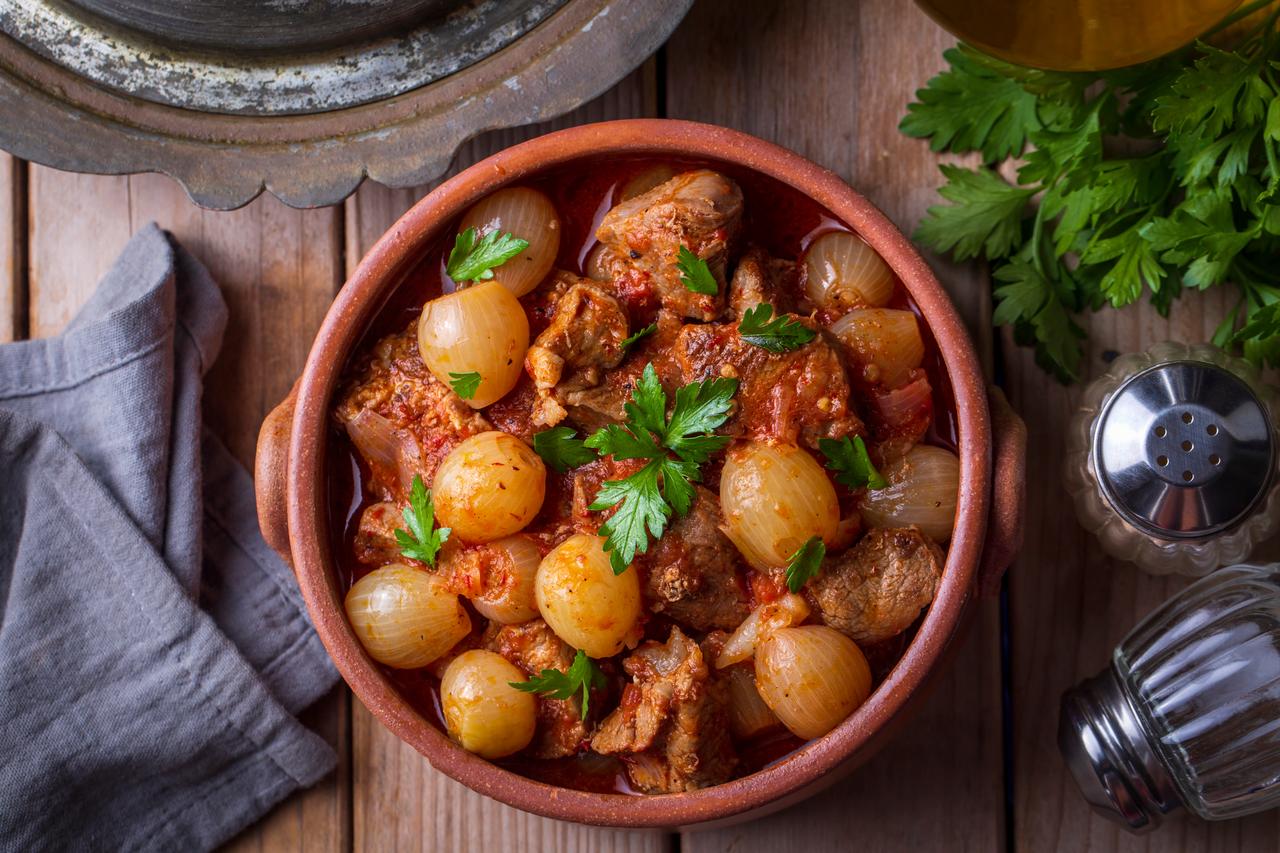

Ingredients
Optional but excellent: A strip of orange peel (no pith)
Method
1. Salt the beef generously. Heat olive oil in a heavy pot or Dutch oven and brown the meat in batches. Do not rush this. The colour is flavour. Remove and set aside.
2. In the same pot, add the whole onions. Cook over medium heat until they take on golden patches but remain intact. They should sweeten, not collapse. Add the garlic and cook briefly.
3. Stir in the tomato paste and cook it for a minute or two to remove its raw edge.
4. Pour in the red wine and vinegar. Scrape the bottom of the pot. Let it bubble for a few minutes so the alcohol cooks off and the sharpness settles.
5. Return the beef and any juices to the pot. Add crushed tomatoes, bay leaves, cinnamon, cloves, allspice (and orange peel if using). Add just enough water or stock to come about two-thirds up the meat. Bring to a gentle simmer.
6. Cover and cook on very low heat for 2–3 hours, until the beef is tender and the onions are soft but holding their shape. The sauce should be rich, dark and slightly glossy. Uncover for the final 20 minutes if it needs thickening.
7. Taste. Add salt and pepper as needed. If it feels flat, a small extra splash of vinegar will bring it back into focus. It should taste warm from the spices, gently sour and faintly sweet from the onions. Never sugary.
Serve with rice, mashed potatoes, bread or orzo.


 Set as preferred source
 Set as preferred source


 2 min read



 1 min read