Newsletters


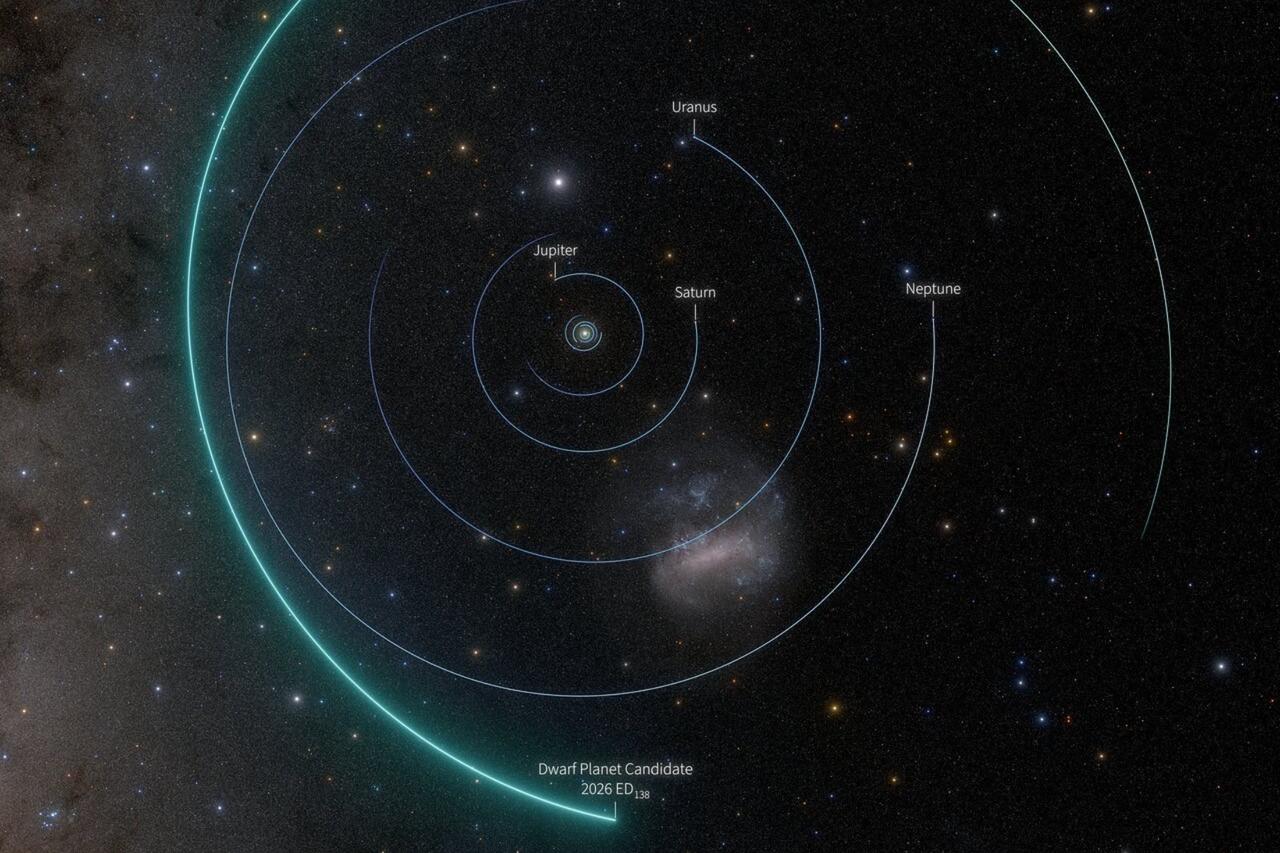


Astronomers have identified a possible new dwarf planet in the cold, dark outer reaches of the solar system, according to Reuters.
The object, designated 2026 ED138, is estimated to measure between 600 and 1,500 kilometers (370 to 930 miles) across.
It orbits about 46 times farther from the sun than Earth does. By comparison, Pluto circles the sun at an average distance of about 40 times the Earth-sun distance.
The object was discovered with the new Vera C. Rubin Observatory, built on top of Cerro Pachon, a mountain in central Chile. The observatory is a joint project of the U.S. National Science Foundation and the U.S. Department of Energy.
Scientists need to make more observations before the object can be officially called a dwarf planet.
To qualify, an object must be massive enough that its own gravity pulls it into a round shape. Researchers believe 2026 ED138 probably meets that standard, but they are still unsure of its exact size and what it is made of.
If confirmed, it would become the sixth dwarf planet recognized by the International Astronomical Union, the organization that officially classifies objects in space. The five current dwarf planets are Pluto, Eris, Haumea and Makemake, which all orbit beyond Neptune, and Ceres, which sits in the asteroid belt between Mars and Jupiter.
Based on current estimates, 2026 ED138 could be one of the largest dwarf planets in the solar system.


 Set as preferred source
 Set as preferred source



 2 min read