Newsletters


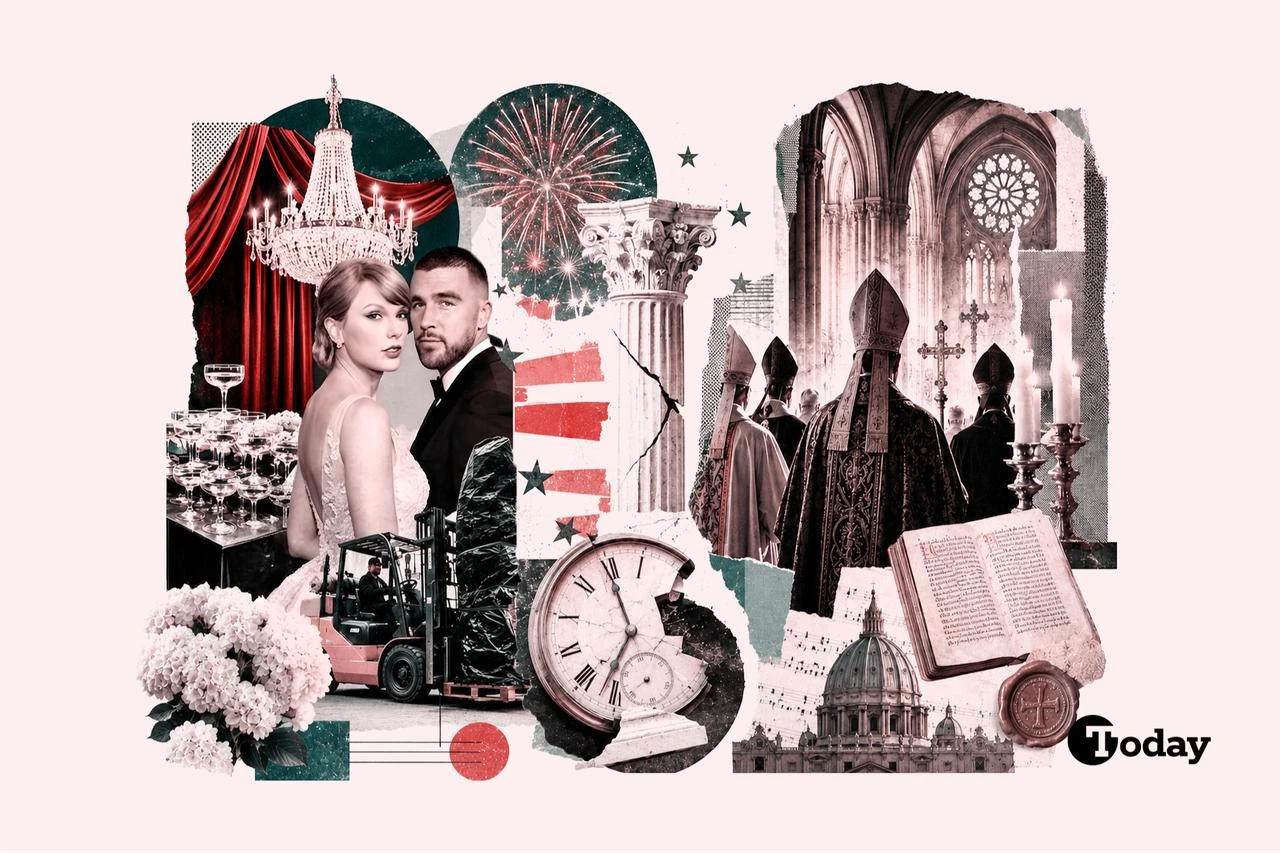


Fourth of July weekends have always been curious exercises in selective memory. Americans celebrate the future by dressing up as the past, wrapping themselves in powdered-wig mythology while eating hot dogs designed to outlive the republic beneath fireworks manufactured in the Far East.
This year, the country stages two celebrations so perfectly American they seem assembled in a laboratory dedicated to American contradictions.
In New York, forklifts creep through the loading docks beneath Madison Square Garden, hauling entire forests wrapped in black plastic. Trees, chandeliers, miles of fabric, no-phone security, tuxedos, cocktail gowns, celebrity planners, anonymous sources, and enough secrecy to suggest either a royal coronation or the filming of the world's most expensive hostage video.
By every credible report, Taylor Swift and Travis Kelce are preparing a lavish multi-day wedding celebration—a rehearsal dinner followed by a thousand-person black-tie spectacle where even the security guards surrender their phones. Somewhere, an event planner is frisking billionaires for burner phones while deciding where to place the imported hydrangeas.
Meanwhile, in the Swiss village of Ecône, another gathering of Americans prepares for its own ceremony. There are no celebrity florists, no speculation about couture, no Instagram-worthy centerpieces. Instead, there are bishops, canon lawyers, and enough Latin to awaken the ghosts of Ancient Rome.
The Society of St. Pius X yesterday dared to consecrate bishops without papal approval. Pope Leo XIV fired back with the Catholic Church's equivalent of a thermonuclear letter from Human Resources: excommunication.
From the loading docks of Manhattan to the altars of Rome, one party celebrates a wedding. The other risks a schism. President Donald Trump, improbably, has a cameo in both stories: denouncing Swift with "I HATE TAYLOR SWIFT," then casting himself as pope in an AI image and proclaiming, "The Catholics loved it."
It’s tempting to dismiss the Vatican drama as an internal squabble over incense and vestments, the theological equivalent of decoding a Swift Easter egg that probably isn’t there. But the real fight is over nostalgia—the hazardous narcotic that convinces people paradise lies behind them.
In the U.S., the Latin Mass Catholic movement has become one of MAGA's most fervent religious allies, embracing Trump's crusade to restore a mythic Christian West. That has turned Pope Leo's insistence on welcoming migrants, resisting militant nationalism and defending the poor into something far larger than a theological dispute: a transatlantic struggle over whether the Church serves the politics of grievance or the Gospel.
Every civilization eventually discovers that memory is easier to market than reality. The Society of St. Pius X looks backward to an imagined Catholic golden age before Vatican II opened the Church to the modern world. The old Latin Mass becomes less a liturgy than a time machine.
Unfortunately, time machines only travel toward fantasies. Historians remind us the pre-conciliar Mass was often hurried, poorly pronounced and filled with worshipers mechanically reciting prayers they scarcely understood. Reality rarely cooperates with nostalgia. Nostalgia never returns the favor.
America’s politics of church and state have become an endless clash between competing fantasies of yesterday. Every campaign promises restoration. Every movement insists paradise existed just before somebody else ruined it. The slogan changes, but the sales pitch remains constant: buy enough yesterday, and tomorrow will fix itself.
Pope Leo inherited those unfinished battles while trying to make unity the hallmark of his pontificate.
The timing could hardly be worse. Catholicism is no longer primarily European. The Church has exploded across Africa, Asia and Latin America, growing to roughly 1.4 billion faithful, while much of Western Europe has emptied its pews. Yet some traditionalists continue fighting to preserve an image of Catholicism inseparable from an older European order that demographic reality has already buried.
It is less a theological dispute than a refusal to acknowledge geography.
Across the Atlantic, another mythology unfolds beneath crystal chandeliers.
Swift and Kelce have become America's unofficial royal family, offering the consensual fairy tale modern democracies increasingly crave.
The public knows almost nothing about the wedding beyond black-tie attire, possible Ralph Lauren or Christian Dior gowns and a guest list optimized for tabloid oxygen. The mystery has become part of the entertainment. Privacy, once ordinary, is now a luxury good.
And that’s why the no-phone policy is the most revolutionary act over a weekend intended to honor revolution. Imagine: a thousand famous people forced to experience a celebration without immediately converting it into content.
There may be more genuine insurrection in that than in half the slogans shouted this holiday weekend. Because whether you're watching bishops threaten schism in Switzerland or forklifts unload ornamental forests outside Madison Square Garden, the same question lingers beneath the fireworks.
What exactly are we celebrating?
The traditionalists celebrate a church they believe has been lost. Swift's admirers celebrate a romance they have collectively helped manufacture into national folklore. The rest of America celebrates a revolution nearly 250 years old while arguing daily about whether the republic it produced still resembles the one described in school textbooks.
Perhaps that is the authentic July 4th ritual now—not patriotism, not religion, not celebrity, but nostalgia itself. It has become the national faith, the universal liturgy, the one ceremony capable of drawing enormous congregations. We genuflect before idealized yesterdays because tomorrow looks expensive, confusing, and poorly lit.
As fireworks boom and barbecues catch fire this weekend, somewhere in Manhattan champagne corks will explode beneath imported trees while, across an ocean, bishops contemplate crossing a line that could echo through the Catholic Church for decades.
Different ceremonies. Same human instinct: everybody wants redemption. Most of us settle for costumes.


 Set as preferred source
 Set as preferred source



 3 min read