Newsletters


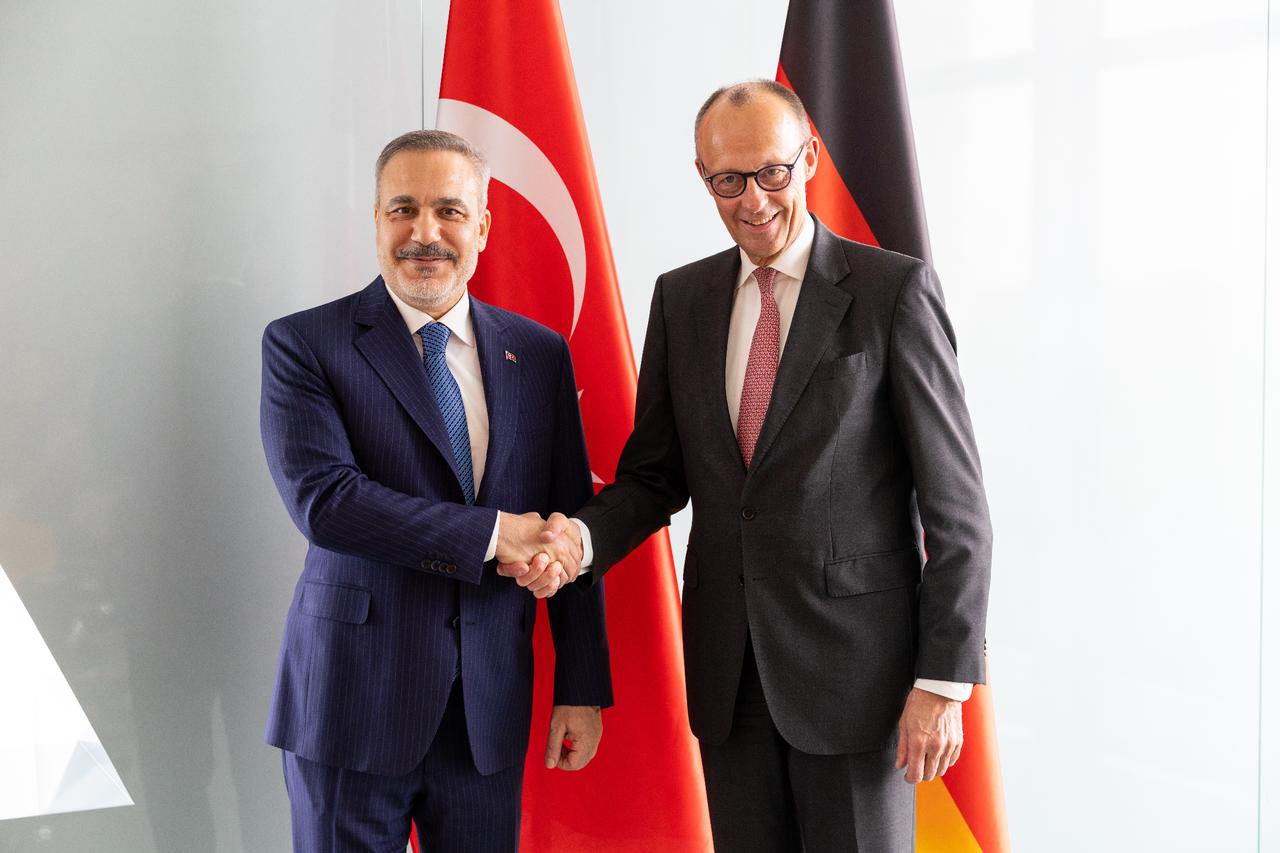


Foreign Minister Hakan Fidan traveled to Berlin this week for the third meeting of the Türkiye-Germany Strategic Dialogue Mechanism, holding talks with German Chancellor Friedrich Merz and delivering a pointed message on Türkiye's long-stalled European Union accession bid.
In a joint press conference with German Foreign Minister Johann Wadephul, Fidan called on the EU to handle Türkiye's candidacy on its merits, warning that excluding Ankara from the bloc's emerging defense architecture runs counter to Europe's own security ambitions.
"Our fundamental expectation from the European Union is that relations with Türkiye and our EU candidacy process be conducted independently of political motivations," he said, adding that barring Türkiye from EU defense and security frameworks "contradicts the security objectives Europe has set for itself."
Türkiye applied for EU membership in 1987 and began formal accession negotiations in 2005, but the process has been effectively frozen for years over disputes ranging from democratic backsliding concerns to the unresolved division of Cyprus.
Wadephul struck a notably accommodating tone, arguing that Ankara deserves a seat at the table as the alliance's industrial and defense strategies take shape. "In areas where we have common goals and interests, Türkiye, as an important trading partner of both NATO and the European Union, must always be considered and included when developing industrial and defense policies," he said.
Wadephul also pointed to July's NATO summit in Ankara as a moment that places Türkiye at the center of alliance affairs. "Türkiye is impressively demonstrating that it takes on responsibility in these tense environments," he said.
Beyond security, the two sides underscored the depth of their economic ties. Fidan described Germany as Türkiye's largest trading partner in Europe and its second-largest globally, and said bilateral trade, currently at roughly $52 billion, could realistically reach $60 billion in the near term.
Germany has long been home to the largest Turkish diaspora outside Türkiye, and commercial links between the two countries span automotive supply chains, manufacturing, and energy, giving both governments strong incentives to maintain close economic coordination.
Fidan used the Berlin platform to address two acute regional flashpoints. On the conflict involving Iran, he urged restraint: "Our priority in the Iran war is to maintain the ceasefire. A resumption of the war would have very serious economic and political consequences at the global level."
He also condemned Israel's intervention against the Global Sumud Fleet, describing it as a clear violation of international law. "We condemn in the strongest possible terms this act of piracy, which openly violates international law," Fidan said.


 Set as preferred source
 Set as preferred source


 1 min read

 1 min read