Newsletters





A large majority of Turkish citizens want Türkiye to remain neutral in the U.S.-Iran war, while support for NATO has declined modestly since 2018, according to Metropoll's Türkiye's Pulse March 2026 survey, conducted between March 11-16, with 1,186 respondents across 28 provinces.
 Breaking News, Direct to You.
 Follow Türkiye Today on WhatsApp
for real-time updates and key insights from Türkiye and beyond.
Follow Türkiye Today on WhatsApp
for real-time updates and key insights from Türkiye and beyond.
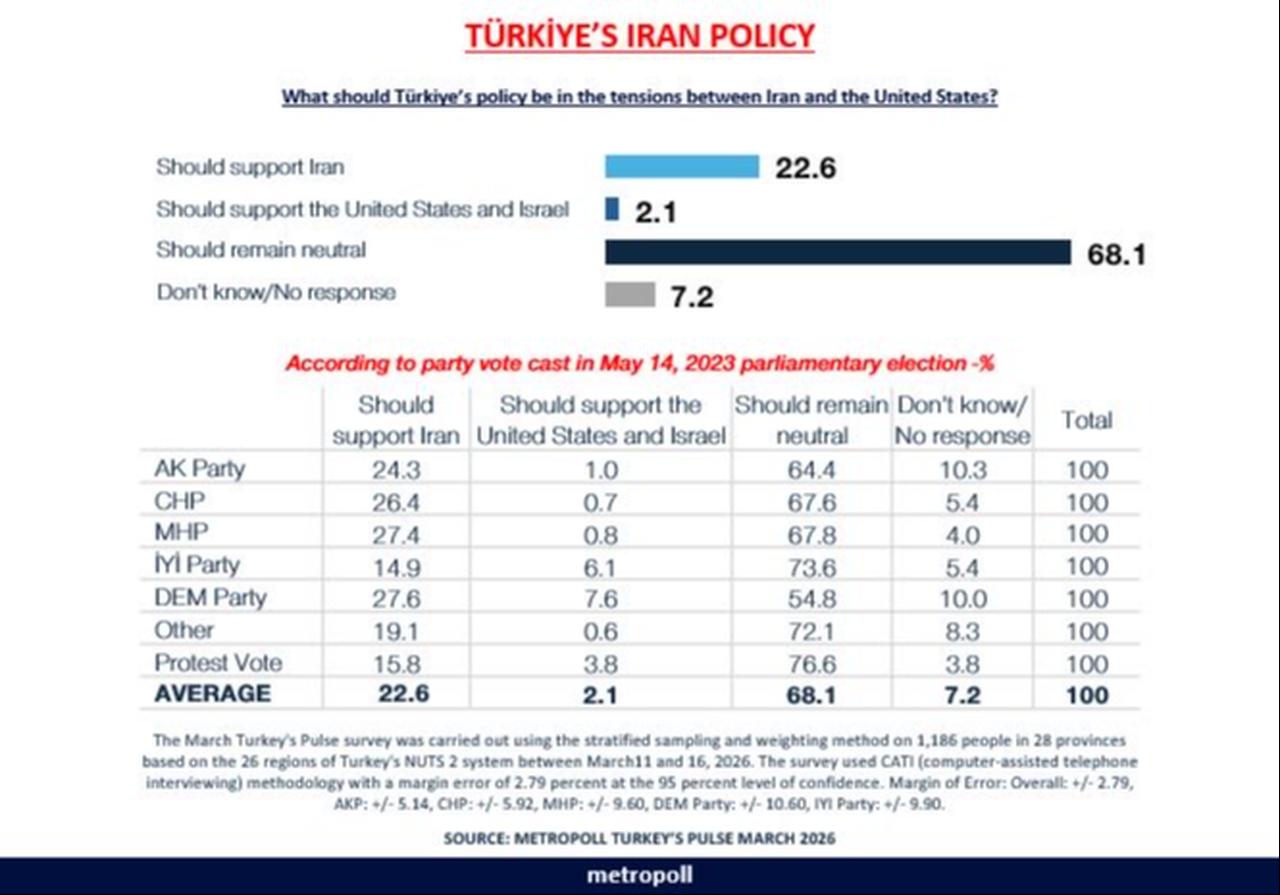
When asked, "What should Türkiye's policy be in the tension between Iran and the United States?" 68.1% of respondents said Ankara should remain neutral.
Just 22.6% said Türkiye should support Iran, while only 2.1% said Türkiye should support the U.S. and Israel, with 7.2% having no opinion or not responding.
The desire for neutrality was consistent across party lines.
Nationalist Movement Party (MHP) voters recorded the highest neutrality rate at 67.8%, followed by the Republican People's Party (CHP) at 67.6%, the ruling Justice and Development (AK Party) at 64.4%, and protest voters at 76.6%.
People's Equality and Democracy Party (DEM Party) voters showed the lowest neutrality preference at 54.8%, with 27.6% of DEM voters favoring support for Iran, the highest of any party.
Good (IYI) Party voters showed the highest rate of support for the U.S. and Israel at 6.1%.

On NATO's importance for Türkiye's security, 61% of respondents said NATO is important, comprising 14.1% who said "very important" and 46.9% who said "important."
27.6% said NATO is not important, 17.8% "not important", and 9.8% "not important at all."
11.4% had no opinion or did not respond.
Compared to January 2018, when 65.1% viewed NATO as important and only 21.6% viewed it as unimportant, the March 2026 data shows a modest but notable decline in NATO support, with the "not important" share rising 6% points.
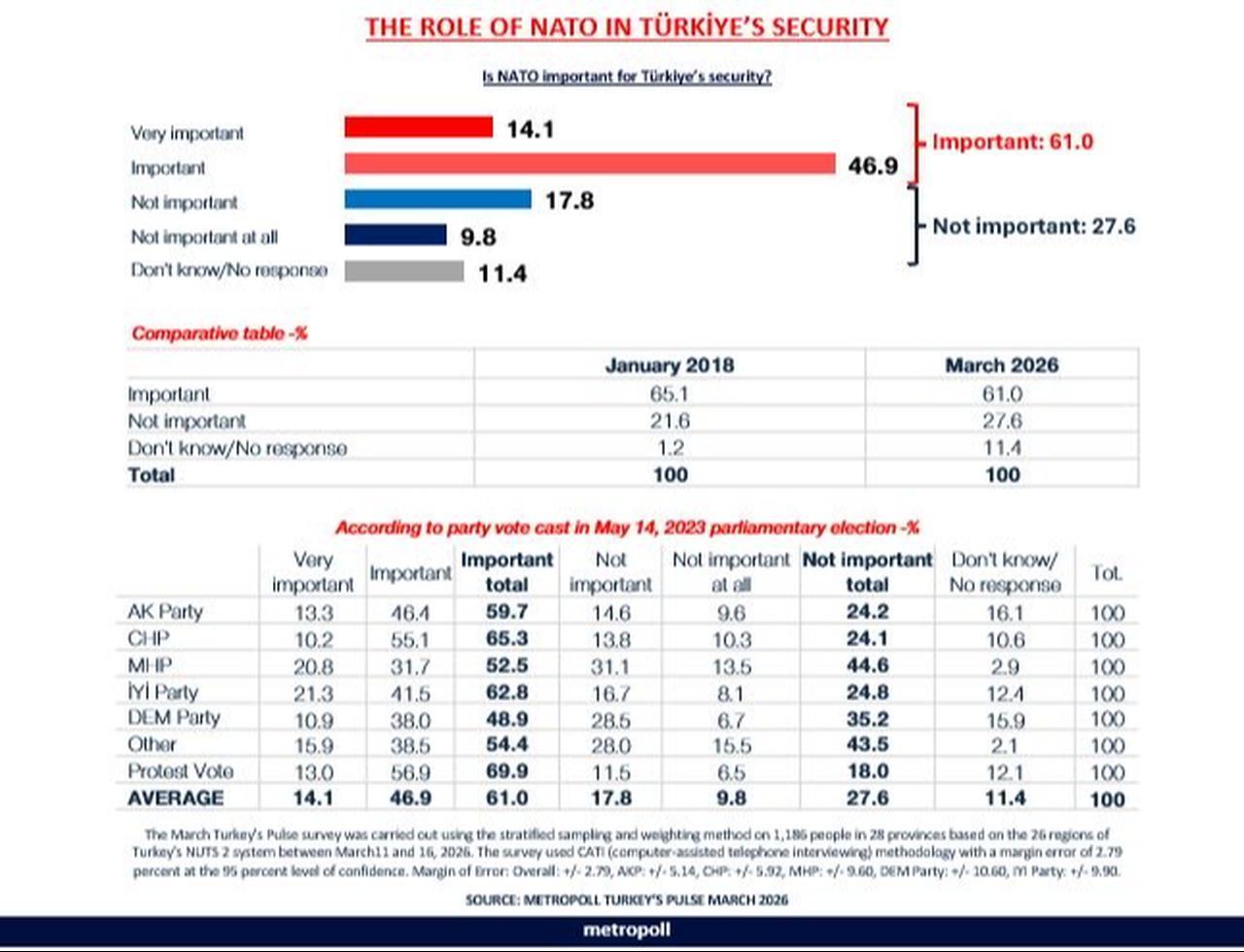
By party vote, IYI Party voters recorded the highest NATO support at 62.8%, followed by CHP at 65.3% and protest voters at 69.9%.
DEM Party voters showed the lowest NATO support at 48.9%, with 35.2% saying NATO is not important, the highest of any party. MHP voters showed the highest "not important" rate after DEM at 44.6%.
The survey was carried out using stratified sampling and weighting among 1,186 people across 28 provinces, based on Türkiye's NUTS 2 regions.
The survey used CATI methodology, with a margin of error of 2.79% at the 95% confidence level.


 Set as preferred source
 Set as preferred source


 6 min read