Newsletters


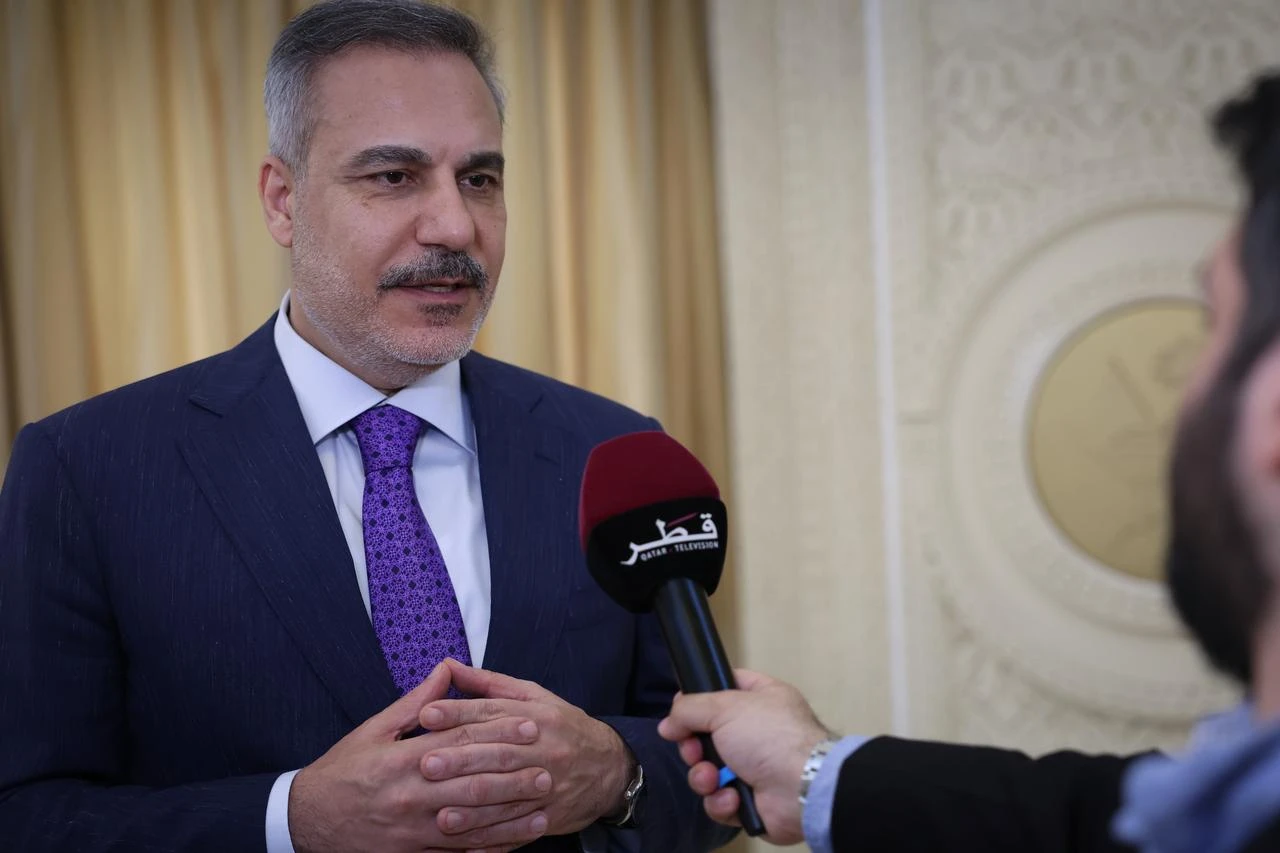


Foreign Minister Hakan Fidan called Sunday for a swift return to a memorandum of understanding between the United States and Iran, saying the diplomatic groundwork built through Qatari, Pakistani and Turkish efforts must be revived to prevent the conflict from destabilizing the broader region.
Speaking during a visit to Qatar, Fidan told Qatar TV that hostilities between Washington and Tehran had already damaged the regional economy and that a wider war risked compounding that instability.
He welcomed Qatar's active diplomacy and confirmed that Ankara is coordinating closely with Doha on the matter.
"Our wish is that an agreement between Iran and America will be reached again as soon as possible," Fidan said, adding that the two sides had previously been brought to a memorandum of understanding through Pakistan's mediation, Qatar's intensive contributions and Türkiye's support. "We need to return to it," he said.
Fidan praised Doha's engagement as a model of constructive diplomacy, expressing confidence that the Gulf state's efforts across multiple channels could yield results.
"I am pleased to see that Qatar is once again trying to do everything it can to resolve this crisis by using all constructive methods and all available channels," he said. "Hopefully, we will receive good news in the coming days."
Qatar has long served as a back-channel mediator in regional and international disputes, hosting negotiations involving Hamas, the Taliban and, more recently, the Iran nuclear file.
Fidan's remarks suggest Ankara views that role as indispensable in the current standoff.

Fidan also used the visit to offer condolences following the death of former Qatari Emir Sheikh Hamad bin Khalifa Al Thani, who passed away last Sunday.
He described the late ruler as "not only a visionary leader for Qatar, but also for the Islamic world and the world at large," crediting him with contributions whose effects continue to be felt across the region.
Fidan praised current Emir Sheikh Tamim bin Hamad Al Thani for strengthening bilateral ties and playing a constructive role in addressing regional challenges, describing the Türkiye-Qatar partnership as one rooted in deep historical bonds that were formalized under Sheikh Hamad's tenure.
Framing the Türkiye-Qatar relationship as a template for regional engagement, Fidan pointed to joint efforts spanning Lebanon, Afghanistan, Sudan, Gaza and the Palestinian issue as evidence of what coordinated Islamic-world diplomacy could achieve.
"We see today that the outstanding example of Türkiye-Qatar cooperation is increasingly appreciated across the region and serves as a model for others," he said, arguing that the region needed "constructive cooperation rather than competition."
Fidan also acknowledged the broader Gulf states, singling out Saudi Arabia, the UAE, Kuwait and Oman alongside Qatar as countries that had made notable strides in development, governance and urban transformation, suggesting Ankara sees strengthened ties with the Gulf bloc as a strategic priority.


 Set as preferred source
 Set as preferred source


 1 min read

 1 min read