Newsletters


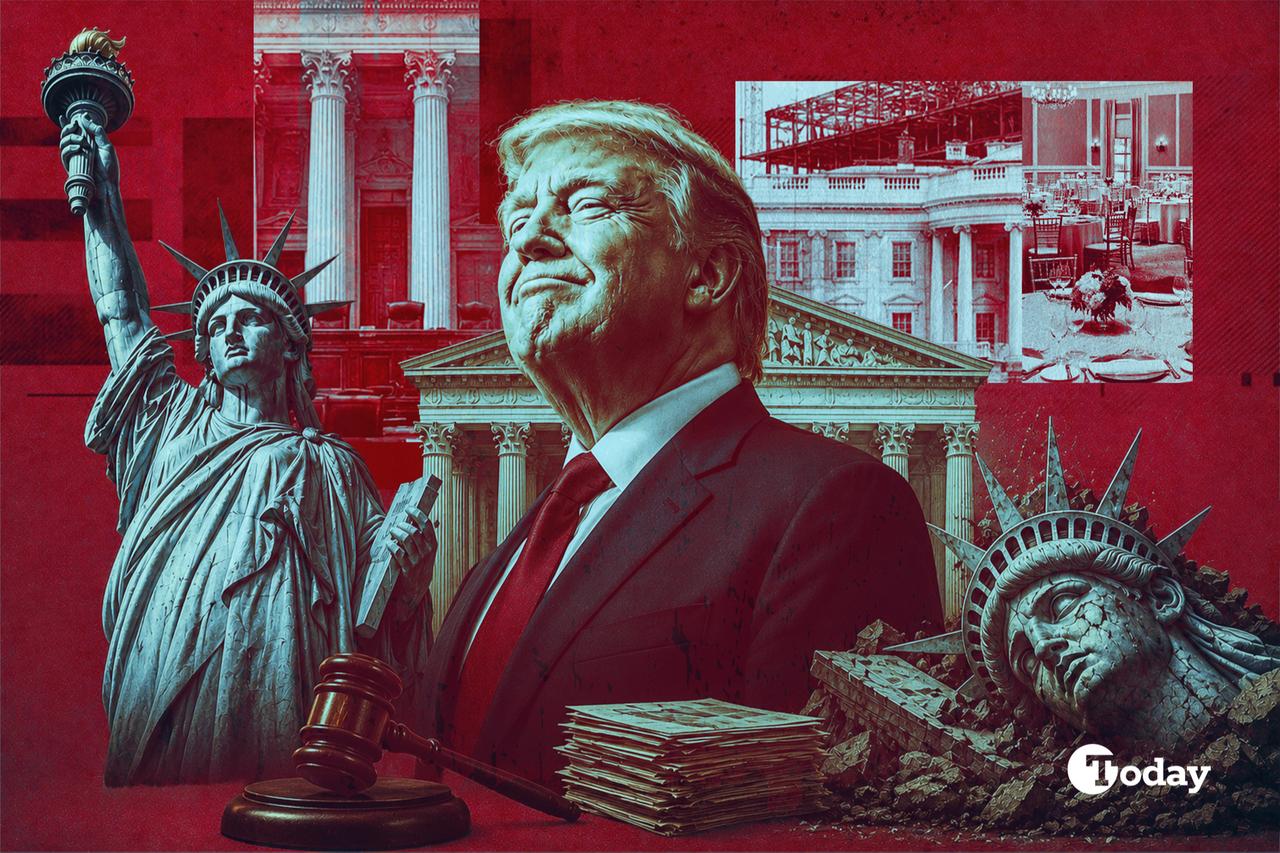


There are days when the world awakens to a public absurdity so grotesquely upholstered in nonsense that language itself begins to wobble. One reaches for an explanation and finds only smoke. One seeks a metaphor and discovers reality has already outperformed satire.
Such is the predicament presented by the bewildering silence that followed a Justice Department lawyer's declaration, before a federal appeals court, that if President Donald Trump moved swiftly enough to bulldoze the Statue of Liberty, the courts would be powerless to stop it.
How does one explain such a thing?
The difficulty lies not in describing the argument. The argument is plain enough. Weeks before America celebrates its 250th birthday, a judge asked whether a government determined to move fast and destroy Lady Liberty could evade judicial review simply by acting before the courts could intervene. The government lawyer replied, "Yes."
No, the difficulty is explaining the silence that followed.
Not a roar of condemnation. Not a stampede of elected officials. Not a procession of corporate titans announcing that some national symbols belong to the American people rather than to the whims of a temporary occupant of the White House. Instead, the republic greeted the proposition with the sort of shrug usually reserved for a delayed commuter train.
This is America blurred: a nation so accustomed to outrage that outrage itself has become invisible.
The country's moral camera has slipped out of focus.
The episode was a close encounter with America's toxic contradictions. Citizens are endlessly instructed that the nation is founded upon laws, institutions, and constitutional safeguards. Yet they are simultaneously asked to accept arguments suggesting that power, if exercised quickly enough, becomes its own justification. It is government by the smash-and-grab theory.
The Statue of Liberty long ago transcended its status as an American monument and entered that rarified category of symbols whose significance exceeds the sovereignty of the nation that hosts them.
To millions who have never set foot upon American soil, “La Liberté Éclairant le Monde” functions as a secular cathedral of aspiration, a copper-clad affirmation that political freedom is not merely a local arrangement but a universal human longing.
Rising above New York Harbor, she has served for generations as a metaphorical lighthouse for dissidents in prisons, refugees on uncertain seas, reformers confronting autocracy, and ordinary men and women seeking some assurance that power may yet be restrained by principle.
The statue's torch illuminates not merely a harbor but an idea that human dignity possesses claims superior to the appetites of rulers. Thus, any threat to Lady Liberty resonates far beyond the territorial boundaries of the U.S.
It would be interpreted in Warsaw, Seoul, Buenos Aires, Istanbul, and Paris not as the alteration of a landmark but as an assault upon one of the world's most recognizable emblems of constitutional restraint and democratic hope.
The statue belongs legally to America; symbolically, however, it has become part of humanity's common inheritance. Indeed, the Statue of Liberty is a UNESCO World Heritage Site.
But now, hovering over Lady Liberty is the pubescent volatility that has become a defining feature of the Trump era—a style of governance that mistakes impulse for strength, disruption for wisdom, and demolition for accomplishment. One is reminded of a teenage boy discovering fireworks in a garage and concluding that civilization itself is an unnecessary restraint.
Is it even necessary to say the Statue of Liberty deserves better?
The great monument was not erected by a real-estate developer and failed casino owner seeking branding opportunities. It was conceived by the French sculptor Frédéric Auguste Bartholdi and presented as a 100th birthday gift from France to the U.S.
For those of us who are dual-nationals, Lady Liberty is the art of the genuine deal. Her internal iron framework was designed by Gustave Eiffel, later celebrated for the tower that bears his name. Dedicated in 1886, the statue became not merely a monument but a national parable.
Millions of immigrants saw her torch before they saw America itself. She stood as a promise, however imperfectly fulfilled, that the republic aspired to something larger than force and appetite.
The statue is not simply metal. It is accumulated memory—global memory.
What would the French say if their president announced that he possessed an inherent right to tear down the Panthéon in Paris? What if a Turkish government lawyer declared that the Hagia Sophia could be reduced to scrap because executive authority demanded it?
One need not imagine uproar in every cafe, editorial page, and parliamentary chamber. The tumult would hit with the ferocity of a tornado, and the proposal would be treated not as a policy disagreement but as evidence that the speaker required a padded cell.
Yet in the U.S., a lawyer advanced a theory broad enough to encompass the destruction of Lady Liberty herself, and the response from much of the nation's political and corporate leadership was a masterpiece of studied indifference.
The silence is revealing.
Politicians who never tire of wrapping themselves in the flag apparently become shy when asked to defend one of the nation's most recognizable symbols. Business leaders who regularly lecture the public about civic responsibility suddenly discover urgent appointments elsewhere. Courage, it turns out, remains the least scalable commodity in the American marketplace.
The immediate legal dispute concerns the demolition of the East Wing of the White House and the construction of a presidential ballroom. The appeals court panel expressed skepticism about the administration's claim that once enough concrete has been poured and enough walls have been knocked down, the judiciary can no longer intervene.
Such a doctrine would transform legality into a footrace.
Under that theory, the question is not whether an action is lawful but whether it can be completed before anyone stops it. Bank robbers have embraced comparable reasoning for generations. Their lack of success should have served as a warning.
Theodore Roosevelt once spoke of the presidency as a "bully pulpit." Modern politics has occasionally mistaken it for a bulldozer.
The deeper scandal is not that an ambitious lawyer made an extravagant argument. Lawyers have been known to advance remarkable propositions when clients require them. The deeper scandal is that so few influential Americans seemed willing to say, publicly and unmistakably, that certain things belong to the nation and not to any president.
The American playwright Tennessee Williams supplied the appropriate diagnosis decades ago through Big Daddy in "Cat on a Hot Tin Roof": "Ain't no odor more powerful than mendacity."
The smell today is overwhelming.
It wafts through Washington's corridors, through boardrooms, through the anxious calculations of officeholders who fear offending a volatile political movement. It hangs over the capital like industrial fog.
And so it goes.
A republic does not usually collapse because its monuments are destroyed. Monuments are stone, copper, or iron. They can be rebuilt. The greater danger arises when citizens cease to recognize what those monuments represent. A people willing to tolerate arguments for unlimited power eventually discovers that the target was never merely a statue, a building, or an East Wing.
The target was the idea that anything stands beyond the reach of power.
That’s why the silence matters.
And perhaps why it deserves outrage.


 Set as preferred source
 Set as preferred source


 4 min read