Newsletters





This articlb was originally written for Türkiye Today’s weekly economy newsletter, Turkish Economy in Brief, in its July 27 issue. Please make sure you are subscribed to the newsletter by clicking here.
The Central Bank of the Republic of Türkiye (CBRT) announced its closely watched interest rate decision when tensions in the Middle East had reached their peak, and oil prices had once again tested the $100-per-barrel mark.
As widely expected, the Monetary Policy Committee (MPC), which met on Thursday, July 23, left the policy rate unchanged at 37%.
However, the bank continues to fund the market at 40%, citing heightened geopolitical risks and persistent inflationary pressures. By maintaining funding at the upper band of its interest rate corridor, the CBRT effectively preserved its hawkish monetary policy stance.
The statement released after the decision contained a notable change in wording. It said:
"Leading indicators suggest that the underlying trend of inflation will temporarily increase in July. Amid rising uncertainty driven by geopolitical developments, energy prices have once again entered an upward trend. Recent data indicate that the weakness in domestic demand has become more pronounced."
The CBRT revised its assessment of domestic demand from 'the weakness in domestic demand continues' in the previous statement to 'has become more pronounced' in the latest release.
For some time, markets have been signaling that the impact of the high-interest-rate environment on access to financing and domestic demand is becoming increasingly evident.
Commenting on the decision, Dr. Kutay Gozgor, Director of Research at Kuveyt Turk Investment, said the statement that "the weakness in domestic demand has become more pronounced" represents the dovish element of the MPC's decision.
"If inflation continues to improve, we expect the funding cost to decline gradually in August, followed by measured policy rate cuts in the final quarter, allowing the policy rate to end the year at 34%," he said.
Akbank Economic Research also highlighted the wording change, arguing that it signals the CBRT's willingness to begin easing if oil prices retreat again, with market funding potentially returning to the 37% policy rate.
Although the CBRT's policy rate stands at 37%, it has been funding the market at the upper end of its interest rate corridor, 40%, for nearly five months.
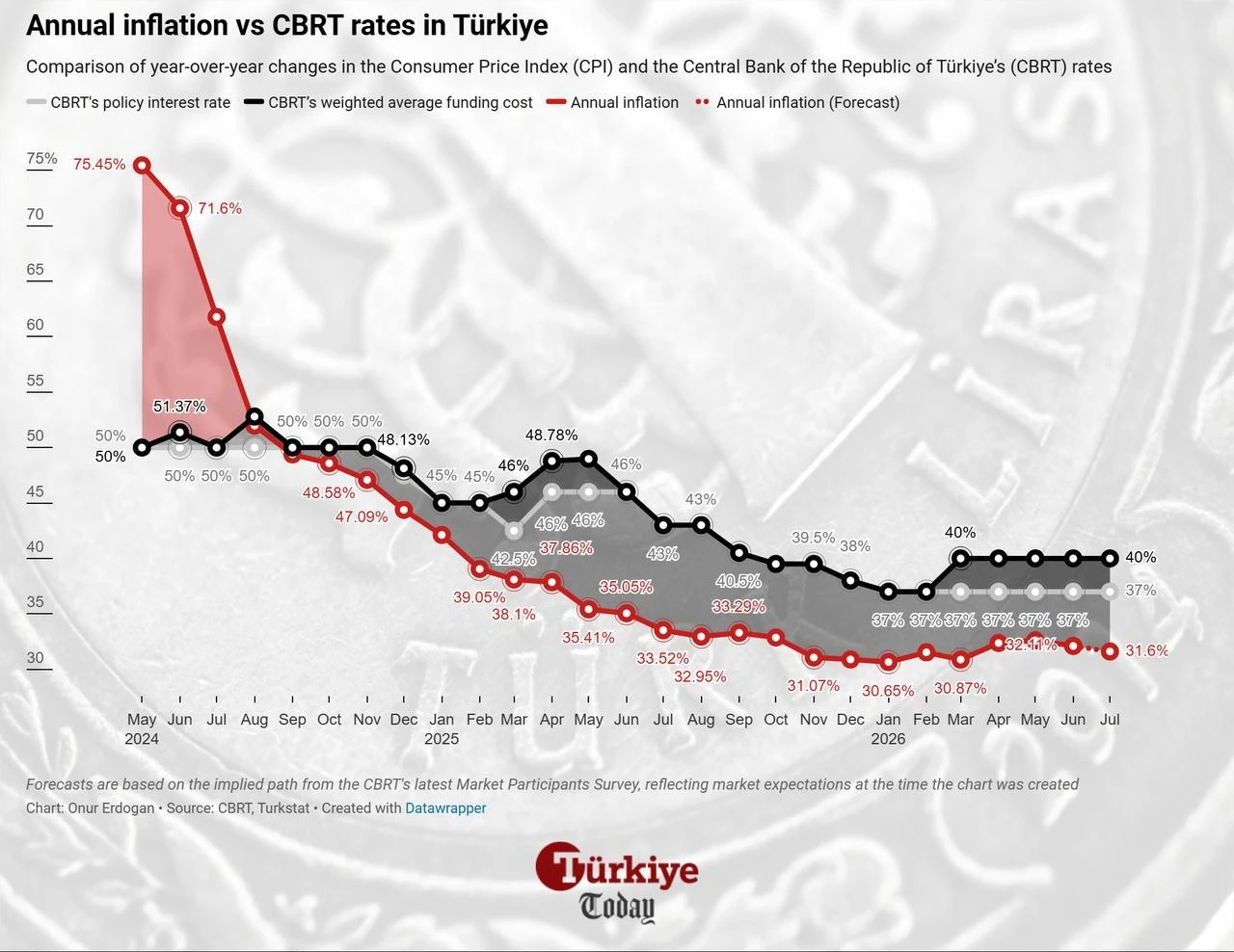

In its assessment, Bank of America said it expects the CBRT to keep the Turkish Lira Overnight Reference Interest Rate (TLREF) around 40% for the time being, as Brent crude has returned to around $100 per barrel.
"Even if the fuel price stabilization mechanism is fully reinstated, near-term risks to transportation prices could limit the room for meaningful easing. We believe the earliest opportunity to lower the TLREF could emerge around the Inflation Report, which is scheduled for release on Aug. 13," the bank said.
Bank of America also noted that the Third Inflation Report could provide a basis for normalization if geopolitical risks ease.
"A renewed momentum toward a U.S.-Iran agreement could improve the outlook. Under such a scenario, the TLREF could move closer to 37% ahead of the Monetary Policy Committee meeting on Sept. 10," the report said.
The bank also projected that if Brent crude averages around $90 per barrel in the second half of 2026, Türkiye's year-end inflation could come in between 30% and 31%, while the policy rate would likely remain at 37%.
In its latest analysis, U.S.-based J.P. Morgan argued that the renewed escalation of tensions in the Middle East and oil prices approaching $100 per barrel are likely to delay the CBRT's rate-cutting cycle.
The bank said the funding rate could remain at 40% until geopolitical tensions subside, postponing the normalization process. It also revised its expectations, suggesting that the 100-basis-point rate cuts previously anticipated for the September and October meetings may instead be delayed until the October and December meetings.
At the same time, J.P. Morgan noted that the stronger emphasis on weakening domestic demand in the latest policy statement indicates that the Central Bank continues to maintain an easing bias.
The bank also warned that the outlook could shift toward fewer rate cuts depending on the duration and intensity of the conflict in the Middle East. It expects the CBRT to resume one-week repo auctions at the Sept. 10 Monetary Policy Committee meeting, bringing the funding rate back to 37%, while forecasting the policy rate to end the year at 35%
Deutsche Bank also warned that externally driven cost pressures could delay Türkiye's disinflation process, raising its year-end inflation forecast from 28.5% to 30%.
The German lender also revised its year-end policy rate forecast upward to 36% from 35%. Its analysts said steps to normalize market funding by lowering the funding cost from 40% to 37% could be postponed until September, while direct policy rate cuts are likely to come onto the agenda in the final quarter of the year.
Meanwhile, U.S.-based Citigroup also argued that room for interest rate cuts in the second half of the year remains limited, forecasting that the CBRT's policy rate will end the year at 35%.


 Set as preferred source
 Set as preferred source



 4 min read