Newsletters


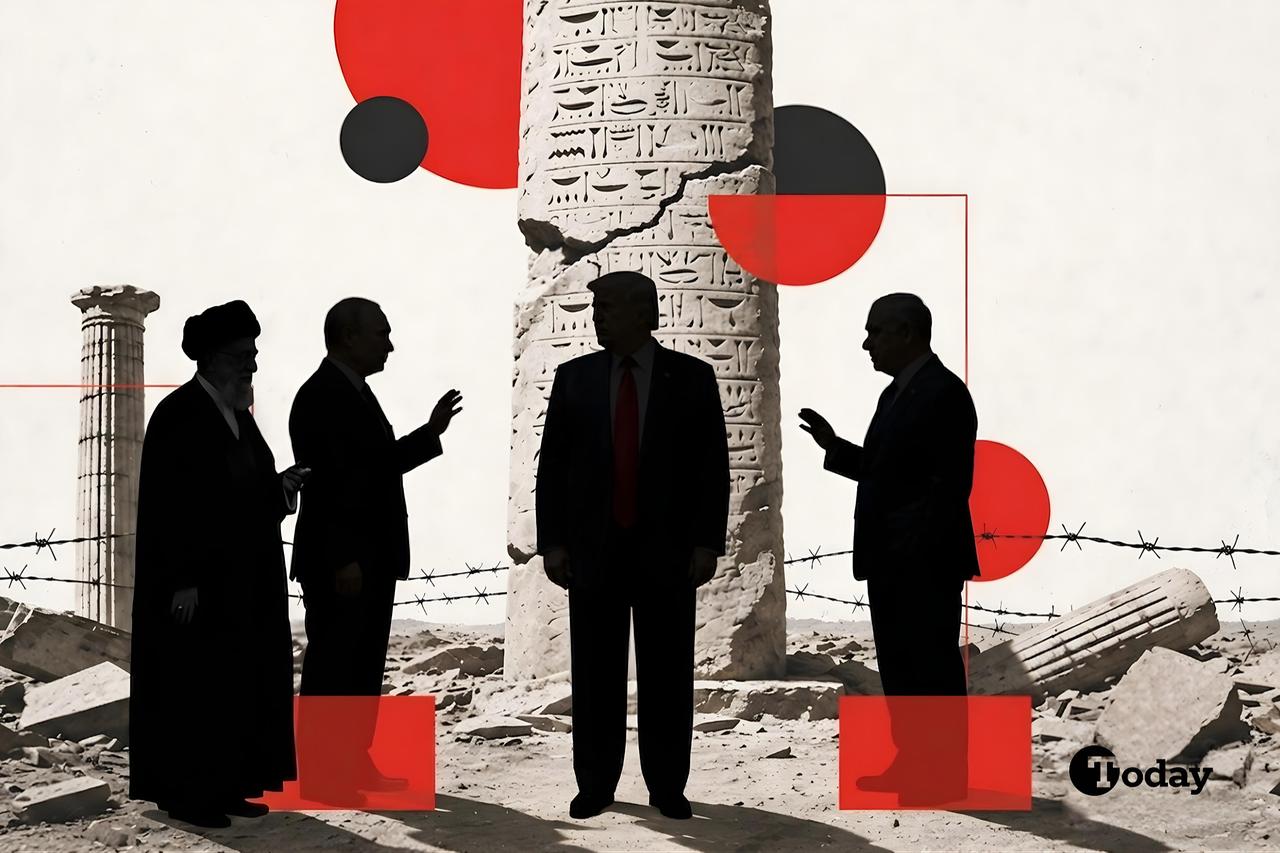


It’s likely the firstborn question ever whispered by humankind into the dark: Does evil exist?
The inquiry is older than empires, older than scripture, older perhaps than memory itself. Six thousand years ago, beneath the pitiless stars of Sumer, the first known name for it was scratched into clay by hands long reduced to dust:
𒉆𒅆𒌨
Namhul.
The word emerged from one of civilization's earliest cities, among the riverlands that lie within modern Iraq. It did not describe a demon, a beast, or a god. It described a ruler.
“The Sumer tablets describe an evil leader as one who oppresses orphans and widows; those who do not seek equity under the law; do nothing to prevent chaos, and murder their own people,” explained Dr. Jonathan Tenney of Cambridge University. “Namhul is also an abstract for rottenness.”
That final word is the most revealing. The Sumerians did not imagine evil primarily as flame, darkness, or supernatural malice. They imagined it as rot: a corruption spreading invisibly through living tissue, working beneath the surface until the structure above can no longer support itself.
The cities of Sumer are dust beneath the Mesopotamian sun. Their kings are bones. Yet their word survives, and one cannot help wondering whether those ancient scribes understood something modern civilization has merely buried beneath more sophisticated language.
There are moments when history appears less like progress than recurrence—an endless return of shapes first glimpsed in humanity's oldest nightmares.
Six millennia after the invention of namhul, another figure emerged from the eastern darkness: Vladimir Putin.
“Evil is still around today, and when evil comes after you,” warned Ukrainian President Volodymyr Zelenskyy, “there will be no one to protect you.”
Read merely as politics, the statement is unremarkable. Read as testimony, it acquires another character entirely. One hears not a president delivering rhetoric but a witness describing an approaching force that others refuse to recognize until it is upon them.
In February 2022, Europe awoke to find an ancient menace walking again. The full-scale invasion of Ukraine shattered assumptions that had hardened into doctrine among Western governments.
The old wars, wars of conquest, deportation, annihilation, and territorial hunger, had not vanished from the world. They had only been dormant.
Years later, the spectre still wanders. Its footprints are visible in shattered apartment towers, blackened hospitals, mined fields, and emptied villages.
Reconstruction estimates now approach $588 billion. Civilian casualties continue to mount. Hundreds of thousands of soldiers and civilians have perished across a widening geography of grief.
“The liquidation of Ukraine is the only formula for peace,” broadcaster Sergey Mardan declared to Russia's vast audience shortly after the invasion.
“If we see Ukraine as a threat, we have the right to use force to ensure the threat is eradicated,” Russian Orthodox Patriarch Kirill preached to his 90 million followers.
Those statements continue to resonate with the terrible simplicity of an incantation. Not peace through settlement. Not peace through compromise. Peace through disappearance. The nation itself becomes the obstacle to peace and therefore must cease to exist. One suspects the Sumerians would have recognized the logic immediately.
The evil Zelenskyy perceived in Putin was not easily defined. It resembled certain cosmic phenomena described by astronomers: immense, imperfectly understood, and apparently expanding. More troubling still, it seemed to alter those who moved within its gravitational field.
Years ago, that corruption found a particularly grotesque vessel in Yevgeny Prigozhin, the former hotdog vendor, convict, mercenary chief, and founder of the Wagner Group.
Prigozhin is dead now, his aircraft having fallen from the Russian sky in August 2023. Yet death has not diminished his symbolic significance. Like many specters, he seems larger after burial than before.
“These abominations are not tolerated,” warns the ancient Hymn to Enlil. “The evil and wicked man do not escape.”
The Sumerian priests spoke with confidence. History offers a less reassuring verdict.
Prigozhin once responded to a journalist's inquiry with characteristic vulgarity: “If you think that my employee will respond to this endless chewing of shit in his mouth ... spit that shit out, breathe some fresh air.”
The phrase lingers strangely. Fresh air is precisely what has become scarce across much of Ukraine. Years of bombardment, industrial destruction, and recurring fires have altered not merely landscapes but atmospheres.
Smoke and chemical residues drift across battlefields and cities alike, creating consequences that may persist long after the final shots are fired.
The uncertainty of consequence has haunted philosophers for centuries. Dante sought evil in the architecture of Hell. Hannah Arendt sought it in the face of Adolf Eichmann. What she found disturbed her because it contradicted expectations.
Evil, she argued, was often banal. The horror was not necessarily profound, demonic, or exceptional. It could be dull, procedural, and terrifyingly ordinary.
“I could stand in the middle of 5th Avenue and shoot somebody, and I wouldn’t lose votes,” was how Donald Trump in 2016 framed the feasible consequence of his actions.
“The law of Hitler’s land,” Arendt observed, “demanded that the voice of conscience tell everybody ‘thou shall kill.’”
There is something uniquely dreadful about lawful evil.
A criminal may be arrested. A president may be impeached. A murderer may be stopped. But when slaughter itself acquires legal sanction, the moral universe begins to warp. Law ceases to function as a safeguard and becomes instead an instrument through which corruption legitimizes itself.
“History shows us that evil and the rule of law can coexist,” notes legal scholar Anna Lukina.
The observation feels less like scholarship than a warning preserved from another age. For law is not inherently moral. It may restrain evil, but it may also provide evil with procedure, justification, and administrative efficiency.
“The language of law and political science fails to get to the core of (Putin),” argues Russian commentator Andrei Babitsky. “We should not be shy to use evil in these debates.”
Others have reached similar conclusions. “What Putin has done is evil,” said Boris Johnson. “I did not expect Putin to be as evil in the way he is fighting this war,” admitted former U.S. Ambassador to Russia Michael McFaul.
Joe Biden likewise spoke bluntly when describing what he regarded as an attempt to erase Ukrainian identity itself. Again and again, observers found themselves returning to the same ancient word, as though no modern vocabulary proved adequate to the task.
Perhaps that is because some phenomena resist reduction. The ancients understood this instinctively. One never sees the plague itself, only the bodies it leaves behind. One never sees the storm in its entirety, only the wreckage afterward. Likewise, with namhul. Its presence is inferred from its consequences.
Back at Cambridge, Dr. Tenney remarked that the Sumerian description of an evil ruler remains strikingly applicable today. The observation is unsettling. Six thousand years have passed. Empires have risen and fallen. Religions have flourished and disappeared. Languages have been born, transformed, and forgotten. Yet the oldest surviving definition remains immediately recognizable.
One begins to suspect that the Sumerians were documenting not a historical circumstance but a recurring visitation. Not a supernatural being, but a pattern moving through history like a contagion. It survives the deaths of kings, outlives ideologies, and repeatedly discovers new hosts through which to express itself.
This leads to the final and most troubling question. Does such a host understand the devastation he creates? Can Israeli Prime Minister Benjamin Netanyahu perceive the suffering he inflicts? Can Trump and the mullahs of Iran feel guilt, remorse, or the desire for redemption?
After decades exploring the darkest regions of human psychology, Miami psychiatrist Dr. Juan Rene Geada offered an answer as stark as any inscription impressed into wet clay thousands of years ago:
“Evil cannot be cured.”
The tablet crumbles. The witness dies. The empire falls. Yet somewhere beyond the reach of law, memory, and history itself, the ancient rot endures. It waits with a patience measured not in years but in civilizations, reappearing whenever power, violence, and indifference align.
The Sumerians gave it a name 6,000 years ago. The unsettling possibility is that they were not describing their own age alone, but every age that would follow.


 Set as preferred source
 Set as preferred source



 7 min read