Newsletters


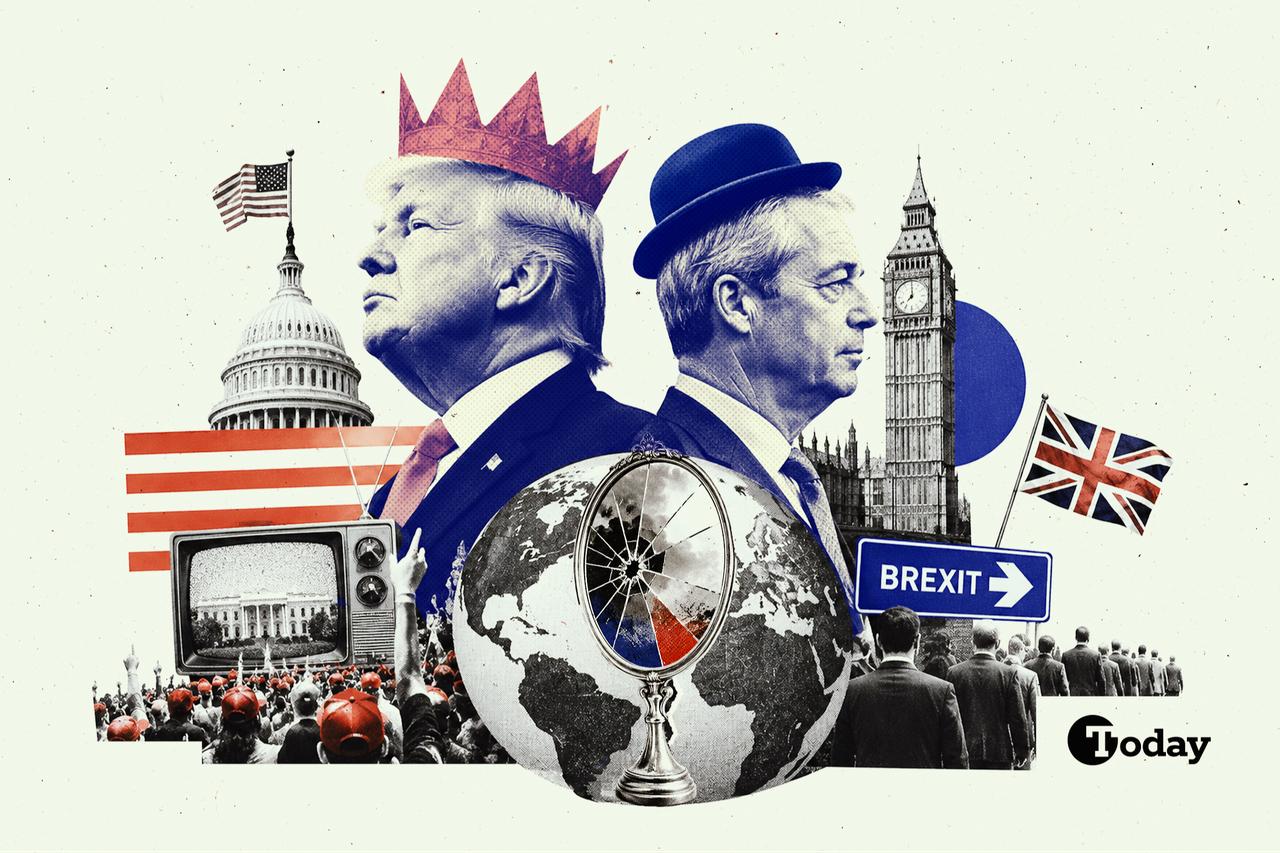


As the smoke clears from America's 250th birthday bash, spare a cheer for a country so politically impoverished that it has defrocked six prime ministers in the past 10 years and is about to anoint a seventh.
Don't let President Trump's blabber-mouthing drown out Great Britain. A decade into Brexit, the country is still rummaging through its constitutional attic for another leader to revive the old catechism of "Keep Calm and Carry On."
There is something oddly reassuring about watching two old democracies shamble through the 21st century like cult leaders who’ve joined their own cult.
Across the Atlantic, Trump has turned politics into a permanent television finale. Across the Channel, Brexit continues to haunt Westminster like a bad investment nobody wants to admit they bought.
Glastonbury and Burning Man pale in comparison to the 2026 Transatlantic Festival of Buyer's Remorse.
The strange beauty of this spectacle is that each country insists the other has completely lost its senses while refusing to inspect the cracked mirror at home.
Americans gaze at Westminster and wonder how a governing party can consume prime ministers faster than Hollywood burns through starlets.
Britons watch Washington and marvel that a republic built on checks and balances has become a gladiatorial arena where every election is billed as the last one that will matter.
Both insist they are merely enduring an unfortunate phase that shall pass as soon as England wins the World Cup and Trump receives the Nobel Peace Prize.
The accolade varies, but the psychology never does. The crowd always discovers a dazzling new certainty, declares skepticism obsolete, and recruits doubters with missionary zeal before reality arrives carrying an invoice.
MAGA and Brexit belong comfortably on that same shelf of flat-track bullies—not because they are identical, but because each intimidated millions into believing that an immensely complicated political and economic reality could be solved through a single, emotionally satisfying act of national will.
One promised to Make America Great Again.
The other promised to Take Back Control.
Both mottos were masterpieces of compression: vague enough to contain every grievance, confident enough to silence every caveat, and emotionally potent enough to overwhelm any spreadsheet waved in protest.
"Every age has its peculiar folly," the Scottish essayist Charles Mackay warned in 1841. "Some scheme, project, or phantasy into which it plunges, spurred on by the love of gain, the necessity of excitement, or the mere force of imitation."
It’s difficult to imagine a more fitting epigraph for the past decade. If Mackay were revising his book “Extraordinary Popular Delusions and the Madness of Crowds” today, Brexit and MAGA would demand fresh chapters. They would sit comfortably alongside financial manias and speculative bubbles—not because they are equivalent in substance but because they reveal the same irresistible human impulse to believe that complexity is merely a conspiracy invented by pessimists.
Once enough people embrace that conviction, facts become optional, expertise becomes suspect, and contradiction itself is recast as proof that the revolution is working.
Nigel Farage deserves his own pavilion at this jubilee of buyer’s remorse. Few modern figures have so persistently transformed grievance into spectacle or so skillfully convinced followers that perpetual outrage is a governing philosophy rather than a campaign strategy. Farage redefined British politics while becoming an influential presence in American ultraconservative circles, reminding everyone that populism travels far more easily than accountability.
America, meanwhile, has perfected converting every disagreement into an existential crisis. Institutions once designed to cool public passions now amplify them. Politics has become less a contest over policy than a struggle over identity, with every compromise treated as surrender and every election marketed as civilization's final examination. The republic survives, but by habit rather than confidence.
Britain's predicament is quieter but no less revealing. Brexit was peddled as the decisive answer to a thousand frustrations, yet the questions multiplied faster than the solutions. Governments came and went with astonishing speed. Prime ministers rose promising certainty and departed trailing excuses. Stability became an aspiration instead of a condition. Westminster discovered that leaving a political union was simpler than agreeing on what should replace it.
Democracies rarely collapse in one dramatic explosion. They exhaust themselves through cycles of magical thinking, theatrical promises, and escalating disappointment. The crowd searches for the miraculous shortcut, the charismatic salesman, and the glorious restoration that requires only faith and a ballot paper.
Reality, infuriatingly, demands patience, compromise, and arithmetic.
As America celebrates 250 years, we should certainly toast its astonishing endurance. But let’s not forget to raise a glass to Britain, that weary laboratory of political improvisation, whose recent history serves as both companion and cautionary tale. The Atlantic may divide the two nations, but delusion has always traveled first class.


 Set as preferred source
 Set as preferred source



 7 min read