Newsletters




The famous writer Anton Chekhov wrote several of his well-known works, including "The Cherry Orchard," in Yalta, where he spent the final years of his life because the climate was considered more suitable for his tuberculosis.
His house in Yalta has been turned into a museum, which you can visit if you ever happen to go there. But I hope you don’t, because today this Crimean town is under Russian occupation.
In many of his letters, Chekhov described Yalta as a place where he felt bored, cut off from life, almost like living in exile.
Today, Ukrainians are living a life of internal exile on their own land.
According to the United Nations and Human Rights Watch reports, human rights violations continue in Crimea today. The violations include suppression of freedom of expression and media outlets, suppression of religious freedom, arbitrary arrests and unfair trials, torture, persecution of Crimean Tatars, and forced Russian citizenship, imposed legislation and conscription.
In a public square in Yalta, there is a statue that Crimeans deeply resent: a bronze sculpture of the “Big Three”—Franklin D. Roosevelt, Winston Churchill, and Joseph Stalin.
These three leaders met 81 years ago in February, after six years of war. The Yalta Conference was held in a Crimean resort town on the Black Sea, then under Soviet occupation.
For the people of Central and Eastern Europe, this conference symbolizes a moment when their fate was handed over to Stalin and when the West effectively abandoned them.
Although there had been earlier attempts to install this statue in Yalta, before the 2014 Russian annexation, Crimean Tatars opposed it, unwilling to see Stalin, who had persecuted and deported their ancestors in 1944.
After the annexation, however, in 2015, the statue was installed in a square next to Livadia Palace, where the leaders had met.
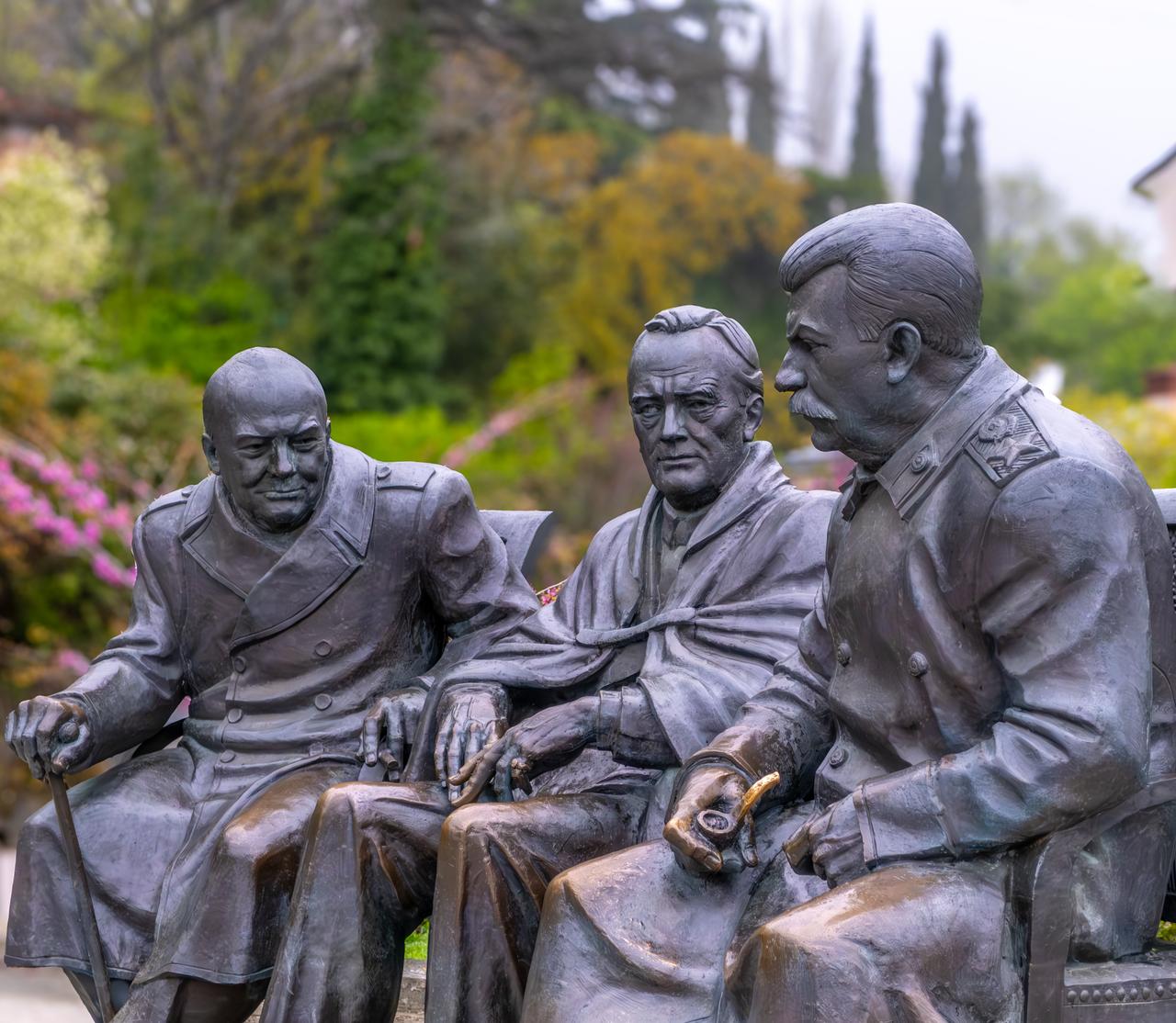

One of the most important issues discussed at Yalta was Poland. At the conference, Churchill and Roosevelt accepted that Poland would be governed by a pro-Soviet Polish government established before the conference, known as the Lublin Committee, expanded to include a few members of the pro-Western London Committee.
Two weeks after the conference, the Soviets demanded that Romania’s king appoint a government controlled by the communists. One month after the end of the conference, Churchill wrote to Roosevelt: “We are faced with a real failure, a total collapse of what was agreed at Yalta.”
In fact, the division of the world among great powers at the negotiating table had already taken place through two separate meetings in 1944.
One was the famous secret “percentages agreement” between Churchill and Stalin, and the other was an agreement between Stalin and Roosevelt defining spheres of influence in the Far East.
Churchill had already acknowledged Stalin’s dominance in much of the Balkans and Central Europe under the Percentages Agreement.
At Yalta, it had been agreed that the peoples of Europe liberated from Nazi occupation would be allowed “to create democratic institutions of their own choice” and enjoy “the right of all people to choose the form of government under which they will live.”
These decisions, however, were not implemented. Within a short time, Central and Eastern European countries fell under Soviet influence and remained under it until the Soviet Union collapsed in 1991 and the bipolar Cold War order came to an end.
For Russian officials, however, Yalta is frequently invoked as a historical moment when a victorious Russia after World War II secured Western acceptance of its “legitimate” supremacy over its neighborhood.
For the Kremlin, Yalta represents a summit where Russia sat at the table on equal footing with the strongest powers, proving its geopolitical weight.
Indeed, in the post-Cold War era, the U.S.-led unipolar global order has long troubled Putin. In his 2007 Munich Security Conference speech, he expressed this clearly: “I consider that the unipolar model is not only unacceptable but also impossible in today’s world…unilateral and frequently illegitimate actions have not resolved any problems.”
For many years, there has been talk in Russian public discourse of a “new Yalta”—an agreement where the world, including Ukraine, would be divided into spheres of influence among the most powerful, i.e., Washington, Beijing and Moscow.
Turning to today, what Russia seeks to achieve in Ukraine and across former Soviet territories is for these areas to be governed by pro-Russian governments.
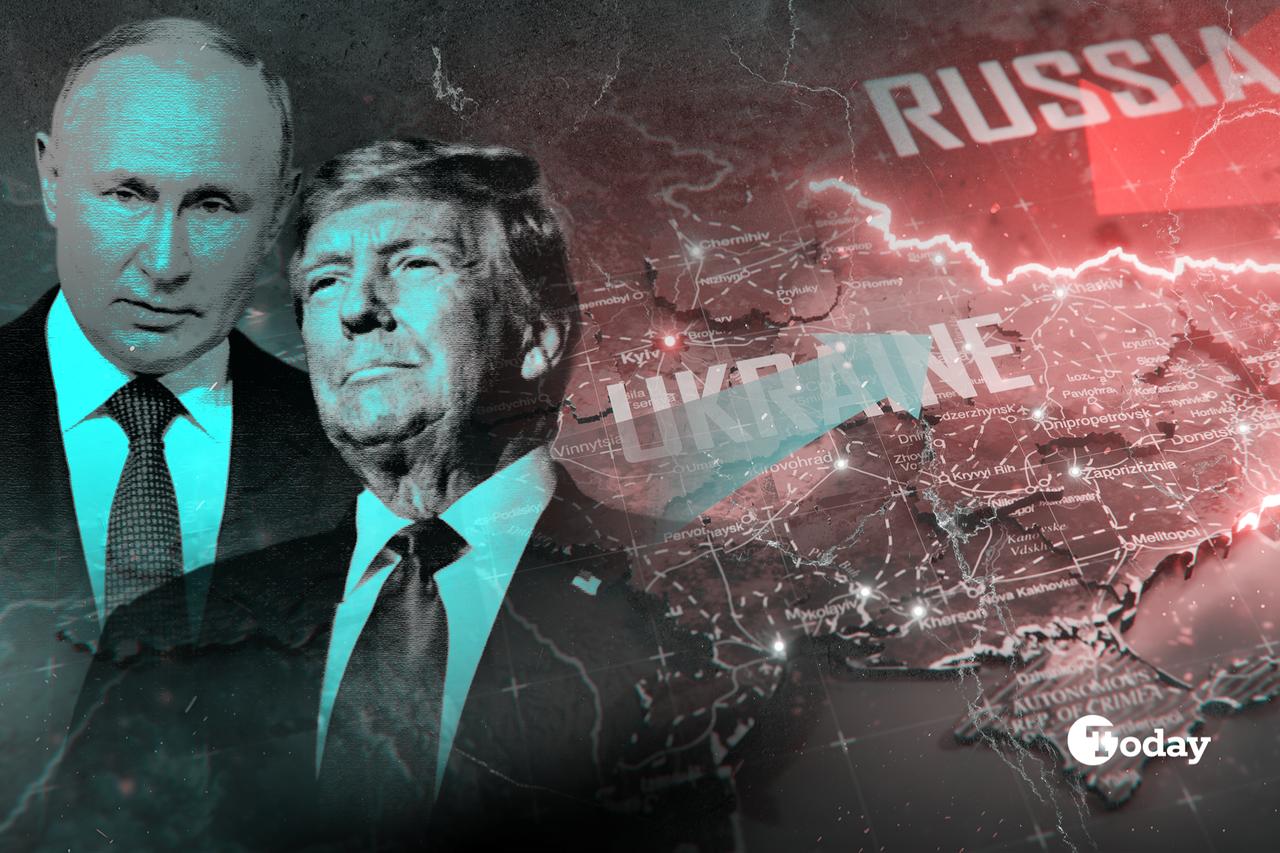
Since the Trump administration came to power, Russia–Ukraine ceasefire and peace talks have been conducted between Russia and the United States.
Talks involving Ukraine and Russia together only began last month. After the first round, Russian officials referred to the Putin–Trump meeting in Alaska, saying they refuse any territorial agreement that is not in line with it. In other words, Ukraine would give up territory that was not conquered militarily.
In exact terms, Russia requires that the entire Donbas region be handed over to it. The Donbas region covers eastern Donetsk and Luhansk; Russia controls almost all of Luhansk and about 80% of Donetsk. Russia seeks to determine Ukraine’s fate through a Yalta-like agreement, guided by the Trump–Putin talks in Alaska.
Aside from paving the way for the end of the war, the only widely recognized positive legacy of Yalta was the decision to convene the San Francisco Conference, which later led to the establishment of the United Nations (U.N.).
Even this legacy is now being revisited. Trump has proposed creating a structure called the “Board of Peace,” perceived by many, including the French government, as a parallel institution to the U.N., which they refused to join, arguing it undermines the U.N.
Moreover, Putin has stated that Russia would be willing to contribute $1 billion from frozen Russian assets in the US to the Board of Peace.
Trilateral talks are expected to resume soon. Negotiations will proceed based on a 20-point peace plan presented by the United States, with limited European and Ukrainian input.
Even in this form, the draft represents the least unacceptable option from Ukraine’s perspective. While the previous 28-point plan gave away Crimea, Luhansk, and Donetsk to Russia, per Ukrainian demand, the revised plan does not include territorial changes for now.
There is no mention of Ukraine’s joining NATO. Whether security guarantees the United States, NATO, and European countries agreed to provide will be acceptable to Russia remains to be seen.
The United States must use all of its leverage against Russia and avoid accepting an agreement that—just as at Yalta—would later encourage Russia to use force again against Ukraine and other regional countries not protected by NATO.
Throughout the negotiations, the U.S. and the EU must spare no effort in continuing to support Ukraine, enabling it to sit at the negotiating table from a position of strength.
Trying to buy time or temporarily divert the threat can later turn into an irreversible failure. Yalta showed this. The 2014 annexation of Crimea showed this as well.


 Set as preferred source
 Set as preferred source


 7 min read