Sign in
 Newsletters




On a mountaintop in Chile's Atacama Desert, an $800 million American telescope has opened its enormous eye upon infinity, only to discover that eternity is being strip-mined by billionaires.
Along the Mediterranean shore in Antalya, Türkiye, the delegates to COP31 are gathering beneath the same endangered heavens to discuss how to save the planet.
Nobody appears to have told them that the sky above it is already being subdivided, illuminated, and prepared for commercial exploitation. Humanity is negotiating the survival of Earth while an almost-there trillionaire prepares to repossess the stars.
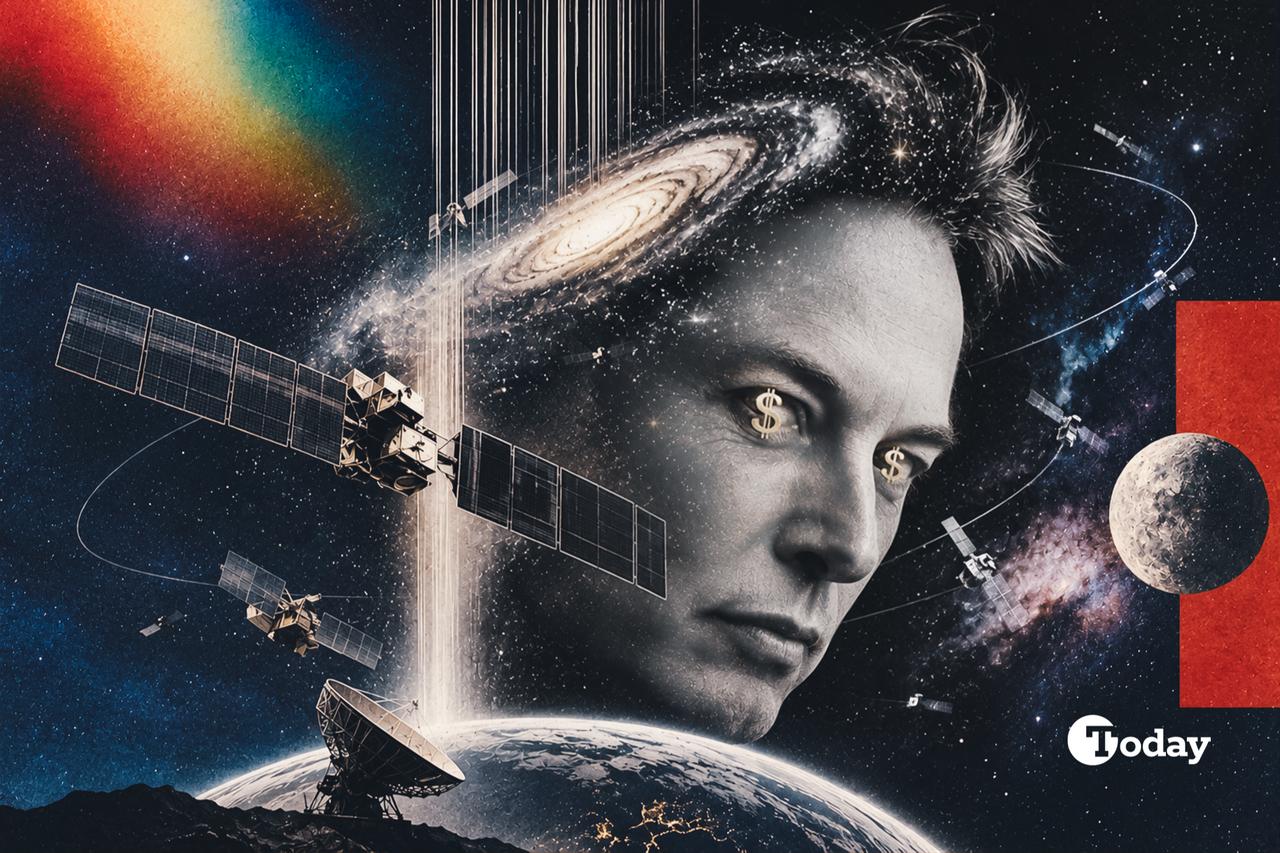
Behold “Gravity's Rainbow,” the 2026 Elon Musk edition. The rockets have returned. The trajectories are multiplying. And presiding over the celestial apparatus is a billionaire skyjacker who seems determined to convert the heavens into commercial real estate.
“Space is just extremely enormous, and satellites are very tiny,” Musk once explained. More recently, at the 2026 World Economic Forum in Davos, he declared that “the lowest cost place to put AI will be space.” The universe, apparently, is not a mystery to be contemplated but a development opportunity awaiting its first zoning permit.
Thomas Pynchon understood the trajectory. In his celebrated 1973 novel, the rocket was never merely a weapon. It was a theological proposition, an industrial sacrament, a screaming mathematical arc connecting desire, death, technology and the terrible appetites of power.
Now the rocket's rainbow ends not in an explosion but in a subscription service.
Musk looked into the never-ending darkness and saw advertising space. His estimated fortune, according to Forbes, stands at $878.5 billion—a malignant constellation of zeroes orbiting a single human ego, while overhead his satellites trace the profitable trajectories of a heaven where the stars are free but the view requires a credit card.
NASA estimates that the observable universe contains at least 10 sextillion stars, with some estimates reaching a septillion. Divide Musk's fortune among the lower estimate, and each star receives approximately 0.00000000008785 dollars. Less than one hundred-billionth of a dollar per sun. Turn the equation around, and there are at least 11.4 billion stars for every dollar in Musk's fortune.
The cosmos remains magnificently indifferent to his balance sheet.
Unfortunately, the sky above Earth does not.
Consider the superb timing. While Musk dreams of populating orbit with a million machines, the United States has just demonstrated its difficulty managing the aircraft already flying beneath them. On Nov. 13, America's air-traffic system suffered a nationwide communications breakdown, grounding thousands of flights and exposing the electronic frailty of the world's most technologically ambitious civilization.
We cannot reliably organize the traffic above our airports. But we are preparing to turn the heavens into a freeway.
The engineering is exquisite. The machinery grows more elaborate. The systems become more indispensable. And somewhere, behind a rack of overloaded routers, the future comes to a complete stop.
More than 17,000 active satellites already orbit our planet, compared with roughly 1,000 a decade ago. Musk's Starlink owns the lion's share. Within another decade, astronomers anticipate more than 100,000. Beyond that lurks the truly deranged prospect of orbital data centers: hundreds of thousands, perhaps millions, of machines hanging in the darkness like a celestial Walmart whose parking lot extends from horizon to horizon.
SpaceX has proposed an orbital computing constellation exceeding a million satellites. Some future spacecraft could spread reflective surfaces across 1,500 square meters. Others might approach the dimensions of a football field.
Imagine a football field crossing the face of God.
At the Vera C. Rubin Observatory, scientists are trying to photograph galaxies, supernovas, asteroids and the invisible architecture of dark matter. Their reward is a growing collection of white streaks slashed across the images like cocaine trails on a black marble countertop.
The telescope can see billions of years into the past. It cannot persuade a communications satellite to get out of the way.
Here is the arithmetic of the catastrophe. With 40,000 low-orbit satellites, Rubin's own simulations suggest roughly 10% of its images could contain satellite trails. At twilight, most images could be affected.
That does not mean 10% of the universe disappears, nor that every streak destroys an entire photograph. It means the evidence is increasingly contaminated, the faintest discoveries increasingly compromised.
And the debris? The dead machines, shattered fragments and glittering industrial dandruff of our orbital civilization? There is no scientifically defensible count of how many individual stars they conceal. Small fragments generally contribute less to visible streaking than large, reflective spacecraft, though their collective scattered light can brighten the sky.
There is a particularly savage irony unfolding in Türkiye. COP31 has adopted a theme reaching back to Gobekli Tepe, the ancient sanctuary whose monumental stones predate Stonehenge by thousands of years. The conference invokes that distant human past in pursuit of a net-zero future. But while diplomats contemplate the survival of civilization, the oldest surviving evidence of its spiritual imagination reminds us of something the billionaires seem to have forgotten.
Humanity inherited the heavens long before it invented property.
The Turkish astrophysicist Ali Alpar once distilled the scientific enterprise into six devastating words: “There is no knowing without looking.”
And now, in the terminal delirium of the billionaire age, we've become the first species clever enough to photograph the birth of the universe and stupid enough to sell off our own eyes.
Astronomer Samantha Lawler warns that proposed sunlit orbital data centers could produce objects rivaling Venus in brightness. In sufficient numbers, their reflected light could drown out the Milky Way and fainter stars during portions of the night.
Hanno Rein offers an even more exquisite nightmare: a future sky containing twice as many apparent stars, half of them counterfeit.
And there it is, the punchline to creation. Humanity spends thousands of years staring upward, inventing gods, calendars, navigation, mathematics, poetry and the entire architecture of its metaphysical terror. Then, in the geological equivalent of a sneeze, we replace the firmament with hardware.
The atmosphere has become a subject of international negotiation. The heavens remain a commercial opportunity.
And the U.S. Federal Communications Commission? It approves satellites without comprehensive brightness limits. The night sky, humanity's oldest public inheritance, remains largely unprotected against visual appropriation.
This is Pynchon's rocket turned inside out. The V-2 descended from heaven, carrying death. Its descendants ascend toward heaven, carrying commerce. Both obey gravity. Both belong to systems whose operators insist that the machinery is inevitable.
The rainbow has become a barcode.
Somewhere over the rainbow, Judy Garland sang of a better world in The Wizard of Oz, Hollywood's immortal fairy tale. Dorothy wanted to escape Kansas. Musk wants to own the place she was escaping to.
For four billion years, the stars have burned above Earth without asking permission, charging admission or collecting personal data. Now the sky is being fitted for a paywall.
The cosmic joke has acquired a billing department.
And somewhere on a Chilean mountaintop, an $800 million eye searches the darkness for the origins of existence, while the future flashes across its lens like a corporate logo.
Gravity always wins.
But first somebody gets to sell the rainbow.


 Set as preferred source
 Set as preferred source


 1 min read


 1 min read