Newsletters


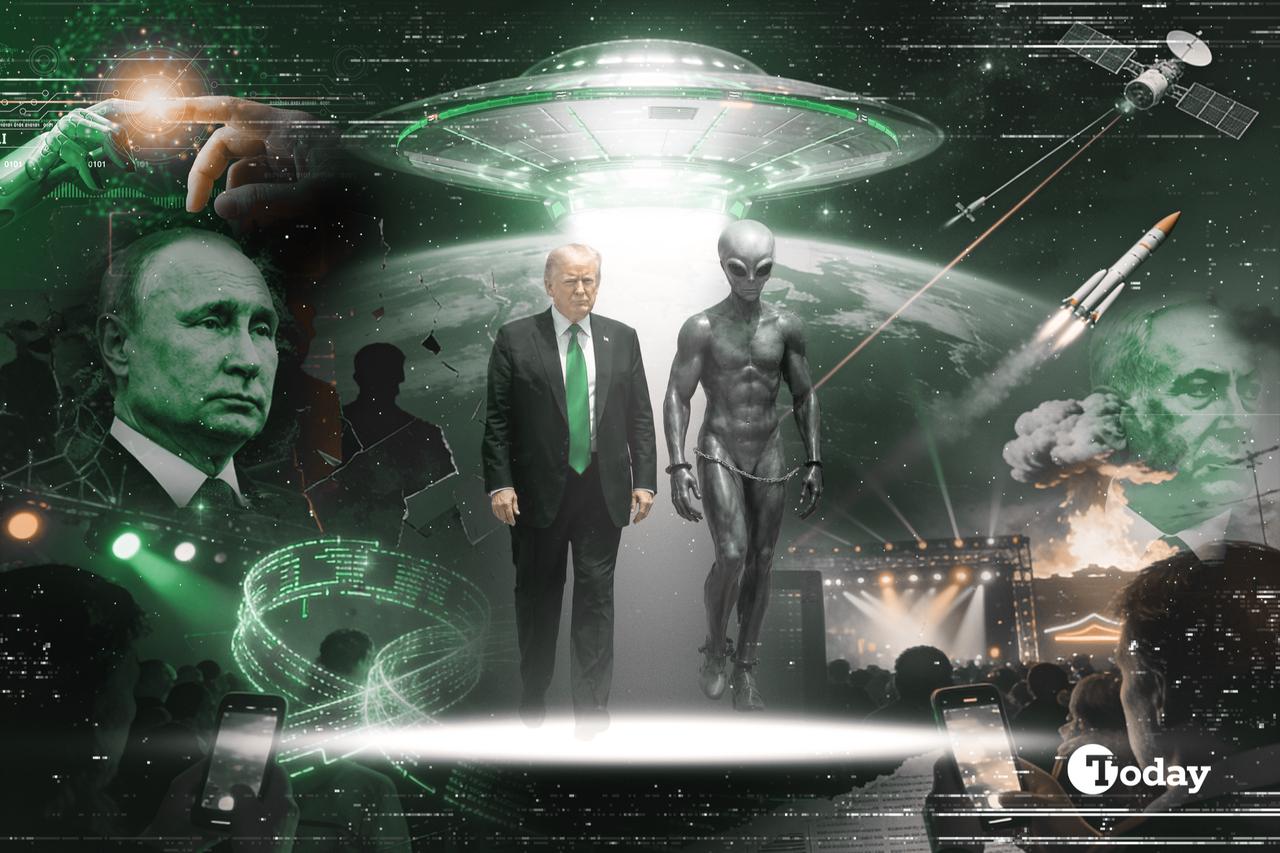


A big Hollywood bang is primed to prove Enrico Fermi wrong.
The man who built the world’s first nuclear reactor tragically lost the plot. Any Nobel laureate can misjudge when trying to guess what civilization would look like before it reached its current level of delirium. A mad script co-authored by Donald Trump, Persian mullahs, Vladimir Putin and Bibi Netanyahu. Toss in catastrophic plagues, billionaires launching orbit-bound gizmos, and ordinary citizens arguing with invisible algorithms designed to manipulate stock markets and the outcome of the 2026 Champions League final between Arsenal and Paris St. Germain.
Fermi posed his celebrated paradox back in 1950, and Academy Award-winning director Steven Spielberg’s upcoming summer blockbuster “Disclosure Day” is set to ignite a worldwide UFO contretemps.
The galaxy, Fermi reckoned, contains a staggering abundance.
Perhaps 200 to 400 billion stars. At least 100 billion planets. Vast distances. Vast time scales. Vast possibility.
So where is everybody?
No radio signal. No giant Amazon warehouse visible from deep space. No polite extraterrestrial ambassador is arriving with a sure-fire plan for Fenerbahce to win anything but woe and an alternative to Starbucks’s disappointing gluten-free muffins.
Nothing.
The silence bothered Fermi.
Scientists and Spielberg have spent decades trying to massage Fermi’s troubles away. Intelligent civilizations destroy themselves before mastering interstellar travel. The distances are too enormous. Alien societies exist but lack the technology to communicate.
Or maybe, according to the Zoo Hypothesis, advanced civilizations deliberately leave Earth alone so humans can evolve naturally without interference.
That theory sounds reasonable until you spend approximately 11 consecutive minutes examining the MAGA administration's recent initiatives in Gaza and efforts to contain the Ebola virus in Uganda and the Democratic Republic of Congo.
At which point, natural evolution begins feeling overly optimistic.
“We deserve to know" is how Spielberg frames the issue on the promotional posters for “Disclosure Day.”
Harvard University professor Avi Loeb recently offered up a tidy alternative theory: humanity’s first encounter with ET might not resemble old sci-fi movies. No glowing saucers. No bug-eyed ambassadors.
Loeb suggests we’ll encounter invisible technologians. You know, artificial intelligence, autonomous systems, and iPhones pulsating with app updates humanity doesn’t understand. The kind of stuff capable of scrambling civilization like a dropped diner omelet.
But suppose Loeb is only half right.
Suppose advanced intelligence—quietly and strategically—arrived years ago by embedding itself inside systems humanity already trusted.
Political gravity bends in bizarre directions. Entire countries reorganize themselves around pulp-fiction personalities and narratives that would have sounded too implausible for paperback thrillers twenty years ago.
Global leaders operate inside pressure cookers of power and conflict so surreal that they sometimes appear generated by exhausted soap opera writers facing impossible deadlines.
The information ecosystem runs on outrage, tribal loyalty, machine optimization, and attention-harvesting algorithms that know citizens better than citizens know themselves.
Meanwhile, humanity voluntarily carries tracking devices into bedrooms, restaurants, and bathrooms while accepting software agreements nobody reads.
If extraterrestrials wanted to study civilization discreetly, Earth mailed them the keys.
Then there’s Eurovision.
Scientists searching for evidence of advanced nonhuman intelligence should stop pointing expensive equipment toward distant star systems and instead examine Eurovision voting patterns with forensic seriousness.
You’ve got pyrotechnics, laser storms, diplomatic tension, sequined performers descending from ceilings, and ballads receiving inexplicable support from countries located suspiciously far away.
Hundreds of millions of viewers treated this season’s spectacle with a sincerity normally reserved for constitutional law and emergency medicine.
If a visitor from another star system—perhaps disguised as a Bulgarian—wanted to blend in, Eurovision 2026 offered perfect camouflage. Beam down, perform "Bangaranga!" score 516 points, and depart undetected. Indeed, Dara could have theoretically returned home carrying detailed field notes.
"Subject species emotionally unstable.
Displays tribal behavior.
Possesses nuclear capability.
Communicates largely through outrage.
Highly vulnerable to lightning effects and memorable choruses."
Fermi believed a barrier he called the Great Filter prevented civilizations from becoming technologically advanced spacefaring societies.
But standing amid synthetic media, machine intelligence, geopolitical turmoil and civilization-wide attention disorders, another possibility emerges.
Perhaps intelligence isn’t the Great Filter.
Perhaps absurdity is.
Human beings split the atom, mapped genomes, golfed on the Moon, built astonishing computational systems, and created social environments capable of turning minor disagreements into civilization-wide blood pressure emergencies.
Maybe nobody calls because nobody needs to.
Maybe advanced civilizations eventually learn that every inhabited planet develops its own strange political rituals, technological anxieties, and theatrical public spectacles.
Maybe they watch quietly.
Taking notes, monitoring Hollywood box-office receipts, and studying humanity with concern are usually associated with Instagram cameras observing squirrels near electrical equipment.
And, of course, eagerly awaiting the June 12 release of “Disclosure Day.”
Purely for research purposes.


 Set as preferred source
 Set as preferred source



 7 min read