Newsletters


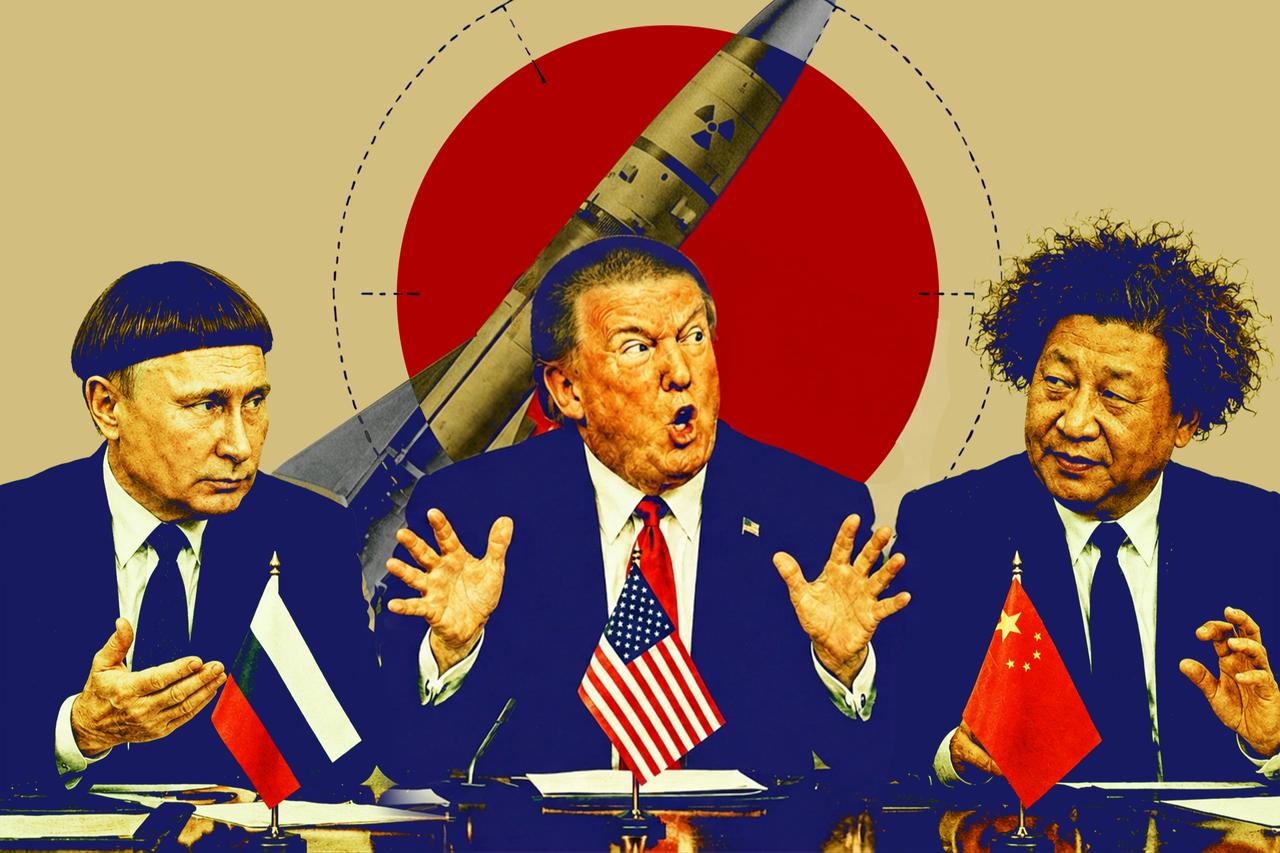


The Three Stooges remain America's most enduring contribution to the delicate art of international diplomacy—a legacy set for a spectacular revival at this week’s scheduled Trump-Putin-Xi summit in China.
Long before the United Nations, NATO, or the invention of mutually assured destruction, three comedians named Moe Howard, Larry Fine, and Curly Howard showed that civilization could be reduced to a sequence of eye pokes, head slaps, collapsing furniture and catastrophic misunderstandings.
The Stooges were the spearhead of American Exceptionalism: the proposition that no other nation could manufacture such magnificent stupidity, distribute it worldwide, and persuade millions that it was entertainment.
To fully understand America, the uninitiated should know that generations of its citizens, including future presidents, generals and captains of industry, spent their formative years watching three grown men assault one another with plumbing equipment.
The Soviets, naturally, took all this very seriously. During my years as a Moscow correspondent, I learned that Soviet scholars at the Institute for USA and Canadian Studies were encouraged to watch the Three Stooges. Evidently, the Russians understood American diplomacy long before the Americans did.
Moe was the authoritarian with the bowl haircut, Larry the bewildered accomplice with the electrified hair, and Curly the bald, excitable man-child whose principal diplomatic contribution was shouting “Nyuk, nyuk, nyuk” while demolishing the furniture.
Their genius was making chaos look like government.
Now, 86 years after the trio’s finest political achievement, the Stooges are returning. This time the production has a larger budget, a Chinese location and enough nuclear weapons to make the original Columbia Pictures executives reconsider their insurance policies.
Donald Trump, Vladimir Putin and Xi Jinping are reportedly preparing for an unprecedented three-way summit in Shenzhen, China. The White House says the agenda includes Iran and nuclear proliferation. Ukraine, inconveniently, may not make the program.
The question confronting humanity is obvious: Who gets to play Moe?
To appreciate the full significance of this casting, we must return to 1940, when three slapstick comedians understood something about dictators that the world's statesmen were still struggling to comprehend.
On January 19, 1940, Columbia released You Nazty Spy!, an 18-minute masterpiece in which Moe Howard portrayed Moe Hailstone, a Hitler-inspired dictator of the fictional country Moronica.
Moe's Hitler parody reached American movie theaters nine months before Charlie Chaplin's celebrated "The Great Dictator." Chaplin had begun production earlier, but the Stooges got there first. The boys understood something fundamental about fascism: beneath the uniforms, grandiose speeches and military pageantry lurked a bunch of ridiculous men fighting over the same chair.
And so to the casting.
Donald Trump is Curly. There can be no serious disagreement about this theatrical proposition.
Curly was noisy, impulsive, extraordinarily confident and frequently astonished by the consequences of his own actions. He approached every problem as an opportunity for spectacular improvisation. Trump brings to international diplomacy a comparable faith in personal performance, dramatic entrances and the possibility that an entire geopolitical dispute might disappear following a sufficiently impressive handshake.
Curly's signature move was to spin helplessly on the floor. Trump's equivalent is the negotiating reversal: threats become compliments, compliments become threats, and yesterday's mortal adversary becomes today's wonderful gentleman.
Curly never encountered a cream pie he couldn't weaponize. Trump has tariffs.
Vladimir Putin is Moe.
Moe was the disciplinarian, the enforcer, the fellow who administered punishment while insisting that everyone else was responsible for the disorder.
Putin's political career has been built around centralized authority, coercion and the projection of strength. His invasion of Ukraine supplies the essential distinction between cinematic slapstick and actual state violence: when Moe struck Larry with a hammer, the audience laughed because nobody was seriously injured. When armies strike Ukrainian cities, people die.
There is something particularly grotesque about the reported decision to discuss Iran while leaving Ukraine outside the summit agenda. In the original Stooges films, Moe frequently escaped accountability by redirecting attention toward Curly's latest disaster.
Putin could hardly request a more convenient screenplay.
Which leaves Xi Jinping as Larry.
At first glance, this seems unfair to China's meticulously disciplined leader. Larry was the comparatively quiet Stooge, perpetually caught between Moe's aggression and Curly's hysteria. He survived through accommodation, watchfulness and the occasional well-timed intervention.
Xi, however, is no passive bystander. He commands the world's second-largest economy, presides over a rapidly modernizing military and hosts this gathering on Chinese territory.
Indeed, Larry may secretly own the theater.
China's nuclear expansion provides the summit's central paradox. Beijing is projected to possess approximately 1,000 nuclear warheads by 2030, while Washington and Moscow already maintain arsenals numbering in the thousands.
The last U.S.-Russia strategic arms-control treaty expired in February. Trump wants China involved in future restrictions; Beijing has shown little enthusiasm.
Three men will therefore assemble to discuss reducing weapons that each regards as essential to his country's security.
This is classic Stooge mathematics: everybody agrees the room is on fire, but nobody wants to surrender his flamethrower.
Elon Musk is reportedly accompanying Trump to Shenzhen, although not into the trilateral meeting. This makes him the obvious fourth Stooge, an executive producer wandering backstage with a futuristic gadget that nobody requested.
The reported scandal involving Nvidia's former chief executive adds another subplot of alleged espionage, sex and Silicon Valley intrigue. Its particulars remain unverified here, but its inclusion in the summit narrative gives the production the atmosphere of a Cold War farce written during a particularly reckless office Christmas party.
And yet there is one profound difference between the original Three Stooges and their geopolitical successors.
Curly, Larry and Moe knew they were making a comedy.
Their modern counterparts are negotiating questions of war, sovereignty and nuclear annihilation.
The old Stooges finished each episode battered, bewildered and miraculously alive. The scenery was destroyed, but the audience could go home.
Now the scenery is the world itself, and nobody gets to leave.
In Shenzhen, the cameras are rolling on "You Dicta-Doodle Spy!" And up in lights, the marquee announces:
THEY CAME TO CONQUER THE WORLD—BUT COULDN’T AGREE ON WHO GOT TO SIT IN THE MIDDLE.
Nyuk, nyuk, nuke.


 Set as preferred source
 Set as preferred source


 1 min read
 1 min read