Newsletters




"If a conventional warhead gets through a defense, a building is damaged or destroyed. If a nuclear weapon gets through a defense, a city is destroyed and a million people are killed," says Steve Fetter, a professor of public policy at the University of Maryland who has studied security since the Cold War.
That is the reason the producers behind Ronald Reagan’s 1983 Strategic Defense Initiative—the ultimate science-fiction military fantasy famously billed as “Star Wars”—are back with their biggest-budget sequel yet.
It is called Golden Dome. Estimated running time: 20 years. Estimated budget: up to $1.2 trillion. Plot: still in development.
Nobody at the Pentagon can tell Congress exactly what Golden Dome is. Not because it is classified. Not because foreign adversaries stole the plans. Because, apparently, nobody knows what it is. This minor detail has not prevented anyone from funding it.
That is the finding buried in a 12-page Congressional Budget Office report released on May 12. Normally, when somebody asks for a trillion dollars, there is at least a rough idea of what the money is supposed to buy.
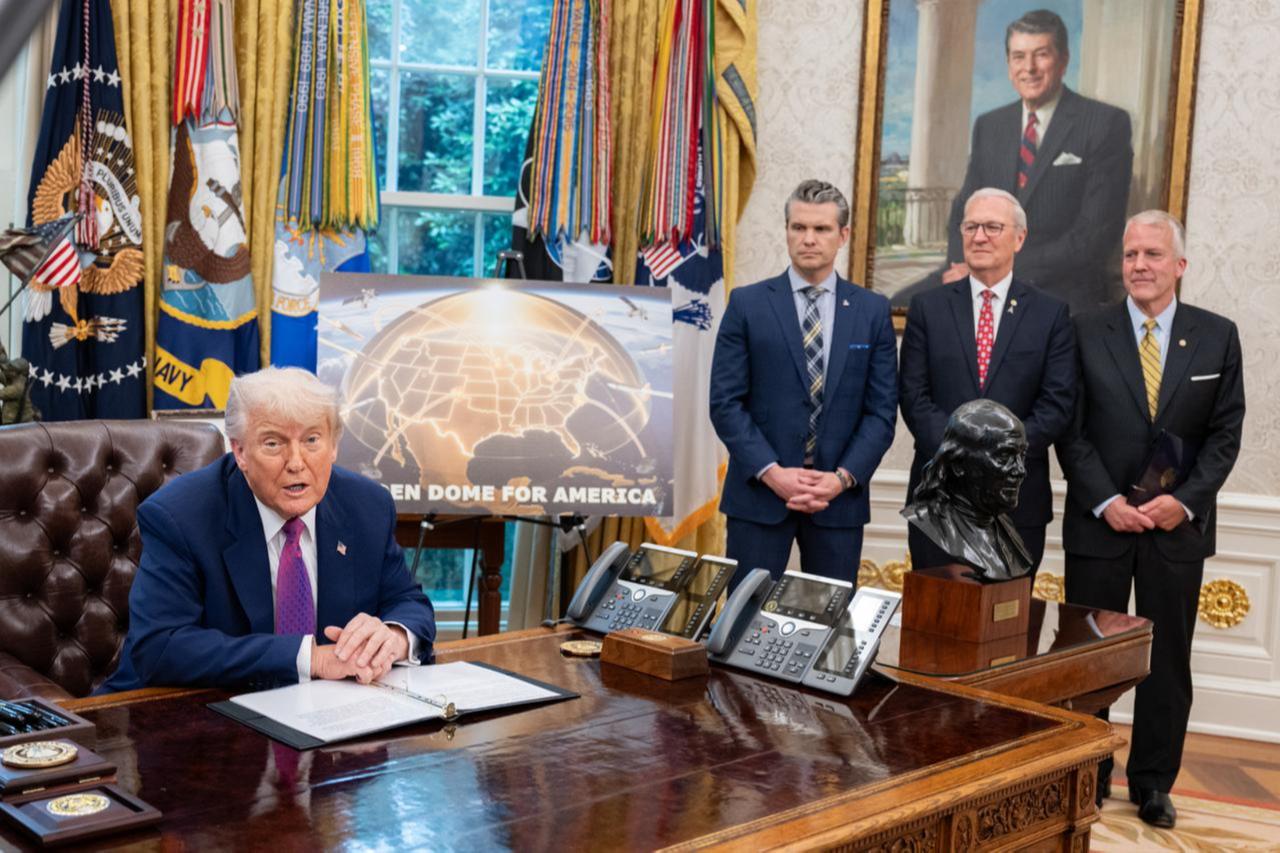
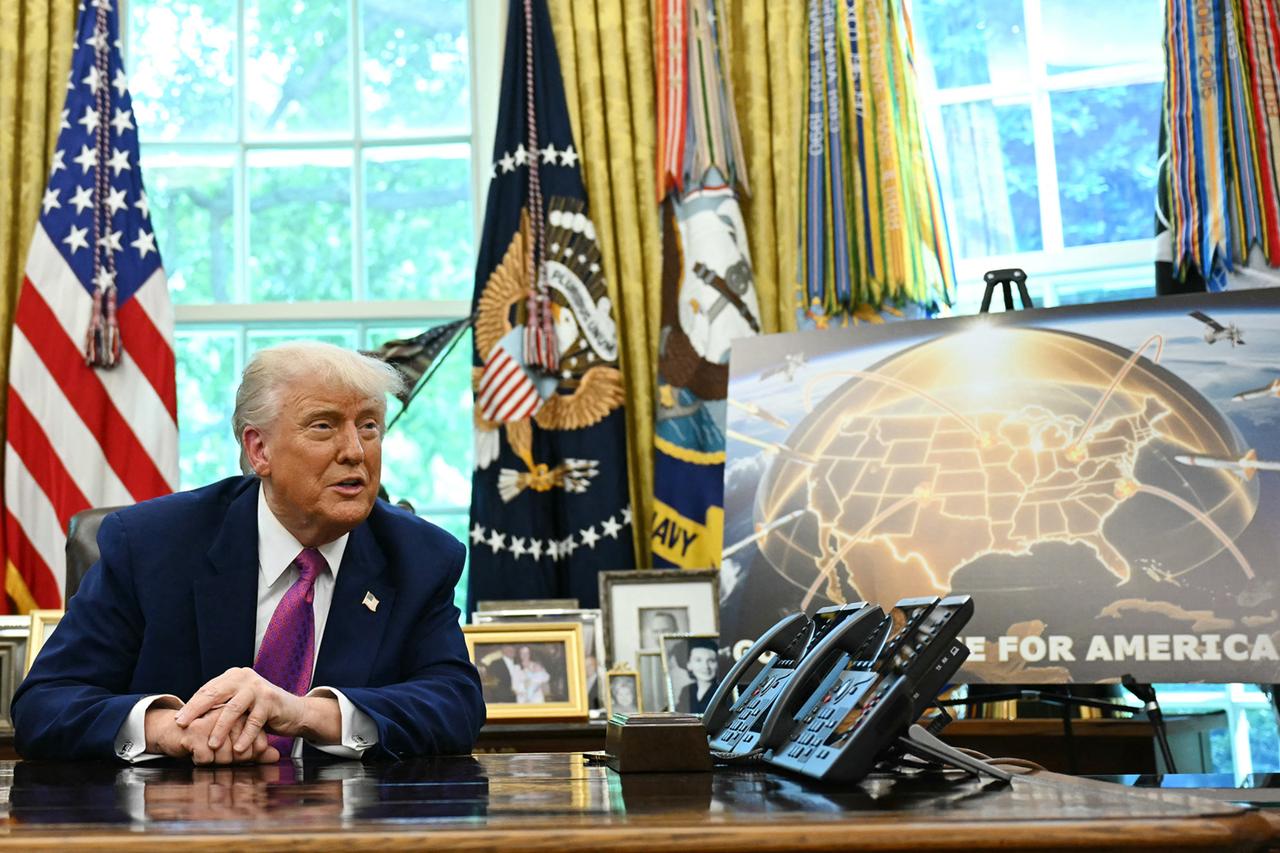
Golden Dome began with an executive order signed by President Trump in the opening days of his second term. Originally dubbed “Iron Dome for America,” it borrowed the name and aura of Israel’s proven short-range missile defense.
Within months it became Golden Dome, a label less evocative of a military weapons system than a bespoke luxury hotel or a vanity project Emperor Palpatine might finance through an emergency supplemental appropriation.
There was never much danger of the initiative being called the Sensible Gray Dome. Gold remains the reigning aesthetic, from the presidential coiffure to the gilt flourishes spreading through the West Wing. Apparently, the only surface left to gild was the upper atmosphere.
The concept nonetheless reaches back to Reagan’s 1983 pledge to make nuclear weapons “impotent and obsolete.” The Pentagon has since opened a Golden Dome Office, put Space Force General Michael Guetlein in charge, and started building something.
Congress would simply like to know what.

The Congressional Budget Office did what budget analysts do when handed a grand vision instead of a blueprint: it invented a plausible one and priced it. The result came out to $1.2 trillion over 20 years, calculated in 2026 dollars—more than six times General Guetlein’s preliminary $185 billion estimate.
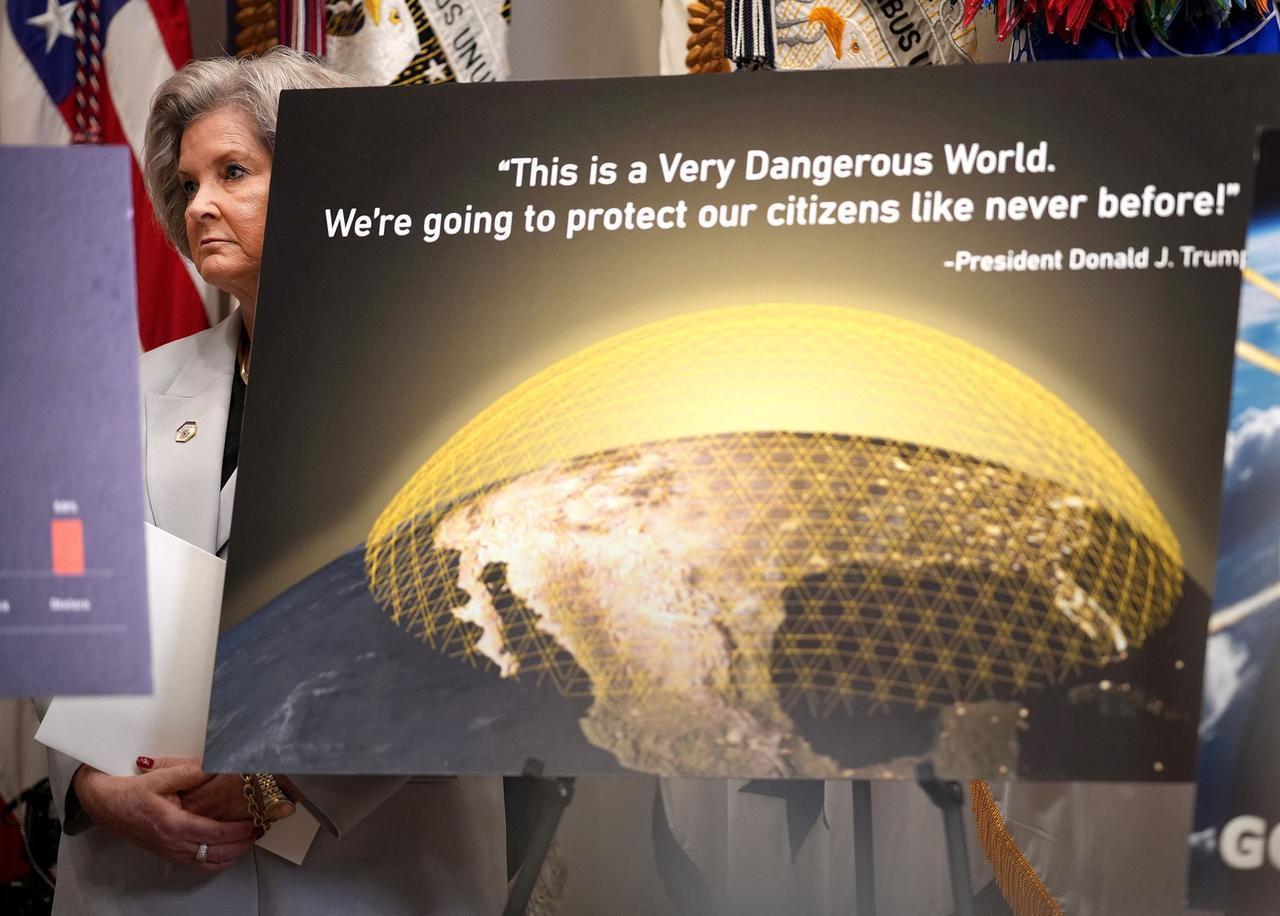
The dream is simple enough: an invisible shield stretching from Hawaii to Maine, capable of destroying virtually anything hostile flying toward the United States, from any direction, at any altitude.
All that remains is figuring out how to do it.
David Mosher, who heads the CBO’s national security division and led the analysis, admitted the agency lacked enough information to estimate what the Pentagon is actually building. So, the CBO priced the executive order instead.
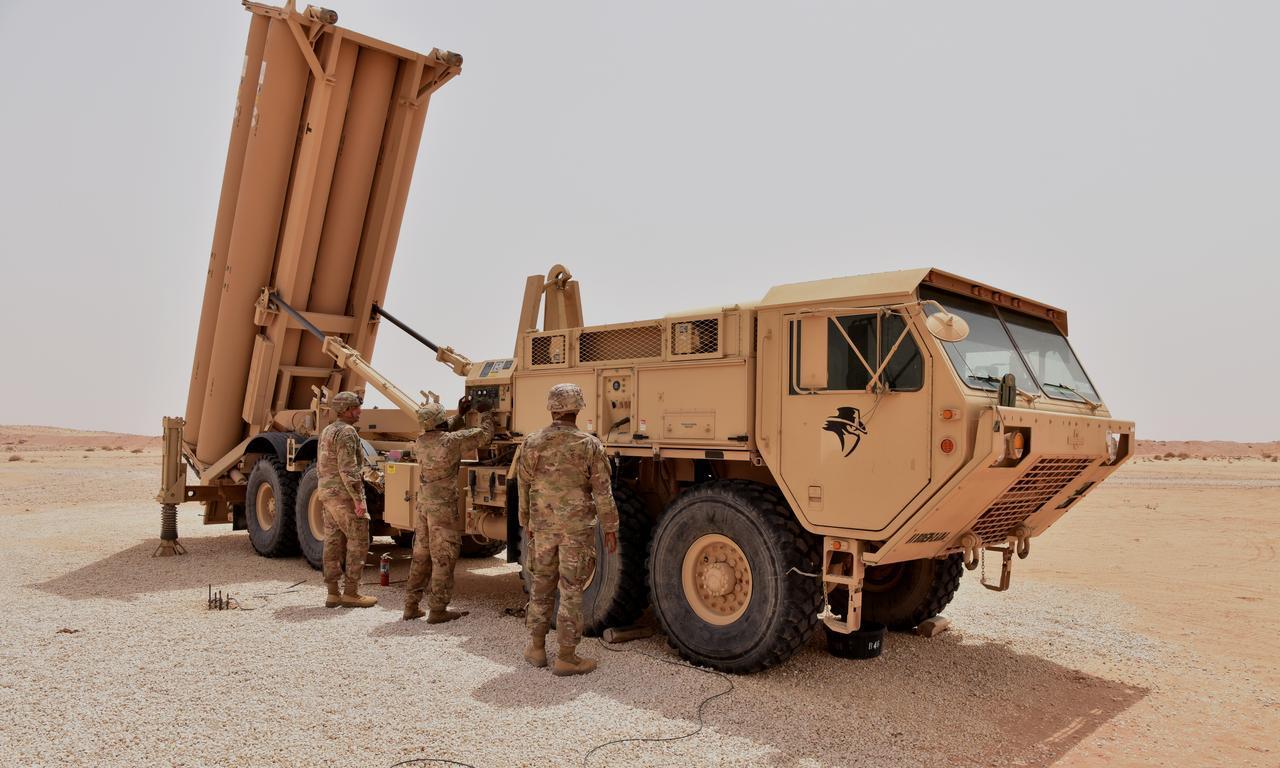
The order called for layers, and the CBO supplied them through an architecture featuring space-based sensors and interceptors, three ground-based interceptor sites, four regional layers using Aegis and Standard Missiles, and 35 defensive sectors protected by Patriot and THAAD batteries against cruise missiles, hypersonics, and drones.
This is less an impenetrable shield than a trillion-dollar drop ceiling.
Crucially, the CBO did not design the system to defeat an all-out Russian or Chinese nuclear attack. The modeled scenario envisioned ten North Korean intercontinental ballistic missiles launched simultaneously, or a smaller, perhaps accidental launch from Moscow or Beijing.
Michael O’Hanlon of the Brookings Institution, who worked with Mosher at the CBO three decades ago, notes that the existing Alaska-California defense system was already designed around roughly that exact North Korean threat. Golden Dome, at least in the CBO’s modeling, is simply a much larger net intended to catch the very same-sized fish.
So why does the net cost $1.2 trillion?
The villain is not North Korea, Russia, or China. It is orbital mechanics.
To destroy an ICBM during its crucial three-to-five-minute boost phase, an interceptor must be nearby—meaning it has to reside in low Earth orbit. Unfortunately, objects in low Earth orbit have an annoying habit of constantly moving.
Park a satellite high enough to remain stationary over one spot, and it is too far away to reach the missile in time. Put it low enough to intercept one, and it keeps racing around the Earth, usually positioning itself someplace entirely useless at the critical moment.
The CBO calls this the “absentee ratio,” a wonderfully bureaucratic phrase for having purchased an expensive interceptor that is currently busy flying over Argentina.
The natural solution, of course, is to buy 7,800 of them.
That is the CBO’s estimate of the satellites needed to guarantee that enough interceptors are overhead to engage ten ICBMs simultaneously. Because low-orbit satellites also have relatively short operational lives, much of the constellation would have to be replaced repeatedly over time.
The space-based layer ends up consuming about 60% of the total bill—roughly $720 billion—largely because physics refuses to let thousands of armed satellites politely remain parked over North Korea.
Even the Death Star got to stay where Darth Vader put it.
Then comes the deeper strategic problem: a defensive shield designed to make America safer can easily look to Russia or China like something designed to make an American first strike survivable without fear of retaliation.
Defense Secretary Robert McNamara warned of this exact logic in the 1960s. Build an imperfect shield, he argued, and rival powers will simply build enough offensive weapons to overwhelm it. That reasoning helped produce the 1972 Anti-Ballistic Missile Treaty, which Washington formally abandoned in 2002.
Vladimir Putin has explicitly linked Russia’s subsequent weapons development to that U.S. decision. In 2018, he unveiled an exotic nuclear arsenal—including hypersonic, nuclear-powered, and undersea weapons—while pointing directly to the American withdrawal from the treaty and the subsequent expansion of missile defenses.
China has been quieter, but equally busy. The Pentagon estimates Beijing has built roughly 350 new ICBM silos while developing satellite early warning capabilities that could push China toward a dangerous launch-on-warning posture: firing nuclear weapons upon detecting an inbound attack before the warheads actually detonate.
This is widely considered a poor moment to discover that a radar computer made a false alarm.
And then there is the perennial problem of decoys. In the vacuum of space, a nuclear warhead and a lightweight decoy travel together identically, leaving the defender to determine which one actually deserves a multimillion-dollar interceptor.
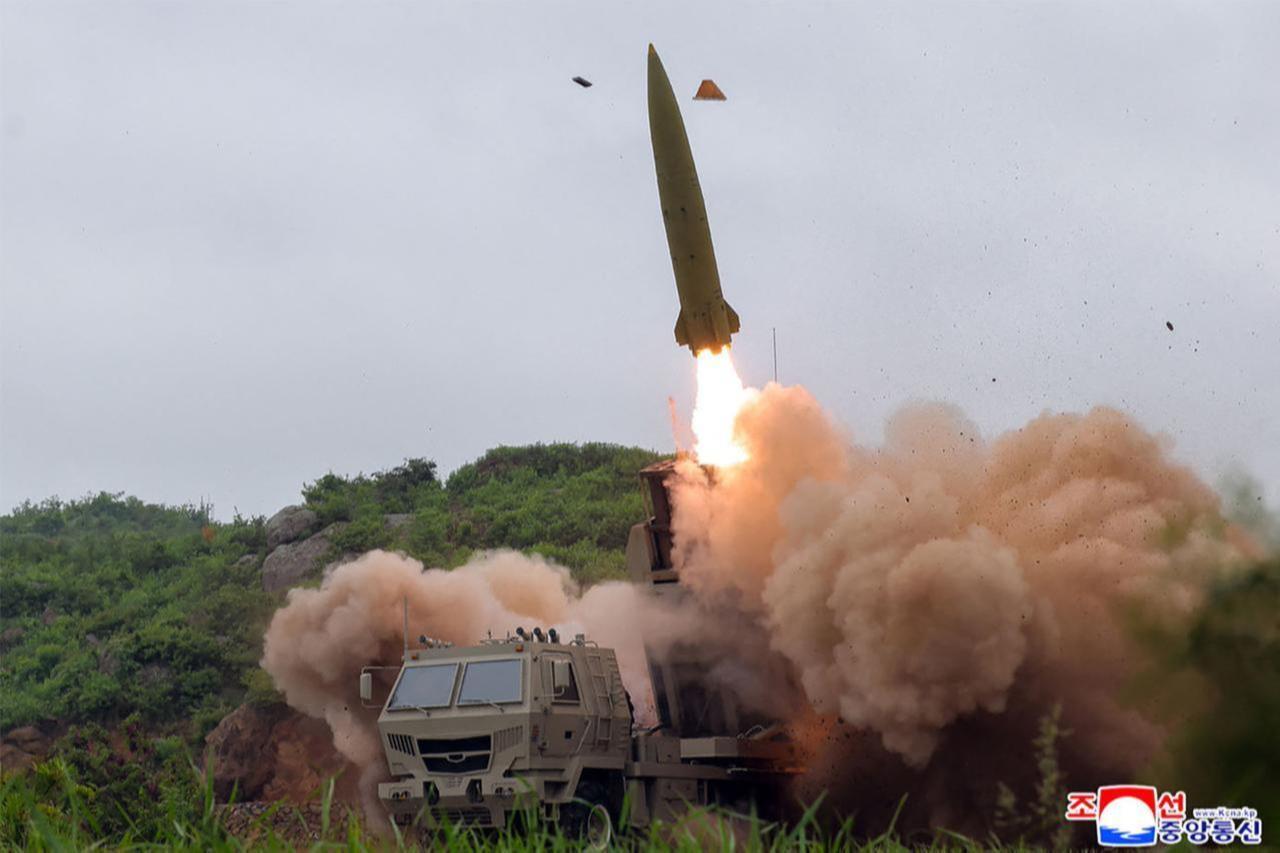
This leaves a central question: if the United States has something approaching a trillion dollars to spend on national security, where does it do the most good? In thousands of orbiting interceptors, or in conventional deterrence in places like Taiwan and Europe intended to keep great-power wars from starting in the first place?
Some analysts favor a less cinematic Golden Dome: fewer vulnerable weapons in space, more proven defenses on the ground, and clear diplomatic measures to convince rivals that America is building a regional shield rather than an offensive enabler that might encourage them to build even more missiles.
Congress, meanwhile, has appropriated about $24 billion so far, with another $18 billion requested for next year. This is a fraction of what the CBO’s version would ultimately require, but still an impressive amount of taxpayer money to spend on a project nobody can quite describe.
That may ultimately be Golden Dome’s most remarkable achievement. Washington has successfully opened an office, appointed a general, and begun spending billions on a system whose final design remains entirely unsettled. In most private industries, this would be categorized as a critical failure. In Washington, it is simply called a program.
Forty-three years after America’s first “Star Wars,” the franchise is back. The script is still being written, and the special effects are considerably more expensive.


 Set as preferred source
 Set as preferred source


 1 min read
 1 min read