

 Newsletters


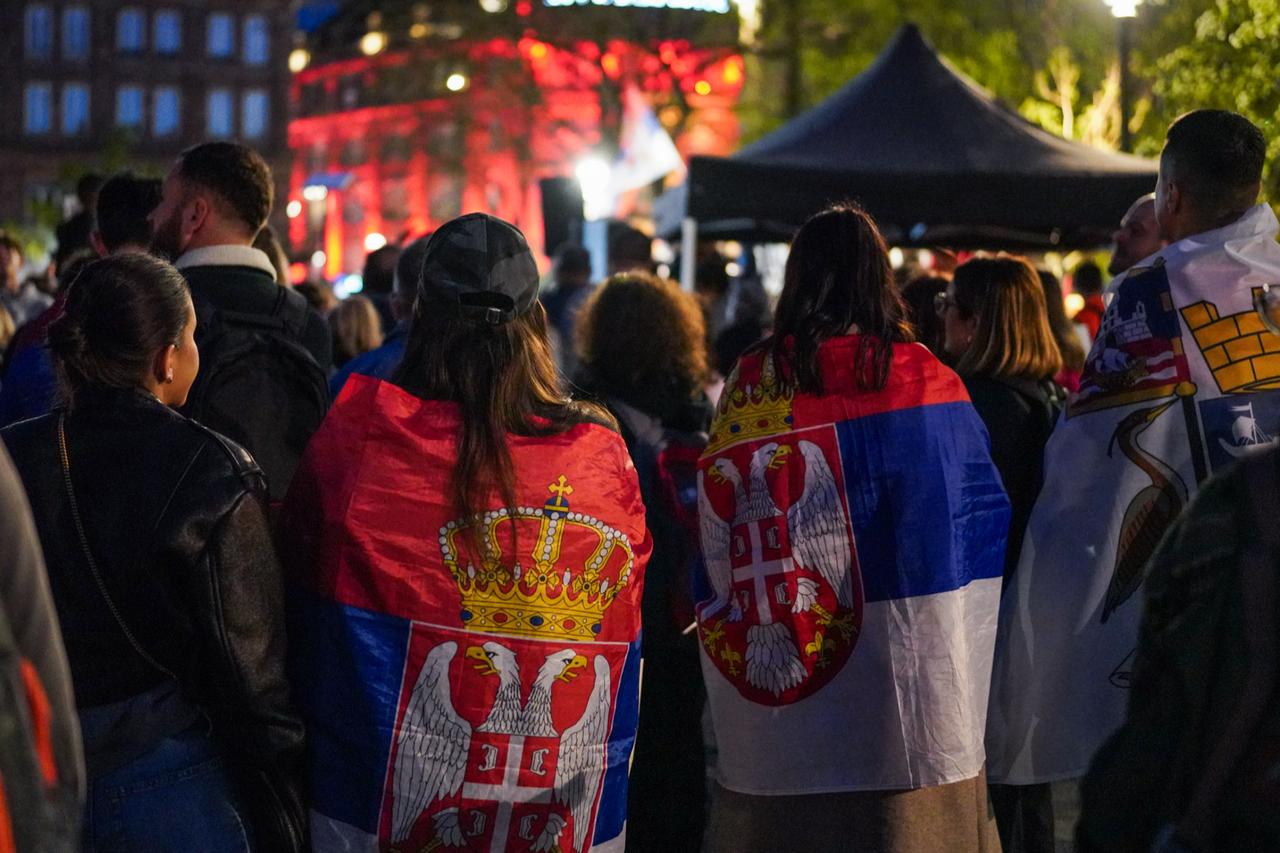


Nothing about Kragujevac on May 17 was accidental.
Here, Serbian students—whose protest movement is widely seen as Europe’s most promising civic mobilization since Maidan—gathered in the city long revered as the cradle of modern Serbian nationalism. Speaking at a tribune dedicated to the rump university Belgrade maintains in Mitrovica to counter Kosovo's independence, the students read aloud a defiant memorandum.
The text was reproduced in full by Danas, Vreme, N1, Insajder and nearly every major Serbian outlet. Its language was not improvised. Phrase by phrase, it was lifted directly from a document the students had been forced to study and mirror.
Serbian students, who have been protesting against President Aleksandar Vucic's government for weeks, unveiled a new memorandum on Sunday whose language and underlying theses closely mirror the 1986 Memorandum of the Serbian Academy of Sciences and Arts (SANU). The document presents Kosovo as "an inalienable and integral part of the Republic of Serbia" and frames the issue as one that "cannot be negotiated."
Balsa Bozovic, former Democratic Party MP and a figure who has spent his career within Serbia's pro-European opposition, wrote within hours: "The students have published their Memorandum on Kosovo, by which they consciously continued the policy of Dobrica Cosic and the SANU Memorandum of 1986. From now on the governments will change, but the ideology will remain the same. Zoran Djindjic, in that scenario, was an incident. Serbia remains on the wrong path."
The judgment came from within Serbian political life itself—this was no Albanian rhetoric. It was a Serbian liberal naming exactly what his own country's reform movement had just done: acting publicly, on its own initiative, and entirely uncoerced.

What was placed in the memorandum was the political theology of organic nationhood in its undisguised form.
Kosovo, the document declares, is not territory. It is a "component of Serbian national identity." Without it, the "cultural and historical code loses its source and meaning." The struggle for it becomes a struggle for "our face, our culture, our future."
Every citizen is enrolled as a "bearer of collective memory" with a "duty" to preserve this heritage.
The population that actually lives on the territory, the more than 90% who are Albanian, appears only once in the text, anonymously, as "the people who live on this territory." They are not named. They are not described. They are not consulted. They appear as a demographic detail to be managed within a Serbian constitutional framework.
This vocabulary is neither specifically Balkan nor specifically Serbian. It is the operating language of ethnonational projects producing violence across Europe.
When Vladimir Putin annexed Crimea in March 2014, he framed it as the recovery of "sacred land," the cradle of Russian Orthodox civilization, an "inalienable part of Russia" whose separation represented an artificial wound in the body of the historical nation.
When he ordered the invasion of Ukraine in February 2022, he framed it as the defense of a "single people" against an administrative fiction imposed by Soviet cartographers. In his view, the population's actual political preferences—expressed in election after election since 1991—were nothing more than the product of foreign manipulation.
The grammar is identical to the grammar of the Kragujevac text.
Territory is no longer territory.
The nation is no longer the citizenry of a state but a metaphysical body whose constitutive geography cannot be amputated without spiritual death. The people living on contested ground become anonymous extras inside a story whose protagonist is the historical-spiritual self.
This was the political theology that produced Bucha and Mariupol. It is also the political theology the Serbian student movement chose, in May 2026, to inscribe as the unified will of the reform generation.
The choice was not forced.
It was a vow.
The architecture has consequences, and those consequences are documented.
The same vocabulary, when it last guided the Serbian state, supplied the cognitive frame within which the revocation of Kosovo's autonomy in March 1989 appeared as restoration rather than usurpation.
It supplied the frame in which the dismissal of thousands of Albanian teachers, doctors, judges and civil servants appeared as administrative housekeeping.
It supplied the frame in which the closure of Albanian-language schools and newspapers appeared as the correction of an anomaly.
It supplied the frame in which the campaign of 1998 and 1999 that displaced hundreds of thousands of Albanians appeared as the defense of something self-evident.
Each step required not a separate decision but an ideological framework that had already been written down.
That framework was written by 16 members of the Serbian Academy of Sciences and Arts in 1986, leaked to Vecernje novosti in September of that year, and never fully dislodged from the institutional center of Serbian intellectual life.
The minority current that opposed it, from Latinka Perovic and Bogdan Bogdanovic to the 18 academicians who signed the 1992 Apel SANU protiv rata, was marginalized within Serbia itself and effectively outsourced to Helsinki committees and small journals.
The architecture survived because its critics were defeated, not because they were absent.
The students were not alive when this happened.
They studied it.
They selected it.
They wrote a document whose structural argument mirrors the document Slobodan Milosevic inherited and operationalized.
They did so knowing what had been done with the previous version.
They did so anyway.
Serbia's pro-European opposition had been waiting for a generation that would reject this inheritance.
That wait is now over.
The generation has answered.
It rejected nothing.
It renewed everything.
The Zeleno-levi front and Pokret slobodnih gradjana, the two formations whose officials have publicly accepted the French-German framework and the de facto reality of Kosovo since 1999, together command no significant share of the Serbian electorate.
Marko Vujacic, ZLF's international secretary, has himself written that everything in Serbian politics outside those two small parties is "delusion."
The phrase should be taken literally.
The pro-European pole in Serbia is represented by one of its own officials describing it as a marginal remnant within a delusional mainstream.
This is not the description of a political force.
It is the description of an exile.
The Kragujevac memorandum is therefore not a misstep by an otherwise reformist movement.
It is the moment the reform movement told Pristina, Brussels, Tirana and Washington what it actually is on the question that determines every other question in the region.
It is the moment Serbian civic protest, the most morally legible mobilization in the country since 2000, declared on its own initiative that Kosovo is not a matter of politics but of national ontology.
It is also the moment the positions of the regime and the reform movement, on this issue, ceased to appear adversarial and instead appeared synchronized.
The implication for Kosovo is not a matter of mood or interpretation.
The interlocutor presupposed by 15 years of dialogue, the future Serbian government that would eventually accept reality and sign, has now been pre-empted from below by the very social force that was expected to produce it.
There is no political space left in Serbia for that interlocutor.
Both lanes are occupied.
The regime holds the maximalist version of the framework.
The reform movement now occupies the civic-respectable version of the same framework.
The space between them is empty.
Vujacic's "delusion" is the only territory left. And Vujacic named it himself.
The reform generation Europe expected to inherit Serbia has, on its own initiative, in its own words, and on its own platforms, signed the very same vow first written in 1986—and now echoed from the Kremlin.
It is the same vow.
It produces the same architecture.
And the architecture produces the same consequences wherever it is allowed to govern.
Djindjic was an incident. The vow remains.
This article was first published on the Kosovo Dispatch website.
DISCLAIMER: The views and opinions expressed in this article are those of the author and may not necessarily reflect the editorial policy of Türkiye Today.


 Set as preferred source
 Set as preferred source


 2 min read
 1 min read


