Newsletters


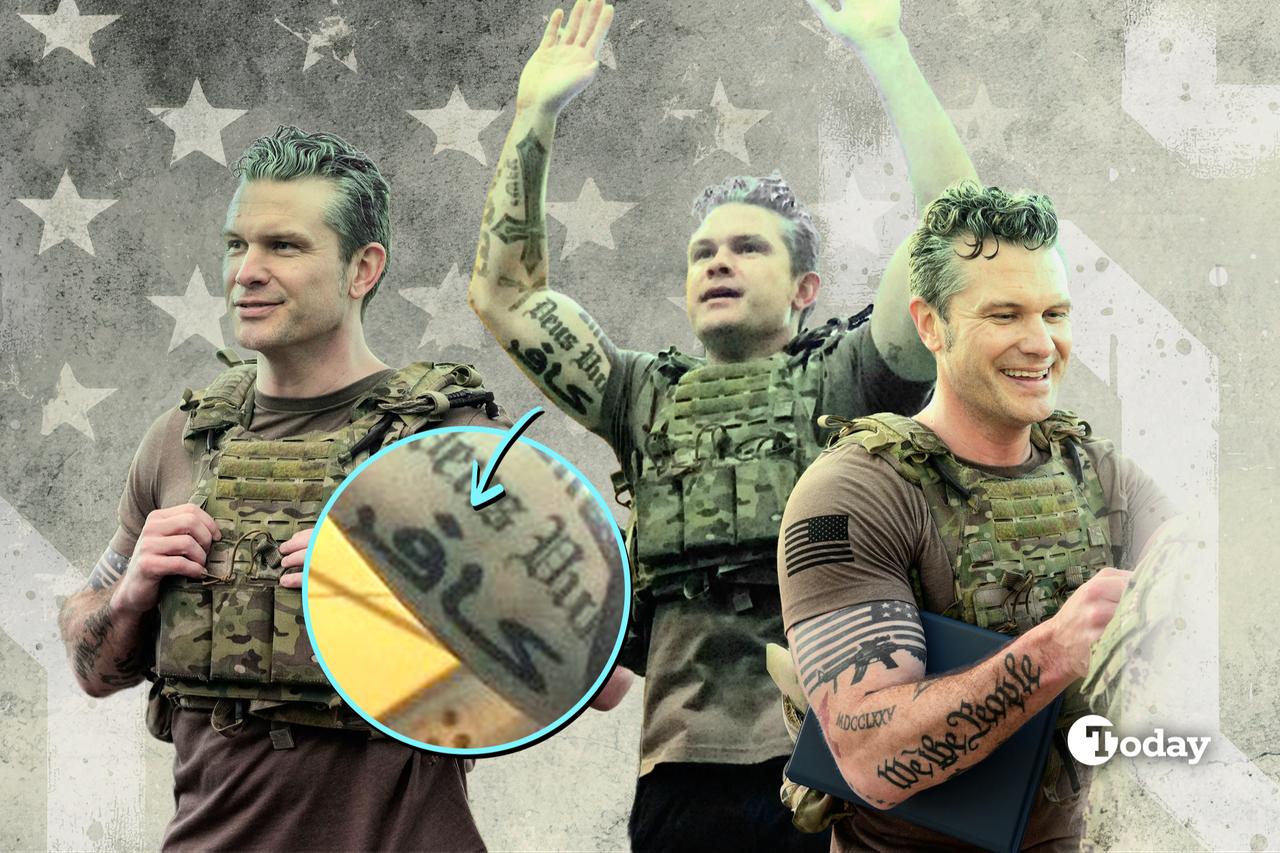


In a war where spectacle drives strategy, the skin is as candid as any classified briefing on what U.S. President Donald Trump and Israeli Prime Minister Benjamin Netanyahu have up their sleeves.
Let other Iran war watchers channel-surf for clues in the televised aerial skirmishes and choreographed Oval Office shouting sessions with the press. The dirty work is scratching the flesh of powerful men—many of them dead—and probing traces in the black lines and shaded sigils that can predict the future.
Behind the shadows of theatrics and etched symbols, whispers from the ranks tell a more unsettling story. One where the men sending others to fight speak in tongues of apocalypse. More than 200 service members made complaints to a watchdog that commanders used biblical “end times” rhetoric to justify the Iran war.
Among the signs scattered across Washington, one figure stands out, his presence writ large in the corridors of power.
This is no whimsy. By the time U.S. Secretary of Defense Pete Hegseth began rattling Trump’s sabre toward the Persian Gulf, his skin had spent years metastasizing across the city like a rash of patriotic hives. The former weekend host of a morning television show on Fox News certainly arrived with the jawline of a recruiting poster and the resume of a cable-news crusader, but what fascinated the capital’s whisper circuit was not his rhetoric about “restoring deterrence.”
It was the ink.
“I was deemed an extremist because of a tattoo by my National Guard unit in Washington D.C., and my orders were revoked to guard the Biden inauguration,” was Hegseth’s lament to a podcaster in 2021. “My commander called me a day before tepidly and was like, 'Major, you can just stand down.' We don’t need you.”
Of course, they didn’t. Tattoos tell a permanent story. They are affidavits written in the dermis and sealed with blood. And the story on Hegseth’s flesh—visible in rolled sleeves, locker-room leaks, and file cabinets of disastrously candid photos—reads like a field manual for a permanent religious war.
Start with the forearms. On the left: a crusader’s cross rendered in stark black geometry, not ornate, not devotional, but martial. The lines are sharp enough to slice through nuance. On the right: a coiled rattlesnake, mouth open, fangs bared, the old Gadsden spirit resurrected for a century that no longer understands revolution without branding. Beneath the serpent, in block capitals: "NO STEP." The grammar is less important than the threat.
Across his chest—half glimpsed through a tactical workout video released by his own media team—sprawls a Latin phrase: "Si vis pacem, para bellum" (If you want peace, prepare for war). The Romans used it to justify the empire. Hegseth’s admirers cite it as prudence. His critics call it prophecy.
“Armed pilgrimages never end well,” cautions Türkiye Today columnist and Byzantine historian Henry Hopwood-Phillips, director of the Daotong Strategy Group political consultancy in London. “The only fruit of the crusades kept by the Christians was the apricot.”
And the tattoos, too.
Hegseth’s flesh crows smaller sigils, all scattered like magical campaign medals. The date of a battle from his early service years, the coordinates of a desert forward operating base, an American flag distressed to appear wind-whipped and half-immortal. And on his right bicep, a Spartan helmet, visor down, faceless and defiant.
Count them all, and you arrive at a dozen distinct pictures at an exhibition, each one a chapter heading in the gospel of force. Twelve apostles of hard power marching around a single body.
Are they messages, or mere fashion statements in an era when U.S. politicians shop for image consultants the way teenagers shop for sneakers?
The answer depends on how much agency to grant the flesh. Tattoos are semiotics with a pulse. In military subculture, they signal allegiance, endurance, and willingness to suffer for belonging. In politics, they become optics. A secretary of defense with inked forearms broadcasts a different message than one swaddled in the anonymity of a blue blazer. The tattoos say: I am not theoretical.
And yet, when Hegseth stands at the podium threatening escalation against Iran (and Venezuela and Cuba and Colombia), the ink begins to look less like autobiography and more like scripture.
The crusader’s cross glows hotter under the television lights. The Latin motto reads less like caution and more like compulsion. One wonders whether the body has become an echo chamber. Symbols reinforce decisions, decisions reinforcing symbols, until the only one who can relieve our confusion is “The Da Vinci Code” hero, Robert Langdon.
Somewhere in the debris of the once opaque corridors of the Islamic Revolutionary Guard Corps, there are bodies marked as well. Not as publicly, not as flamboyantly, but marked nonetheless. Tattoos in Iran exist in a legal gray zone—technically frowned upon and occasionally harassed by authorities—but culture is harder to police than narcotics.
Among certain Guard units and affiliated militias, small tattoos of Quranic verses, stylized calligraphy of Imam Hussein’s name, or the Zulfiqar sword associated with Imam Ali appear on shoulders and ribs. They are rarely displayed in press conferences. They are personal talismans, martyrdom insurance policies etched in ink.
In Tehran’s northern districts, past the glass storefronts selling contraband Western denim, tattoo parlors hum discreetly behind unmarked doors. Artists work with curtains drawn, machines buzzing like restrained hornets. They ink roses, Persian script, and sometimes portraits of fallen fighters. The aesthetic is different—less bombastic, more devotional—but the principle is identical: permanence as identity.
“They say tattoos are forbidden,” an Iranian inker said, “but everyone wants something that lasts.”
The Persian tattooist was talking about youth, love, and revolution.
“Ink,” he added before the signal disappeared, “is cheaper than reality in Iran.”
Hegseth’s muscular Americana and the Guard’s restrained martyrdom, both inscribing conviction onto flesh while their governments flirt with catastrophe. Somewhere, in a carpeted office park, a battalion of psychologists in sensible shoes is nodding gravely at the epidermis, convinced they’ve found the grail in a sleeve of ink.
“A-ha!” they actually have shouted, almost certainly stroking their peer-reviewed chins, Hegseth’s tattoos humming quietly in the fluorescent light, a shrine to certainty. The enchantment deepens. It gets footnotes.
When Hegseth briefs Congress about “surgical options” in Iran, the Spartans on his bicep do not whisper about supply chains or second-order consequences. They murmur about Thermopylae. The crusader’s cross does not cite oil futures. It cites destiny. This is not mystical thinking. It is narrative reinforcement. Hegseth has inscribed the Trump-Netanyahu sandwich board on his flesh.
In Tehran, a young Guardsman with a hidden verse about sacrifice might find himself deployed not in defense but in retaliation spirals engineered by men who will never bleed beside him. His ink promises glory; geopolitics promises entropy.
Hegseth may insist that his tattoos are mere reminders of service, nothing more. The Revolutionary Guard may insist theirs are private devotions, apolitical. But when missiles arc over the Gulf and commentators parse escalation ladders, goosebumps erupt and remember what the mind prefers to forget. Permanence feels righteous in the moment of inscription.
War, like ink, is easier to start than to erase.


 Set as preferred source
 Set as preferred source


 7 min read