Newsletters


Armenians head to the polls on Sunday, Jan. 7, in what is seen as the most consequential parliamentary election since independence.
Prime Minister Nikol Pashinyan’s Civil Contract party is seeking a mandate to advance regional reconciliation with Azerbaijan and Türkiye, deepen ties with the West, and draft a new constitution. A fragmented pro-Russian opposition is challenging the country’s foreign policy direction.
The June 7 vote functions as a public verdict on Pashinyan's "Real Armenia" doctrine and his government's peace architecture for the South Caucasus.
A two-thirds constitutional majority, a high bar analysts describe as a challenging task, would allow Pashinyan to put a new constitution to a referendum, a step Baku has set as a precondition for signing a final peace treaty.

Pashinyan's "Real Armenia" concept calls on citizens to focus on the country's internationally recognized territory rather than historical aspirations, including references to Karabakh.
Public office holders in Armenia wear the concept as a golden-yellow lapel pin depicting the country's legal borders.
"We have this concept of Real Armenia... We do not need to look outside of our borders, because when we look outside of our borders, others also look inside our borders, and we need to stop," said Sargis Khandanyan, chair of Armenia's Standing Committee on Foreign Relations, in an interview with Türkiye's state-run Anadolu Agency (AA).
The primary constitutional change sought is the removal of references to the 1990 Declaration of Independence, which calls for unification with Azerbaijan's Karabakh region.
That removal is Baku's key precondition for finalizing the peace treaty signed at a White House summit in August 2025, hosted by U.S. President Donald Trump, where Pashinyan and Azerbaijani President Ilham Aliyev also signed a Joint Declaration establishing the basis for bilateral and international transportation.
The declaration includes the U.S.-facilitated Trump Route for International Peace and Prosperity (TRIPP) corridor linking mainland Azerbaijan with its Nakhchivan exclave through southern Armenia.
"These elections are a referendum on how the peace process and the foreign policy are being perceived by the public," Khandanyan said.
"We will work on institutionalization of this by pushing on a silent peace agreement with Azerbaijan and ratification of it," he added.

At his final campaign rally at Republic Square in Yerevan, Pashinyan said a new constitution was essential to address structural failures in the Armenian justice system.
"I consider it important for an independent judiciary to exist in Armenia, but unfortunately, it is obvious that Armenia has not yet succeeded in making justice visible and understandable to the people," he said.
"The most important reason this problem has not been resolved to this day is, frankly, the constitution, which was not adopted by the Armenian people and which protects ordinary civil and judicial mafias in every possible way," Pashinyan noted.
Pashinyan called on voters to go to the polls and "stand up for the Republic of Armenia, its independence and freedom."
The rally closed with a performance by the "Varchaband" music group he founded, followed by a drone show.
Armenia's normalization process with Türkiye has also been progressing.
On May 11, both countries finalized preparations for the launch of direct trade.
Turkish Deputy President Cevdet Yilmaz and Pashinyan signed a historic Memorandum of Understanding (MoU) to jointly restore the Ani Bridge on their shared border.
"I believe that there is no obstacle between Armenia and Türkiye to normalize the relations and for Türkiye to open its border," Khandanyan said.
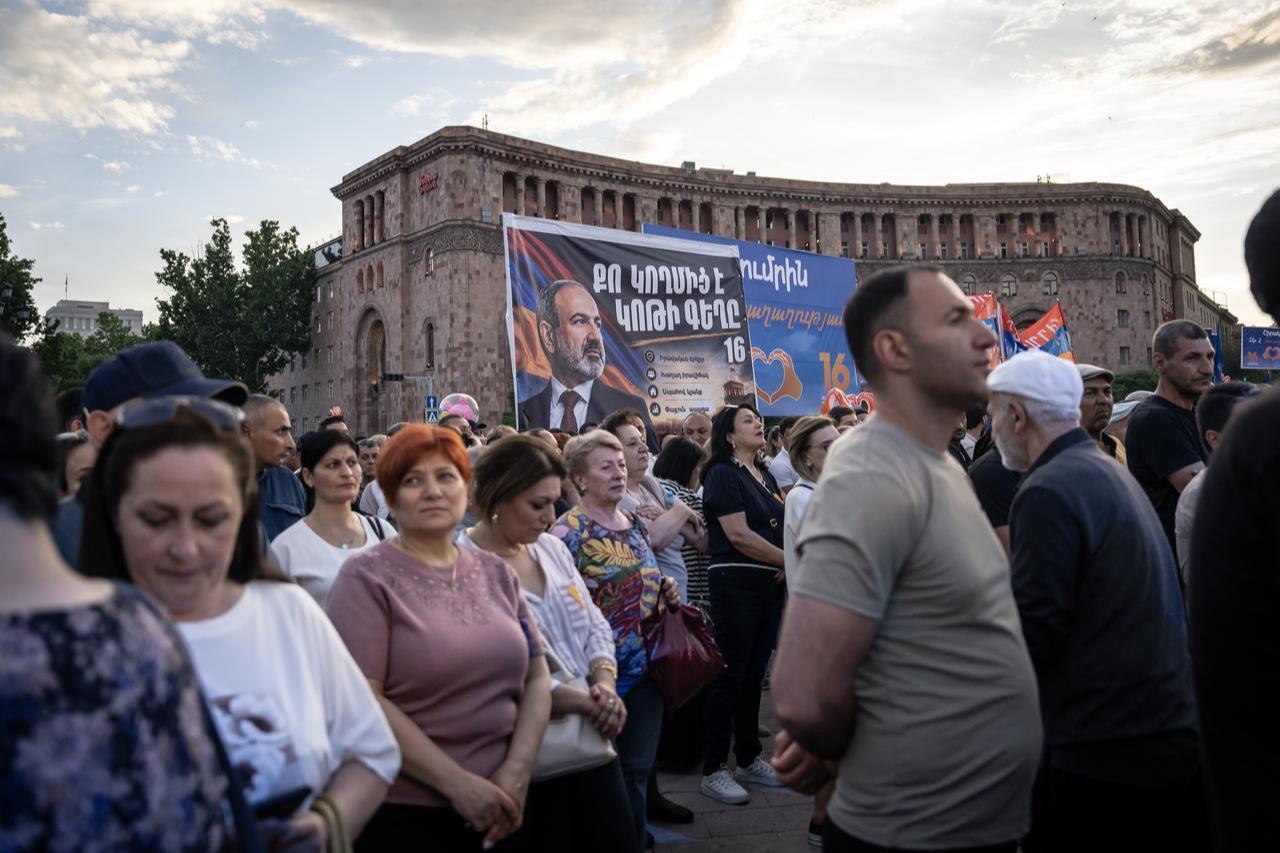
Pashinyan's Civil Contract leads all polling.
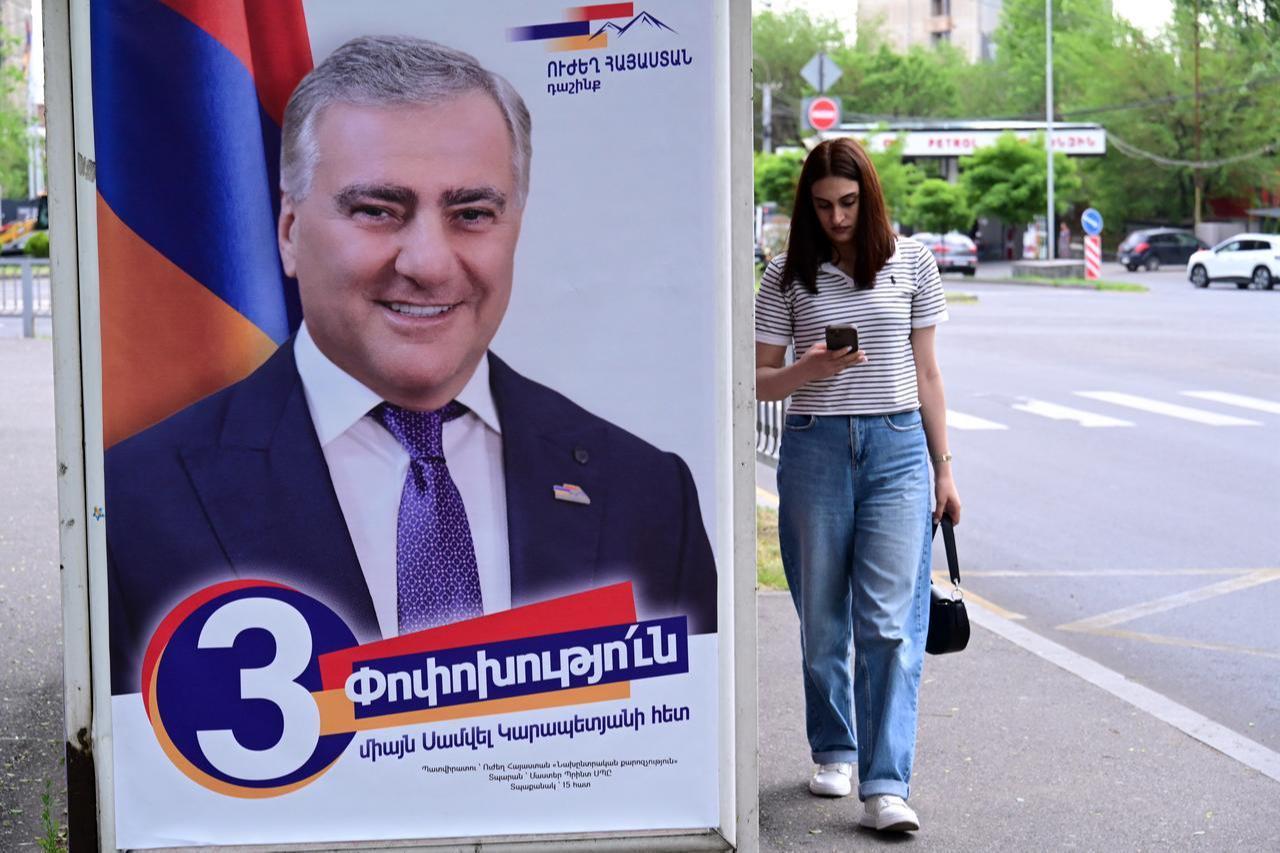
The International Republican Institute (IRI) survey of approximately 1,500 respondents in May showed Civil Contract at 32% when undecided voters are excluded, with Samvel Karapetyan's Strong Armenia second at 6% and former President Robert Kocharyan's Armenia Alliance at 3%.
More recent IRI and EVN Report surveys put Civil Contract between 24 and 26.1%.
Strong Armenia, whose leader is currently under house arrest on charges of inciting a coup, polls at 9 to 11.9%. Kocharyan's alliance sits at 3 to 3.3%, struggling to clear the 8% threshold required for electoral alliances.
Crucially, nearly 30% of the electorate remains undecided.
The opposition has campaigned on stronger ties with Moscow, resistance to further concessions to Baku, and the protection of national institutions, including the Armenian Apostolic Church, which has openly criticized the Pashinyan government for what it calls the weakening of national values.
Eighteen candidate lists are competing for at least 101 seats in parliament.
Armenian election law allows the first-place party to receive bonus seats to reach 52% of parliament, regardless of its raw vote share, a provision designed to ensure stable governance.
Voting runs from 8:00 a.m. to 8:00 p.m. local time.
The election will be monitored by domestic and international observers, including the OSCE Office for Democratic Institutions and Human Rights.


 Set as preferred source
 Set as preferred source


 1 min read