Newsletters




Iran approved on Saturday the passage of ships carrying humanitarian and essential goods through the Strait of Hormuz, according to a letter by the Agriculture Ministry’s trade development office, Iran’s semi-official Tasnim News Agency reported.
Backed by the government and the armed forces, the directive permits vessels carrying essential goods and livestock feed to pass through under designated protocols, the report said.
After the approval, industry associations informed their member companies to proceed with sending cargo ships to southern Iranian ports following the removal of the previous restrictions, it added.

Regional tensions have escalated since the United States and Israel launched a joint offensive on Iran on Feb. 28, killing more than 1,340 people to date, including then-Supreme Leader Ali Khamenei.
Tehran has retaliated with drone and missile strikes targeting Israel, as well as Jordan, Iraq and Gulf countries hosting U.S. military assets.
Iran has also restricted the movement of ships through the Strait of Hormuz, where tensions have caused major disruptions to maritime traffic.
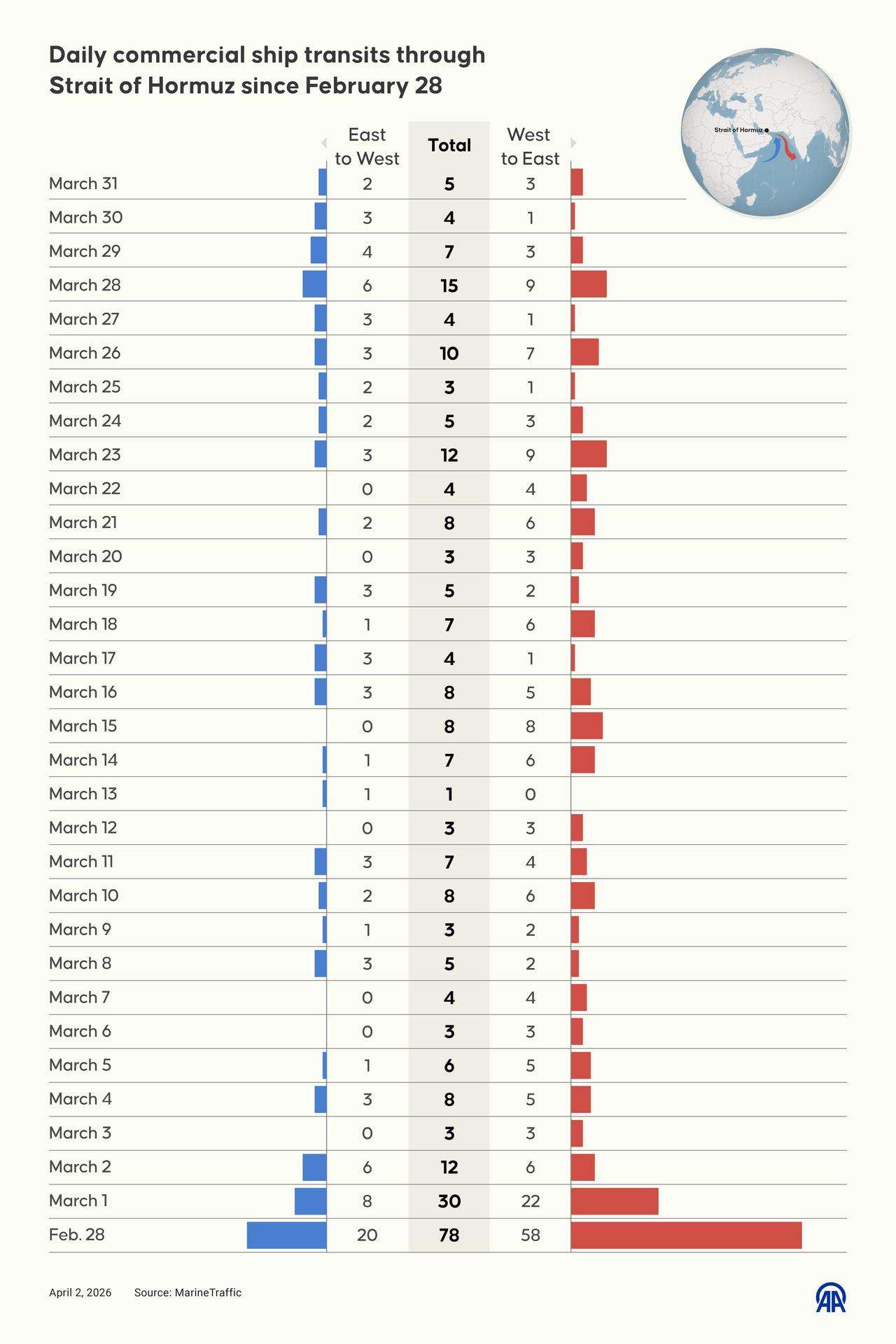
The Strait of Hormuz handles around 20% of global oil trade. Tanker traffic has slowed sharply, with crossings dropping to zero on some days and overall traffic declining by more than 90%.
The daily transport of 15 million barrels of crude oil through Hormuz is now at risk, while rising insurance costs and security concerns are putting additional pressure on shipments.
 2 min read

Meanwhile, a total of 220 vessels transited the Iranian-controlled Strait of Hormuz in March, with liquid tankers accounting for more than half of all crossings, according to data shared by MarineTraffic and Kpler on Friday.
MarineTraffic said on the U.S. social media company X that 111 of the crossings, or 51% of the monthly total, were made by liquid tankers, followed by 82 dry bulk vessels, or 37%, and 27 LPG carriers, or 12%.
No LNG crossings were recorded during the month, the data showed.
Traffic through the strategic waterway remained heavily tilted toward west-to-east movements out of the Gulf, which totaled 149 crossings, or 68% of the monthly volume.
East-to-west transits into the Gulf stood at 71, or 32%, pointing to an uneven traffic flow through one of the world’s most critical maritime chokepoints.


 Set as preferred source
 Set as preferred source


 1 min read