Newsletters


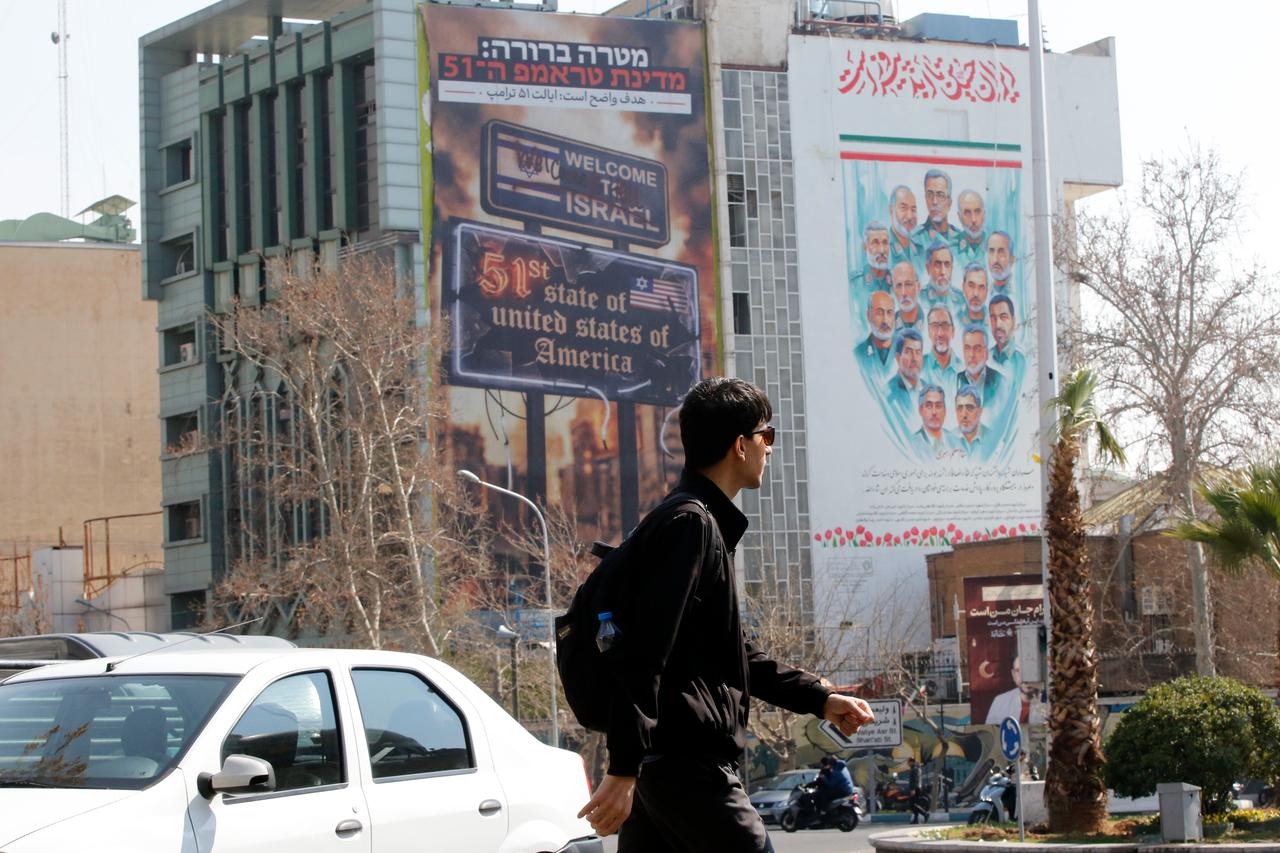


Iran has submitted a draft proposal to the United States through Omani mediators ahead of a new round of indirect nuclear talks in Geneva, describing the move as a practical test of Washington’s commitment to diplomacy, Iranian state media reported Thursday.
The state-run news agency IRNA said the proposal was delivered to the U.S. side via Oman as Iranian and American delegations prepared for a third round of negotiations scheduled for later Thursday, Feb. 26, at Oman’s embassy in Geneva.
“Rejecting it would amount to confirming the initial suspicion that the United States is not genuinely committed to diplomacy and that its diplomatic posture is merely a game,” IRNA reported, without disclosing details of the proposal.


Iranian Foreign Minister Abbas Araghchi arrived in Geneva late Wednesday accompanied by a delegation that includes his deputy for political affairs, Majid Takht-Ravanchi, along with nuclear, legal and economic experts.
Shortly after his arrival, Araghchi met with Omani Foreign Minister Badr al-Busaidi to discuss the framework of the talks and the draft proposal to be presented to the U.S. side.
According to Iranian media, Araghchi stressed during the meeting that the success of the negotiations depends on “seriousness from the other side” and avoiding “contradictory behavior and positions.”
Oman’s Foreign Ministry said the two diplomats reviewed views and proposals that the Iranian delegation plans to present with the aim of reaching an agreement.
U.S. envoy Steve Witkoff also met with Busaidi after arriving in Geneva on Thursday morning, according to media reports, to exchange views and receive the Iranian draft proposal.
Ahead of his departure, Araghchi said Iran would resume talks “with a determination to achieve a fair and equitable deal in the shortest possible time.”
He said the new round would be based on understandings reached during previous talks in Muscat and Geneva, calling the process “a historic opportunity to strike an unprecedented agreement.”
Following the previous round on Feb. 17, both sides said they had agreed on guiding principles for a potential deal.
The talks come amid a significant U.S. military buildup in the Persian Gulf and after a series of military drills by Iran’s Islamic Revolutionary Guard Corps.
Meanwhile, a new poll showed limited confidence among Americans in President Donald Trump’s handling of military force abroad.
According to a survey conducted by the Associated Press and the NORC Center for Public Affairs Research between Feb. 19 and 23, 56% of respondents said they had “very little” or “no confidence at all” that Trump would make the right decisions on the use of military force outside the United States. Only 27% said they had a great deal of confidence.
The poll of 1,133 adults also found that 55% of respondents do not trust Trump to make the right decisions in relations with U.S. adversaries, while 28% said they do.
On Iran, 48% of respondents said they are extremely concerned that Tehran’s nuclear program poses a direct threat to the United States, while 31% said they are somewhat concerned. About 61% described Iran as an enemy of the U.S., up from 53% in a similar poll conducted in September 2023.
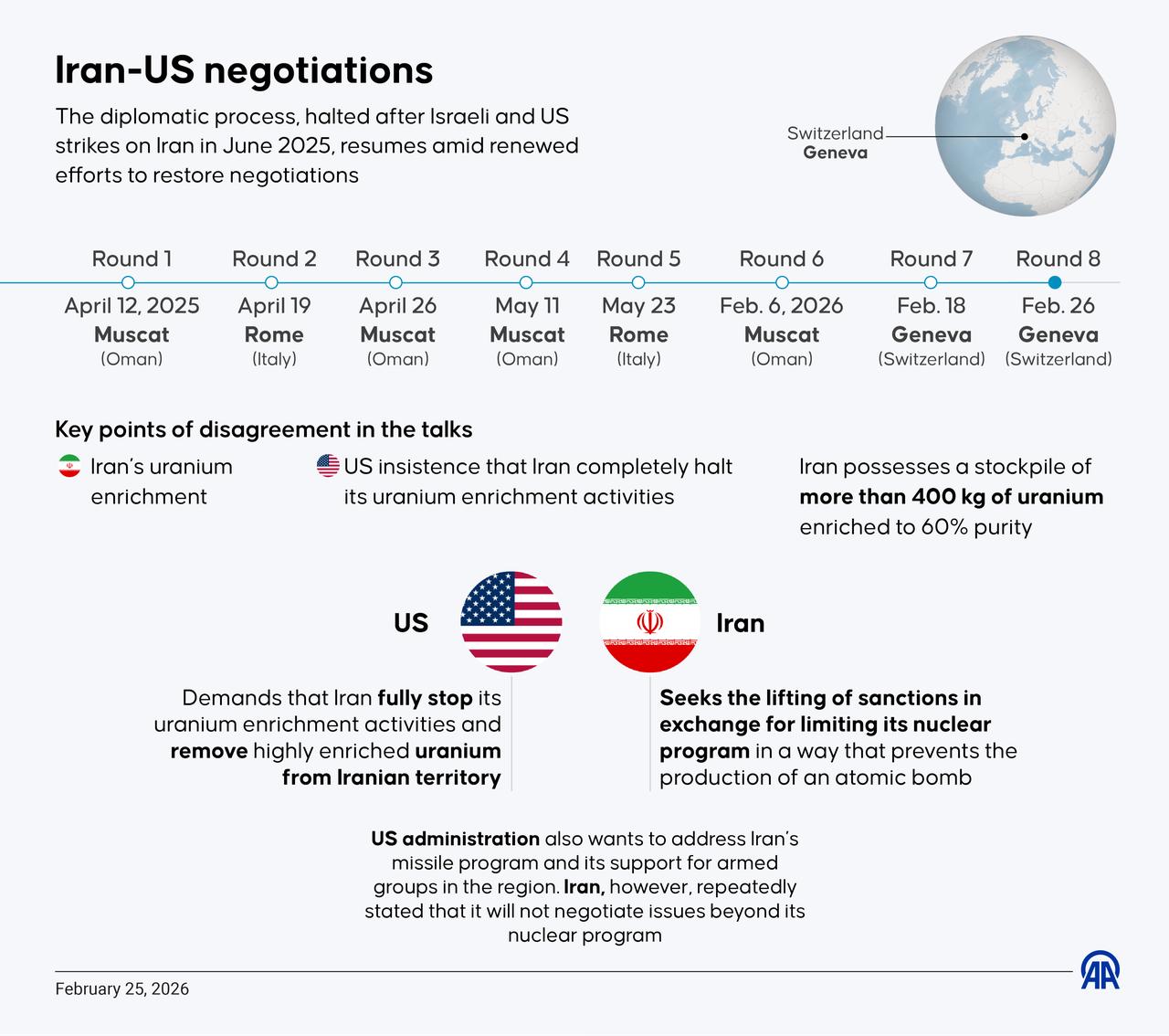
Indirect nuclear negotiations between Tehran and Washington were revived after being disrupted by Israeli and U.S. strikes on Iran in June 2025.
The talks resumed through mediation led by Oman, with diplomatic support from regional countries including Türkiye.
Iran and the U.S. first met in Muscat on Feb. 6, followed by a second round in Geneva on Feb. 17. The current round is scheduled for Feb. 26.
Iran is seeking the lifting of sanctions in exchange for limits on its nuclear program that would prevent the production of a nuclear weapon. The United States is demanding that Iran halt uranium enrichment and remove its stockpile of highly enriched uranium.
Key issues include the cap on enrichment levels, the status of roughly 440 kilograms of uranium enriched to 60%, the timeline for sanctions relief, and verification mechanisms.


 Set as preferred source
 Set as preferred source


 2 min read
 1 min read