Newsletters


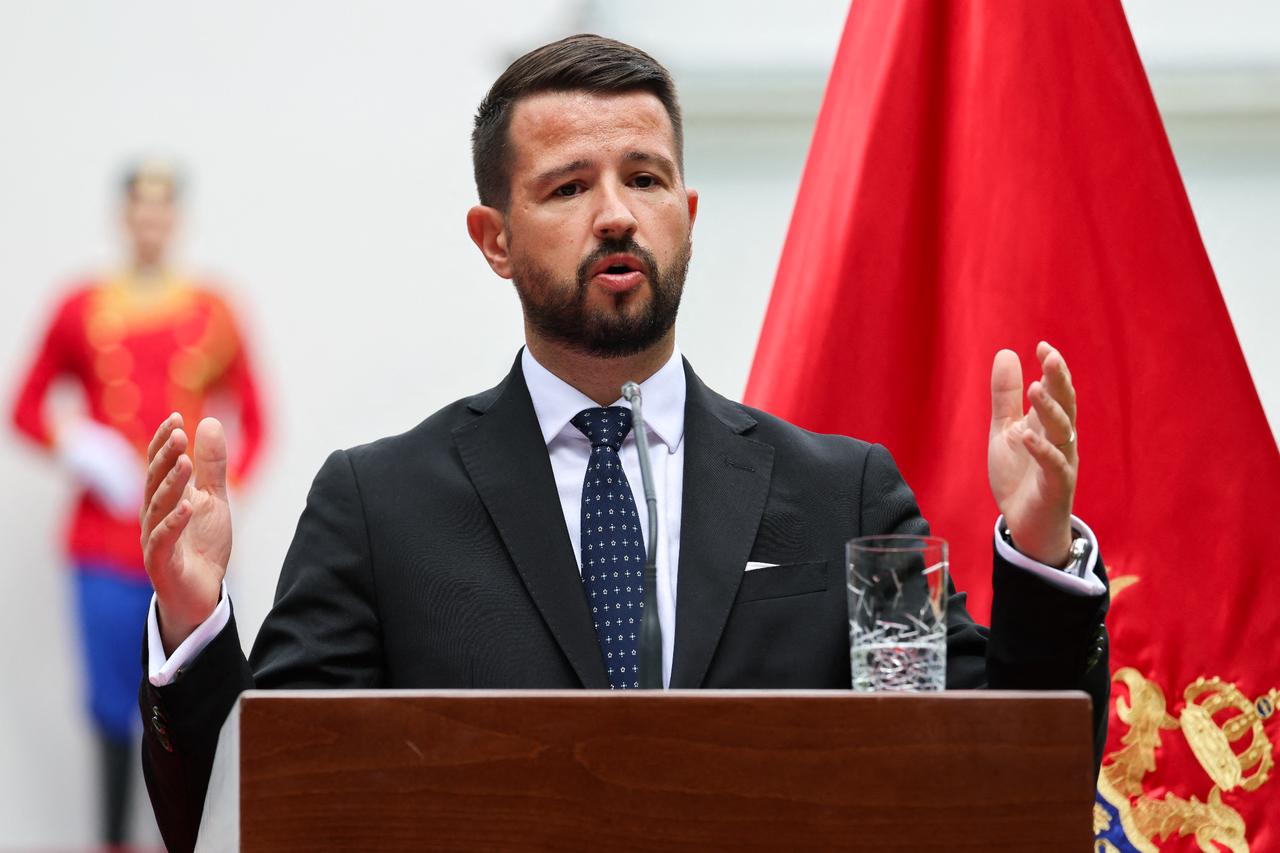


Montenegrin President Jakov Milatovic’s office said Friday that he had called a meeting of the heads of the country’s security sector and the Defense and Security Council after Prime Minister Milojko Spajic alleged that Montenegro faces “hybrid threats” from two neighboring countries.
Spajic claimed that officials from at least two countries in the region were involved in coordinated activity aimed at destabilizing Montenegro and undermining its path toward European Union membership.
Milatovic’s office said security chiefs would be asked to provide precise information on Spajic’s allegations, as well as a comprehensive assessment of the country’s security situation.
Spajic said Thursday that Montenegro had “serious operational security information” indicating that threats would accompany the country’s expected progress in opening new EU negotiating chapters.
Montenegro is currently seen as the frontrunner among Balkan states to become the next EU member.
“We have serious security operational information that the announced closure of new negotiating chapters will be accompanied by coordinated hybrid action, involving officials from at least two countries from the region,” Spajic said Thursday.
“According to our knowledge, such activities are aimed at destabilizing Montenegro, with the expected support of certain political actors and part of the media scene in our country,” he said in a post on X.
Spajic did not publicly specify which neighboring countries he was referring to.
However, Montenegrin newspaper Vijesti reported Friday that Serbia and Albania were the two countries referenced by Spajic.
The newspaper quoted an unnamed source as saying that some key actors in the region were unhappy with Montenegro’s rapid progress toward European integration and wanted to slow it down.
Another anonymous source quoted by Vijesti claimed that a senior government official was vulnerable because of compromising information that could be used by foreign powers.
The source suggested that the official’s political party could leave the ruling coalition as a result.
Milatovic’s office said the president was concerned by the reports and that “the public has the right to know which official this is.”
However, it added that serious security issues should not be used to score political points.
“Issues concerning the security and stability of the state must be addressed responsibly, based on facts and through the institutions of the system,” the office said.
Albania’s Minister for Europe and Foreign Affairs Ferit Hoxha rejected suggestions that his country was part of any “destabilizing scenario” in Montenegro.
Posting on X, Hoxha said the allegations could not “artificially create problems between our two countries.”
“Although no formal accusations have been articulated against Albania, I wish to state clearly and strongly that Albania is not, and cannot be, part of any destabilizing scenario, whether in Montenegro—a neighbor, friend, partner and NATO ally with whom we share the same EU membership goal—or anywhere else,” he wrote.


 Set as preferred source
 Set as preferred source


 2 min read

 1 min read