Newsletters


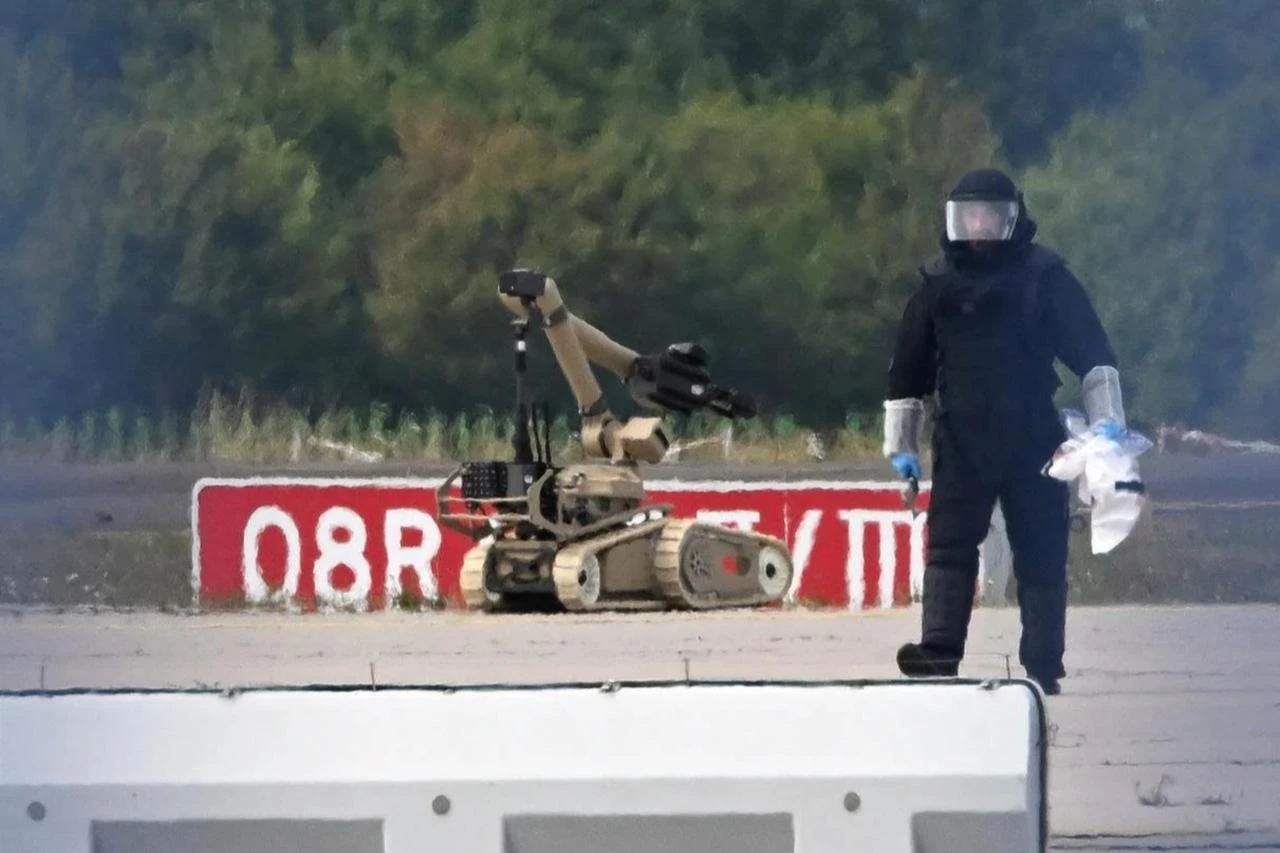


Leipzig Airport came closer to a catastrophic explosion earlier this week than previously disclosed, according to newly reviewed security camera footage cited by the German newspaper Die Zeit. The footage indicates that an armed drone did not merely hover near a parked cargo aircraft, as initially understood, but struck one of its wings directly before falling to the ground.
The incident occurred on the night leading into Wednesday, when an armed drone was discovered on the grounds of the airport near an Antonov-brand cargo aircraft, a type of plane used to transport military materiel to Ukraine, among other cargo. The device was a quadcopter roughly the size of a microwave oven, fitted with four rotors and carrying the explosive Semtex.
According to Die Zeit's reporting, most of the airport grounds are covered by security cameras, and footage from those cameras has now been analyzed by investigators. The video reportedly shows that at around 7:30 p.m. on Tuesday, an object flew directly toward the parked Antonov aircraft and struck one of its wings.
Wings are considered especially sensitive parts of an aircraft because they typically house fuel tanks, and are a common target for anyone seeking to detonate an explosive device aboard a plane. In this case, however, the object appears to have bounced off the wing and fallen to the ground; marks on the wing are said to support this account.
It remains unclear why the explosive device did not detonate.
The drone was not discovered until roughly four hours later, when it was noticed by chance by the driver of a tourist group's bus.
Earlier accounts, including one given by Bundestag member Detlef Seif of the Christian Democratic Union (CDU) after an official briefing on Thursday, had suggested the driver kicked the device before later pinning it to the ground.
The newly reviewed footage instead indicates the drone was already lying on the ground when the driver approached it. After a brief hesitation, he placed his foot on the device and alerted airport security.
The footage has also revised understanding of where the explosive itself was located. Rather than being found attached to the drone, as previously reported, the explosive charge was discovered some distance away, possibly having detached from the device on impact with the aircraft.
Germany's Federal Criminal Police Office, the BKA, took over the investigation over the weekend. Investigators say the footage offers new clarity on how the drone approached the aircraft, not cautiously, but in a manner consistent with an intent to cause damage.
That finding has weakened one of the earlier investigative hypotheses, that the drone may have been intended merely as a warning rather than a functioning weapon.
Federal Interior Minister Alexander Dobrindt, a member of the Christian Social Union (CSU), cut short his vacation to travel to Leipzig on Wednesday.
While there, he described the incident as part of a "hybrid attack scenario" involving "foreign powers," language that is commonly understood in Germany as an allusion to Russia, without naming the country directly.
That reticence drew criticism from Konstantin von Notz, a Bundestag member and security policy spokesman for the Green Party, who said the government needed to "make clear where all the traces lead, and clarify that such operations will have clear consequences."
Investigators have not yet found clear evidence directly linking Russia to the incident. However, several details point to a highly professional operation.
The drone was reportedly not purchased commercially but custom-built in a manner investigators say would be beyond the capability of casual criminals or hobbyists.
Because it was a non-commercial device, it was not detected by conventional radar systems. The Semtex explosive it carried is powerful enough that it could plausibly have caused the aircraft to explode; while occasionally available on the black market, it is normally associated with military use. As a result, investigators now consider it more likely that a state actor was involved in some capacity.


 Set as preferred source
 Set as preferred source


 2 min read
 1 min read