Newsletters


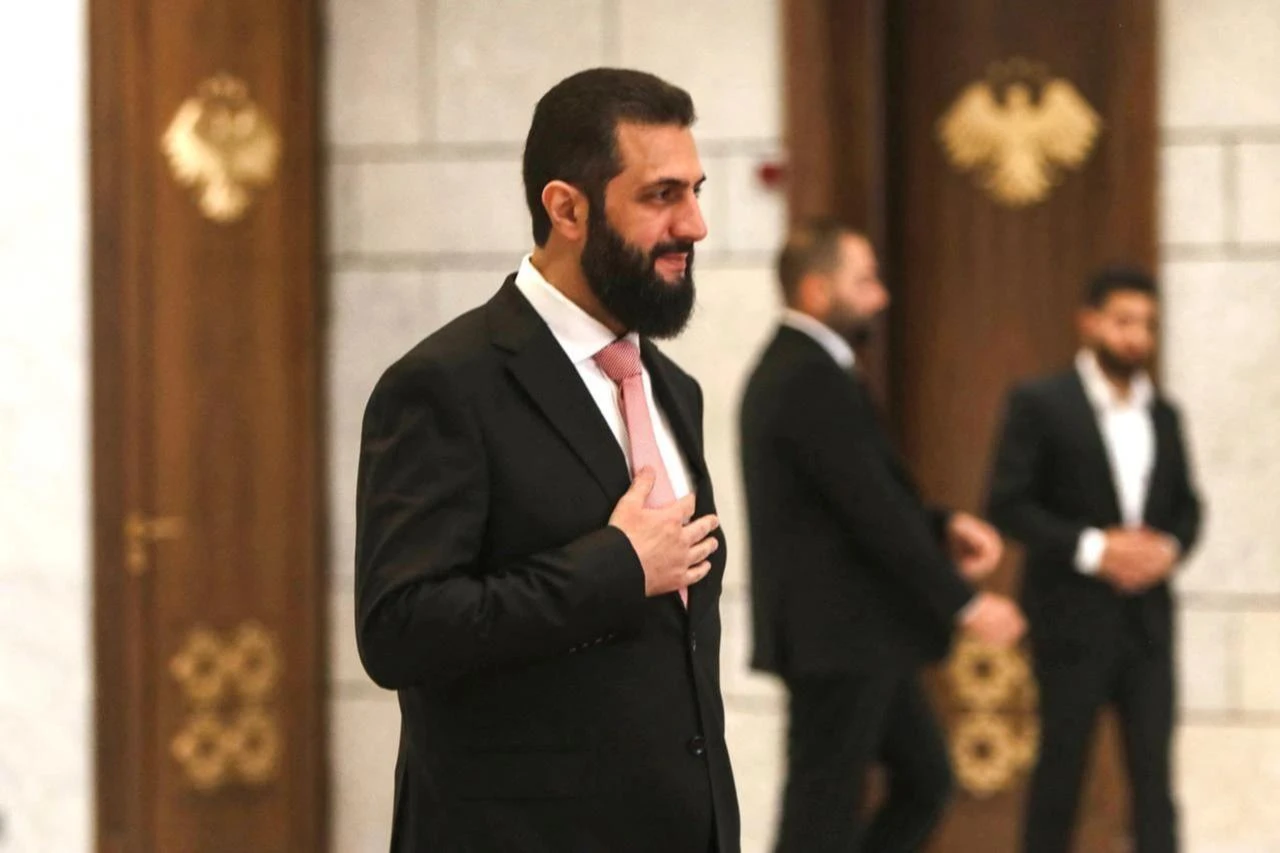


Syrian President Ahmad al-Sharaa said the removal of the former regime was a historical necessity not only for Syria but for the entire region, describing his country as a civilizational crossroads shaped by seven thousand years of diversity.
In an interview with the Qatar-based Al Jazeera network, Sharaa offered an unusually personal account of his political formation, tracing his sense of belonging to the Golan Heights to conversations within his family and community from childhood onward.
Sharaa said he was shaped by Arab nationalist discourse that addressed the concerns of Arab peoples, while also finding common ground between that tradition and Islamic discourse.
He drew a careful distinction between Islam as a faith and the varied historical experiences that have emerged in its name.
"We separate Islam from Islamic experiences, which contain different ideas and interpretations," he said.
He described Syria as a key state in the region, one whose transformation carried consequences well beyond its borders.
Shara said he drew on multiple intellectual and political traditions as he moved toward action, and that he worked to organize efforts to bring down the regime from inside Damascus itself.
He stressed that his movement received no external support throughout the process, operating under siege and intense pressure.
"While we focused on the military dimension in fighting the ousted regime, we simultaneously carried out preparations for the reconstruction process," he said, describing a deliberate parallel effort to plan for governance even as the conflict continued.
Despite operating under severe constraints, Shara said his movement gave simultaneous attention to reconstruction and economic planning alongside the armed struggle, treating postwar governance not as an afterthought but as an integral part of the campaign.
He added that communicating the work being done in Idlib and other areas formerly under opposition control to the international community was a priority, and that his movement used media organizations and visiting delegations to carry that message abroad.
Shara framed Syria's multiconfessional and multiethnic character not as a source of fragility but as the foundation on which the new order must be built, pointing to the country's seven-thousand-year history of coexistence as a resource rather than a liability.
"The removal of the former regime was necessary not only for Syria but for the entire region," he said.


 Set as preferred source
 Set as preferred source


 1 min read

 1 min read