Newsletters


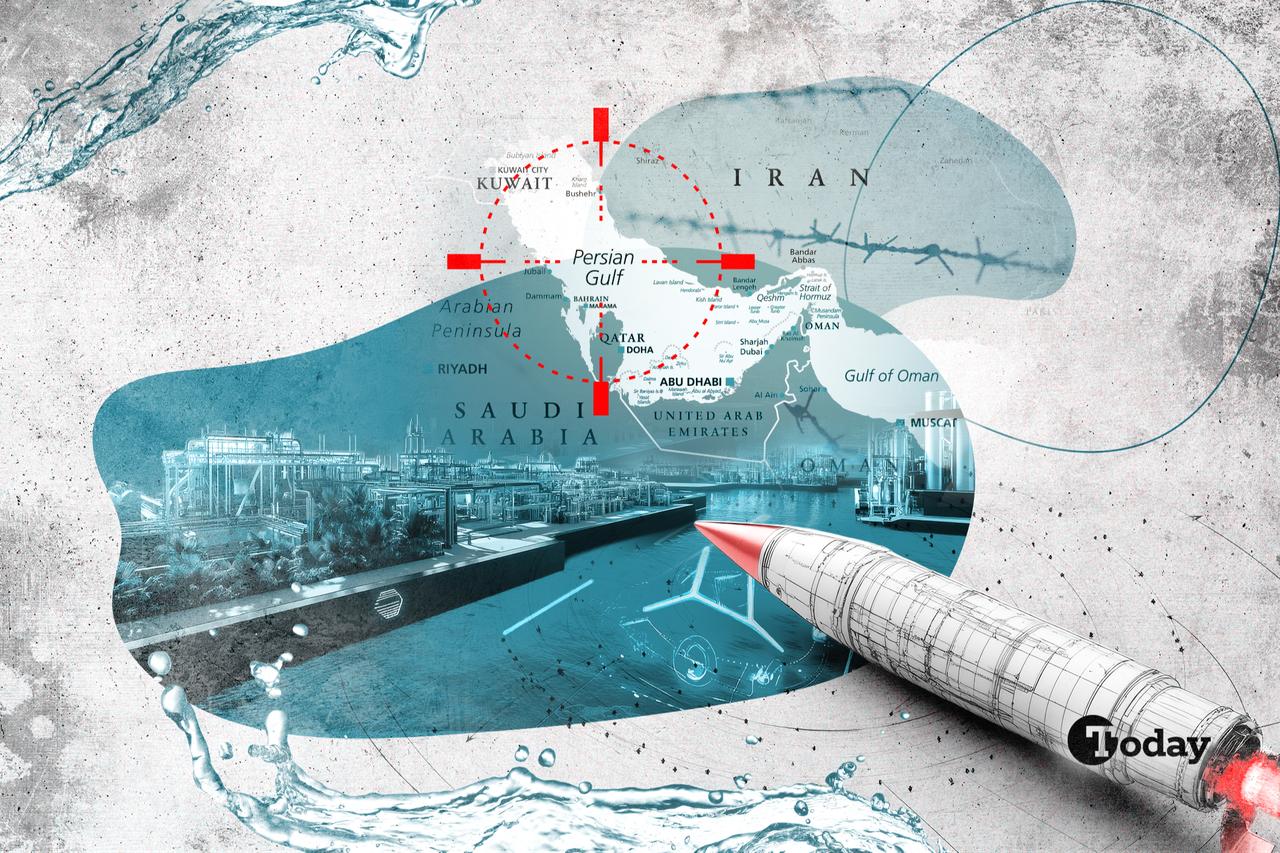


Operation Epic Fury is my third Gulf War, so let me assure those of you who are new to the territory that night falls fast on the Persian Gulf, regardless of what American and Israeli politicians say on television.
The West, for decades, has guaranteed that the lights along the petroleum-rich shorelines of Dubai, Doha, and Kuwait City glitter like an Atlantic City casino owner’s smile—bright, confident, always masking the odds.
But the real revenue of those regions is not cultivated in the Saudi oil port in Ras Tanura, or the Burj Al Arab hotel in Dubai, or the I.M. Pei-designed Museum of Islamic Art in Doha. Their income sits low against the waterline in miles of pipes, turbines, and humming steel: desalination plants, the machines that turn seawater into life.
In the Gulf, freshwater is manufactured.
Oil burns. Water disappears.
In military briefings, analysts talk about missiles, drones, and naval fleets. But there’s another chart in the room. U.S. and Israeli officials have never been fond of reporters who ask about the map dotted with desalination plants along the Gulf coast.
Every one of them is a target.
Across the states of the Gulf Cooperation Council—Saudi Arabia, the United Arab Emirates, Kuwait, Qatar, Bahrain, and Oman—more than 400 desalination plants operate, forming the largest concentration of desalination infrastructure on Earth. These installations collectively produce roughly 15.9 million cubic meters of freshwater every day, a volume that translates to about 5.8 billion cubic meters a year—more than enough to fill millions of Olympic pools and supply tens of millions of people who live in some of the driest terrain on the planet.
For many of these countries, the numbers are existential. About 90% of Kuwait’s drinking water, 86% of Oman’s, 70% of Saudi Arabia’s, and roughly 42% of the United Arab Emirates’ water comes from desalination plants that draw life from the Gulf and the Red Sea.
Oil runs their economies. But water runs their lives. And that makes the desalination plants the most vulnerable strategic targets in the Middle East.
Military planners have long understood that the Gulf’s water infrastructure is its Achilles’ heel. During the 1991 Gulf War, a senior Arab diplomat described the vulnerability in stark terms: destroy the desalination plants, and the cities “become unlivable within days.”
Even the prospect of contamination of the Gulf’s waters has alarmed officials. Qatar’s prime minister, Sheikh Mohammed bin Abdulrahman Al Thani, warned that regional conflict affecting the Gulf’s waters could leave the region with “no water, no fish, nothing… no life.”
It’s a chilling phrase because the geography makes the threat plausible. Most of the desalination plants sit right on the coastline, clustered along narrow stretches of the Gulf. The intake pipes that pull seawater into their membranes are easy to map and easier still to sabotage.
If Iran truly intends to apply pressure on the Gulf states, it doesn’t need to strike oil terminals and luxury hotels. Hit the desalination plants. The math is lethal. The destruction is more than an inconvenience. It would trigger a cascading crisis.
Within days, municipal water systems collapse. Hospitals would ration water for surgery and sterilization. Power plants—many of which depend on desalinated water for cooling—shut down.
Food imports pile up in ports because distribution networks depend on electricity and water. Sanitation systems fail. Cities like Dubai or Doha—global hubs built in deserts—could not sustain their populations without desalinated water. Tens of millions of residents are now dependent on emergency shipments of bottled water or water tankers.
The Gulf would face a modern form of siege warfare.
And unlike oil fields, desalination plants cannot easily be replaced or repaired overnight. They are billion-dollar complexes with specialized membranes, turbines, and pipelines. Even temporary shutdowns can cripple supply chains.
In strategic terms, these plants are the infrastructure equivalent of aircraft carriers—expensive, irreplaceable, and highly visible.
This is no Chicken Little scenario. There is precedent for targeting water infrastructure in the Gulf. I was there to see it happen.
During the 1991 Gulf War, Iraqi dictator Saddam Hussein ordered the destruction of key infrastructure in Kuwait as his forces retreated, sabotaging oil wells and damaging water facilities, including desalination plants. The aim was simple: leave a wasteland behind and make recovery slow and costly.
Kuwait’s experience illustrated a brutal truth. Oil fires blackened the sky, but it was the damage to water infrastructure that threatened an immediate humanitarian crisis. The country had to scramble to repair plants and import water while engineers restored production.
Three decades later, the stakes are far higher. Gulf populations have multiplied, cities have exploded outward, and dependence on desalination has only deepened.
Politicians are fond of saying that oil defines the geopolitics of the Persian Gulf. Tankers, pipelines, embargoes, the chess pieces of power. Sure, oil is wealth. Water is existence and, ultimately, the only resource that determines survival.
The irony is that oil made desalination possible in the first place. Cheap energy powered the massive thermal plants that boiled seawater into a fresh supply. In Saudi Arabia alone, hundreds of thousands of barrels of oil per day have historically been used to fuel desalination operations.
Oil created the modern Gulf states. Water keeps them alive. The mullahs of Iran know this.


 Set as preferred source
 Set as preferred source



 3 min read