Newsletters


An image showing what appears to be an Iranian missile marked with the phrase “In memory of the victims of Epstein Island” has circulated widely on social media as the war involving Iran, the United States, and Israel continues to generate competing narratives online.
The image began spreading on March 10 after being shared by Iranian media, placing one of the most controversial scandals in recent American history directly into the imagery surrounding the conflict.
The inscription refers to Jeffrey Epstein, the American financier who died in 2019 while awaiting trial on sex trafficking charges. His case has returned to public debate following the release of additional documents tied to the investigation.
The authenticity of the missile image itself has not been independently verified, and it is possibly AI-generated.
However, its rapid spread reflects how the Epstein scandal has entered the broader political messaging surrounding the war and the competing attempts to frame it.
References to Epstein had already appeared in Iran’s political messaging weeks before the image began circulating.
In remarks delivered in mid-February, Iran’s Supreme Leader sAli Khamenei described Epstein’s private Caribbean island as evidence of Western moral corruption, calling it “a stark example of the essence of Western civilization and liberal democracy,” as reported by Chosun.
He argued that the scandal exposed deeper problems within Western political systems and said the island was only “one example” of broader corruption, as reported by Chosun.
Similar symbolism appeared again in early March.
A graphic shared through an X account associated with Khamenei depicted a large file labeled “Epstein” floating like an island in the sea. The design resembled both a dossier and a U.S. aircraft carrier positioned near the Persian Gulf.
A red tie emerging from the file appeared to reference U.S. President Donald Trump. The imagery suggested that Western military actions in the region could be intended to shift attention away from the Epstein scandal, though no evidence has been presented to support that claim.
At the same time, recently released documents connected to the Epstein investigation have also drawn attention to Iran.
Among the materials is an email written by evolutionary biologist Robert Trivers referring to a meeting between Epstein and former Iranian President Mahmoud Ahmadinejad in New York following one of Ahmadinejad’s speeches at the United Nations.
Ahmadinejad’s former media adviser, Ali Akbar Javanfekr, rejected the claim and said such a meeting “never took place,” as reported by Iran International.
Other correspondence in the documents involves Iranian businessman Alireza Ittihadieh, a private jet broker who exchanged emails with Epstein between 2014 and 2018. Their early exchanges focused on arranging flights for Epstein and his associates, but later included discussions about developments inside Iran and U.S. policy toward Tehran.
In one message discussing political developments, Epstein wrote that conditions would worsen before improving.
Some claims circulating around the Epstein files extend further back in time.
Statements attributed to Epstein’s former associate Steven Hoffenberg allege that Epstein became involved in arms trading networks connected to Iran during the early 1980s through Chinese weapons exports during the Iran-Iraq war.
These allegations appear in the book "A Nation Under Blackmail" and remain disputed. The claims form part of a broader set of narratives linking Cold War financial networks, intelligence operations, and arms trafficking.
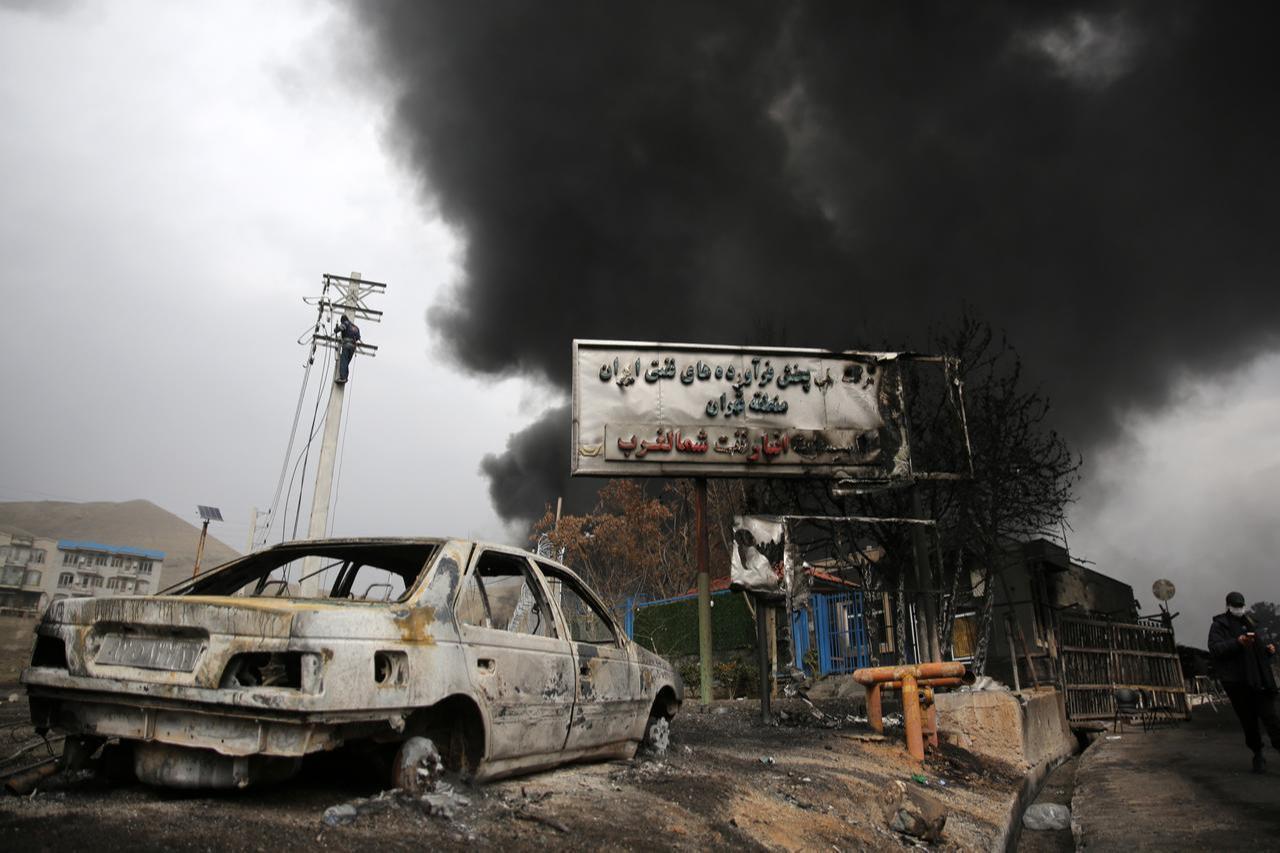

The information struggle surrounding the conflict has intensified as political messaging from multiple sides continues to evolve.
Speaking to reporters on March 10, U.S. President Donald Trump said the United States had made “major strides toward completing our military objective” in Iran but also suggested further action could follow.
At one point, he described the campaign as nearly complete, while later indicating that the United States could still “go further,” as reported by NPR.
Meanwhile, Iranian officials have framed the conflict as foreign aggression and warned that continued attacks would be met with retaliation.
The viral missile image spread quickly across social media as narratives about the war continue to clash online. While its authenticity remains unclear, this incident also documents the growing role of AI-generated imagery in the digital information battle surrounding the conflict.
What was written on the Iranian missile, we may never know.


 Set as preferred source
 Set as preferred source


 3 min read