Newsletters


The media tends to frame immigration through the lens of hardship—displacement, discrimination, and disadvantage. Vulnerable communities are cast as victims, and the narrative rarely ventures beyond that.
But not every story fits that template. Erkut Sogut, who currently serves as Chief of Soccer Operations at DC United in Major League Soccer, is a case in point.
The son of Turkish immigrants who settled in Hannover, Germany, he has built a career spanning sports law, football agency, academic lecturing, and executive leadership in American professional soccer, and he attributes part of that trajectory directly to his background as an immigrant child.
"Being an immigrant, you actually start 2-0 up," he said in an interview with Türkiye Today. You grow up in two cultures, and you usually know two languages. You know two different cultures. It's being richer—through culture and through language."
For Sogut, the multicultural upbringing that others might frame as a source of confusion or disadvantage was, in practice, a competitive edge—one he has drawn on at every stage of a career that has taken him from a student flat in Germany to a private jet with football star Mesut Ozil and from a bus stop in Düsseldorf to the executive offices of a Major League Soccer club.
Sogut was born in 1980 in Hannover to parents who had left the small Anatolian town of Topakli in Nevsehir.
His father worked in a factory. His mother cleaned offices and private homes, rising as early as 3:30 in the morning to hold down two jobs at once. The neighborhood was populated almost entirely by immigrant families in similar circumstances.
By the time he was 11 or 12, Sogut had begun to understand what that daily routine cost his mother. It was not a realization that produced resentment; it produced resolve.
"You see that in your life and you say you have to reach the best place for that mother," he has said. He made himself a private promise: one day, he would call her and tell her she would never have to work again. He lived that day.
His father placed enormous value on education above all else. While neighbors talked about saving money, the Sogut household operated on a different principle: the best school, the best education, whatever it took.
Sogut struggled with a significant stutter throughout his school years, severe enough that he avoided raising his hand in class.
At the end of tenth grade, his teacher went through the class one by one, offering career guidance. When she reached Sogut, she told him in front of all his classmates to become a car mechanic, handing him a list of apprenticeship programs. The reason is that he could not speak.
He had, in fact, earned the academic grades to continue to the Gymnasium—Germany's selective secondary track, which roughly 80 percent of students do not qualify for. He went anyway. Eight students from his class made the transition. Only three graduated. Sogut was one of them.
He describes the teacher's words not with bitterness but as a catalyst. That same day, he decided he would no longer allow the stutter to define him.
He began raising his hand in class, initiating conversations, and placing himself deliberately in situations that required him to speak. The stutter receded. The habit of confronting discomfort stayed.
His father's preferred career paths were doctor or lawyer. Sogut had no appetite for medicine, so he constructed a compromise: study law, pursue a doctorate, and become a university professor.
He moved to a new city, left his mother's cooking and the comfort of home behind for the first time, and began.
While studying, he identified a prominent sports agent and arranged a five-minute meeting through a mutual contact—a former classmate working as the agent's secretary.
He took a two-hour train journey for the appointment, his tie slightly crooked. The agent was unmoved. The meeting ended almost as soon as it started.
At the door on his way out, Sogut turned and told the agent he would make him a better agent. The agent later admitted he had laughed it off entirely.
On the train home, Sogut devised a plan.
Once a month, he would produce a professional briefing document for the agency—practical, specific intelligence on topics like regional tax differences across football markets—print it at a copy shop, travel to the office, and leave it with the secretary. He did this for six months without a single response.
In the seventh month, the agent called. He had a legal dispute with the Turkish Football Federation and needed a formal response prepared. Sogut, at that point a six-month law student who had never seen the inside of a courtroom, said yes.
He worked nights and weekends. They won. The agent pointed to a door and told him it would always be open. Sogut worked there for years—unpaid, while waitering on the side—and eventually declined a salaried partnership offer, telling the agent his goal was a professorship and that he needed to keep moving, but he took what he wanted from there: to witness and to learn firsthand.
A licensing exam training course Sogut launched in Istanbul brought him unexpected visibility within Turkish football circles. A call came while he was touring the law library at Oxford. Mustafa Ozil, father of German international Mesut Ozil, had found his website and wanted him to train the staff at their management office in Germany.
For six months, Sogut traveled back and forth between his studies and the Ozil operation. When his master's degree ended, they offered him a full-time legal role. He accepted on one condition: the PhD continued.
For five years, he maintained both lives at once — doctoral student and legal representative for one of the world's most prominent footballers. The contrast between the two occasionally made itself felt in concrete ways.
After Mesut Ozil's transfer to Arsenal in London, Sogut found himself departing from a small private terminal at Luton airport, attended by pilots who carried the bags, boarding a jet for the hour-long flight to Dusseldorf. An hour after landing, he was at a bus stop, student travel card in hand, riding home.
"What a thing life is," he thought on the bus. "Just moments ago, I saw service on a private jet. Now back to student life." He did not find it demoralizing. He had chosen not to give up student life, and he did not.
In 2022, Sogut and his wife relocated to the United States with their two sons, Emre and Koray.
The family settled in California. His stated reason for the move was consistent with a goal he had carried since his teenage years in Germany: the road to a Harvard professorship ran through America.
His connection to football remained. He had known the ownership of DC United, the Washington-based Major League Soccer club, for roughly a decade.
When they asked him to help identify a new head coach, he found one in Switzerland. When they subsequently asked for a sporting director, he presented candidates they had passed on. Then came dinner at the club owner's home in Los Angeles and an offer he initially declined.
The owner did not want Sogut to find someone for the job. He wanted Sogut to take it. After conversations with his wife and his mother, he accepted.
The title is Chief of Soccer Operations. In a 30-club league, there are 30 such positions. He sits between ownership and every football-related department: the first team, youth academy, medical staff, and all recruitment activity, based in California, traveling to Washington as needed.
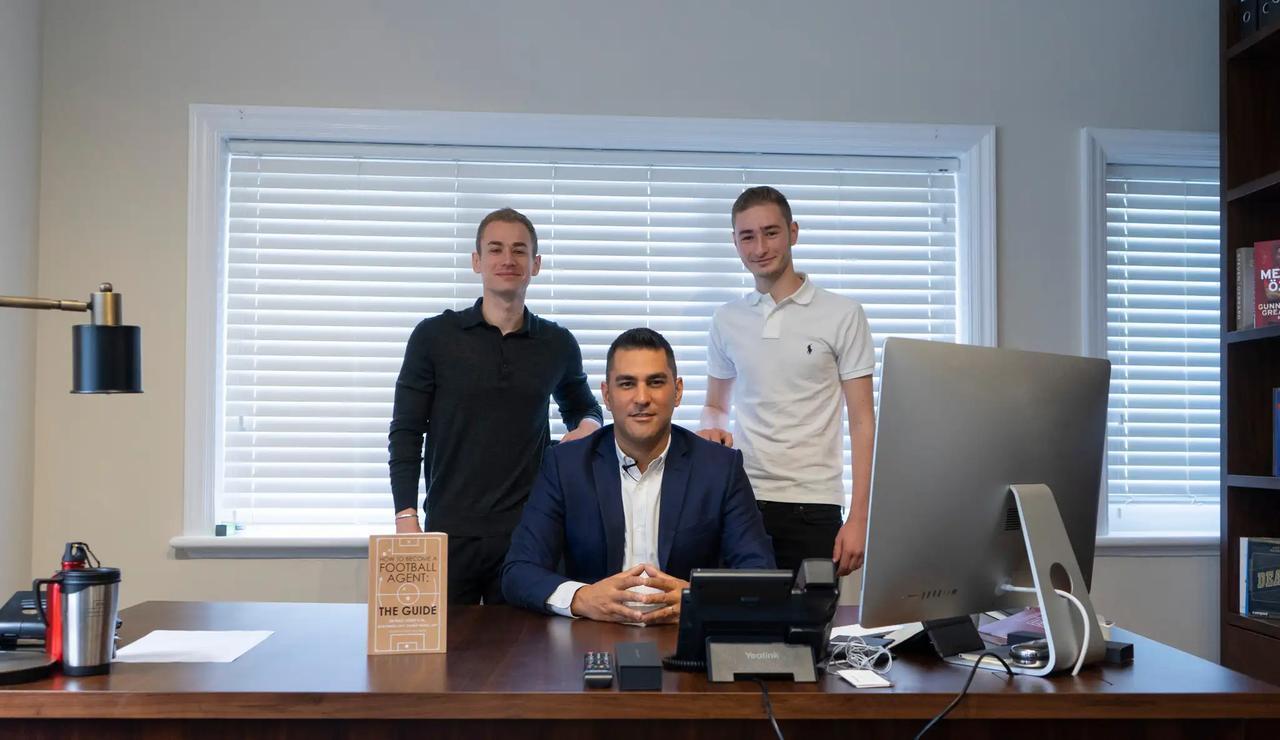

Sogut is straightforward about the edge his background as an agent gives him in running a club. "I know how agents act, I know what agents want, and I know when agents ask for certain things, why they do it. It's a big advantage, but it also helps me a lot to do deals because I understand them. I understand why an agent is asking for a certain thing because I was in that position."
On recruitment, his thinking has evolved beyond pure football ability. "Character scouting is getting more important every day," he said. "Sometimes it's not always about the best players in the world; sometimes it's about the best characters. You might have a football ability—there are areas you can develop—but changing characters is very difficult. Football ability, to a certain level, you might still develop if you're a young player. But changing character is very difficult. So character is very important for me."
Sogut credits his years living across Germany, Türkiye, India, England, and now the United States with giving him something that formal education alone could not provide: the ability to read people across cultures.
He sees Washington itself as a natural home for that worldview. "DC United's fans are from all over the world. We have fans from Central America, from South America. They sing in Spanish; they sing in English. Immigrants bring the passion from their countries into this country, and you can see that every weekend in stadiums throughout the United States."
For Sogut, that diversity is not a side note; it is central to what makes American soccer viable and growing.
"Immigrants built this country. They bring all their perspectives, their cultures, their foods, and their traditions, and that makes this country so rich. And I think immigrants play a big part in growing soccer in the United States."
Through all of it—the agent years, the transfer negotiations, the private jets and the bus rides, the courtrooms and the classrooms—one image has remained fixed.
Sogut has described it with consistent specificity: standing at a lectern at Harvard as a full professor, with his mother, father, siblings, wife, children, and closest friends flown in from around the world to attend his first lecture.
He has taught at Harvard Law School and Harvard Business School already. The professorship remains the endpoint he is building toward, one campus visit, one book chapter, and one transfer window at a time.
"I never said I couldn't do it, nor did I say I couldn't reach it," he has said. "I just don't know when I will arrive there."


 Set as preferred source
 Set as preferred source


 1 min read