How Türkiye’s 1923 jersey inspired its 2026 World Cup look
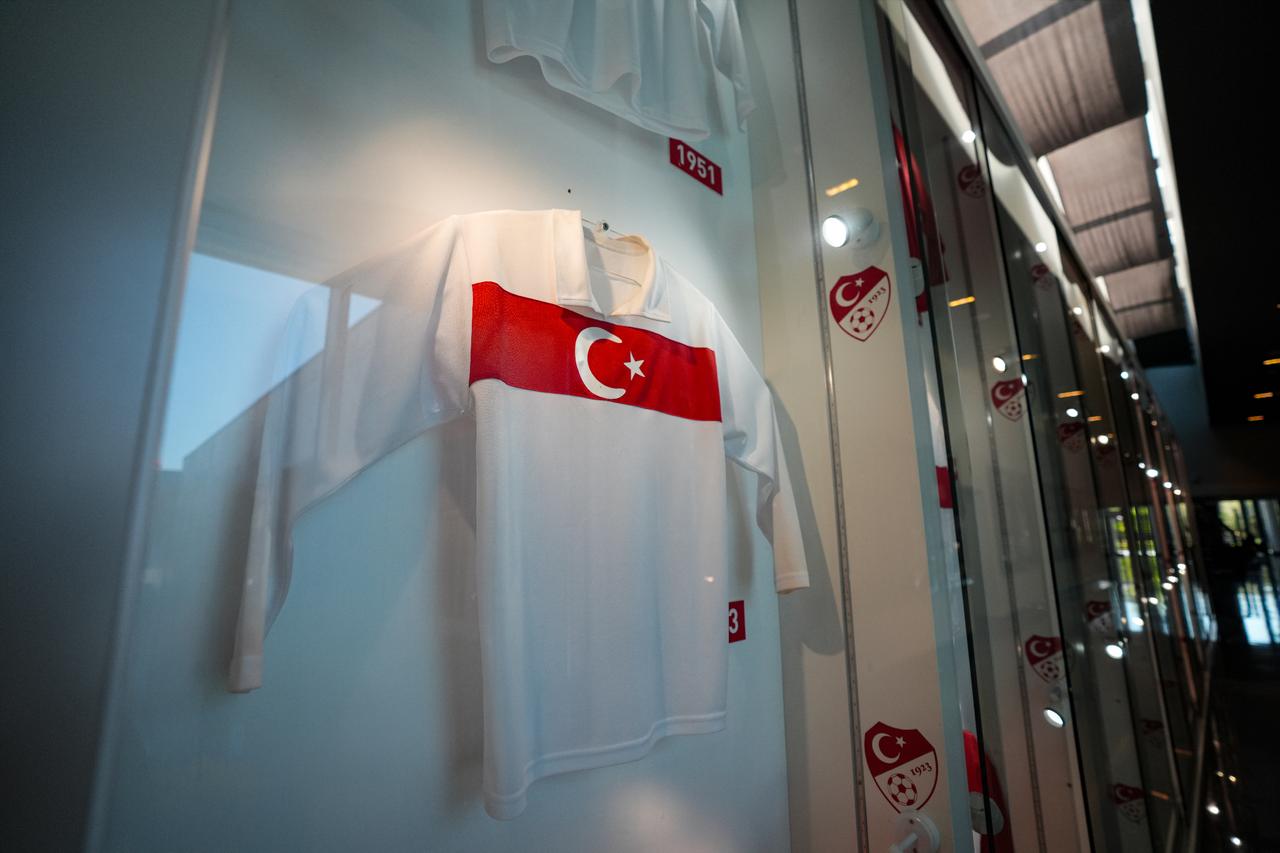
A classic white Türkiye national team jersey with the red crescent-star band is displayed as part of the national team’s jersey history exhibition. (AA Photo)
Türkiye’s national football team will return to the World Cup stage in 2026 wearing a jersey inspired by 1923, linking the squad’s new campaign in North America with the first match played just three days before the proclamation of the Republic.
The crescent-and-star jersey, known in Turkish as the ay-yildizli forma, has followed Türkiye through some of the defining moments of its football history.
From the hand-stitched red band used in the team’s first match against Romania in 1923 to the classic red-striped design prepared for the 2026 World Cup, the shirt has remained one of the strongest symbols of the national side.
Hand-stitched beginning before the Republic
Türkiye’s football federation was founded in 1923 under the name Futbol Heyet-i Muttehidesi, and the country became FIFA’s 26th member on May 21 that year.
On Oct. 26, 1923, three days before the Republic was proclaimed, Türkiye played its first official match against Romania at Taksim Stadium under coach Ali Sami Yen. The game ended 2-2, with Zeki Riza Sporel scoring the first goals in Turkish national team history.
The players wore a laced white shirt with a red band and crescent-and-star emblem sewn by hand on the chest. White shorts and black socks completed the look, setting up the visual identity that would later become one of the country’s most recognizable football designs.
World Cup debut delayed, then made in Switzerland
Türkiye qualified for the 1950 World Cup in Brazil but did not take part because of economic conditions and the long distance to the tournament.
The national team finally stepped onto the World Cup stage in Switzerland in 1954, facing Hungary, West Germany and South Korea in its group. Türkiye lost its opening match to West Germany, but Suat Mamat scored the country’s first World Cup goal in the red jersey with a white crescent-and-star band.
The team then beat South Korea 7-0, before losing a play-off match to West Germany. The 1954 tournament marked the first time Türkiye’s jersey was worn on the global football stage.
A classic white Türkiye national team jersey with the red crescent-star band is displayed as part of the national team’s jersey history exhibition. (AA Photo)
From Europe to the World Cup podium
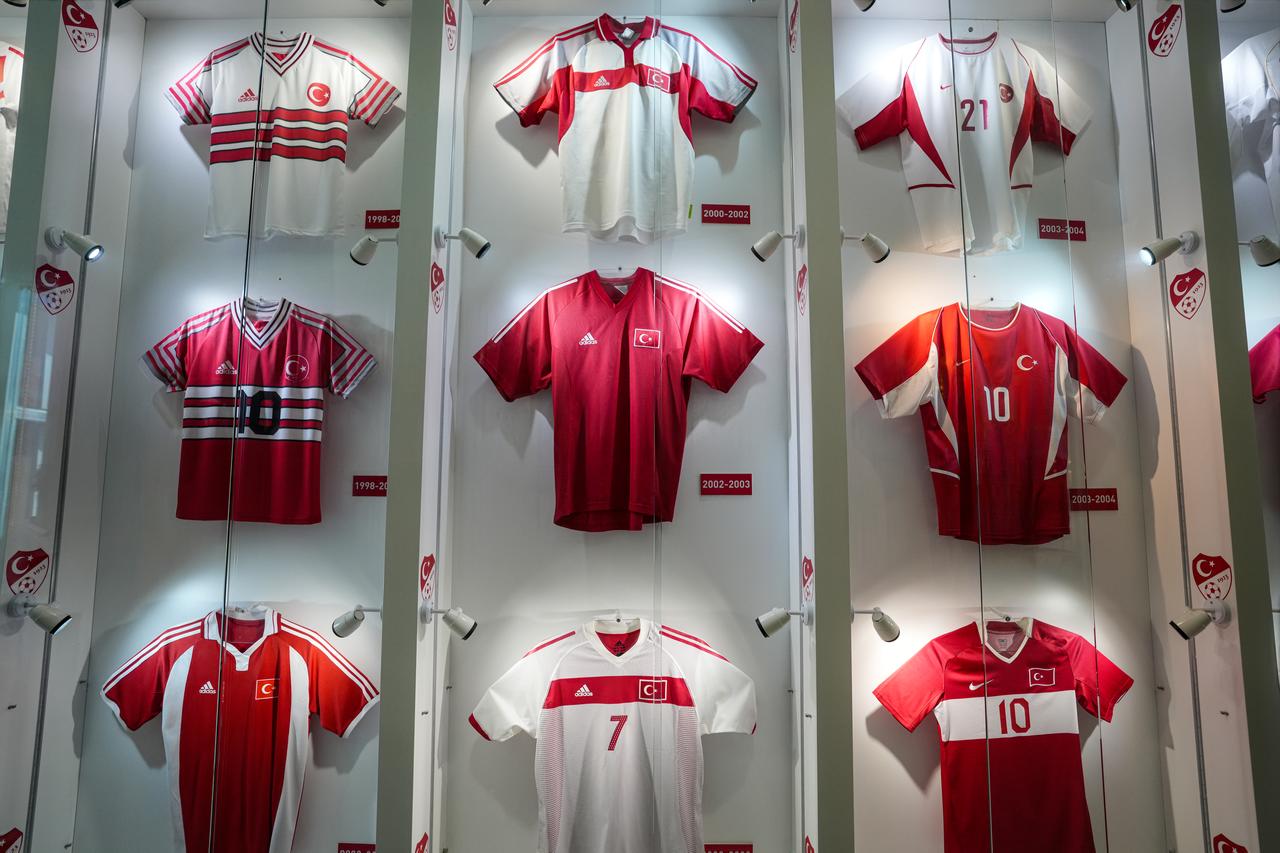
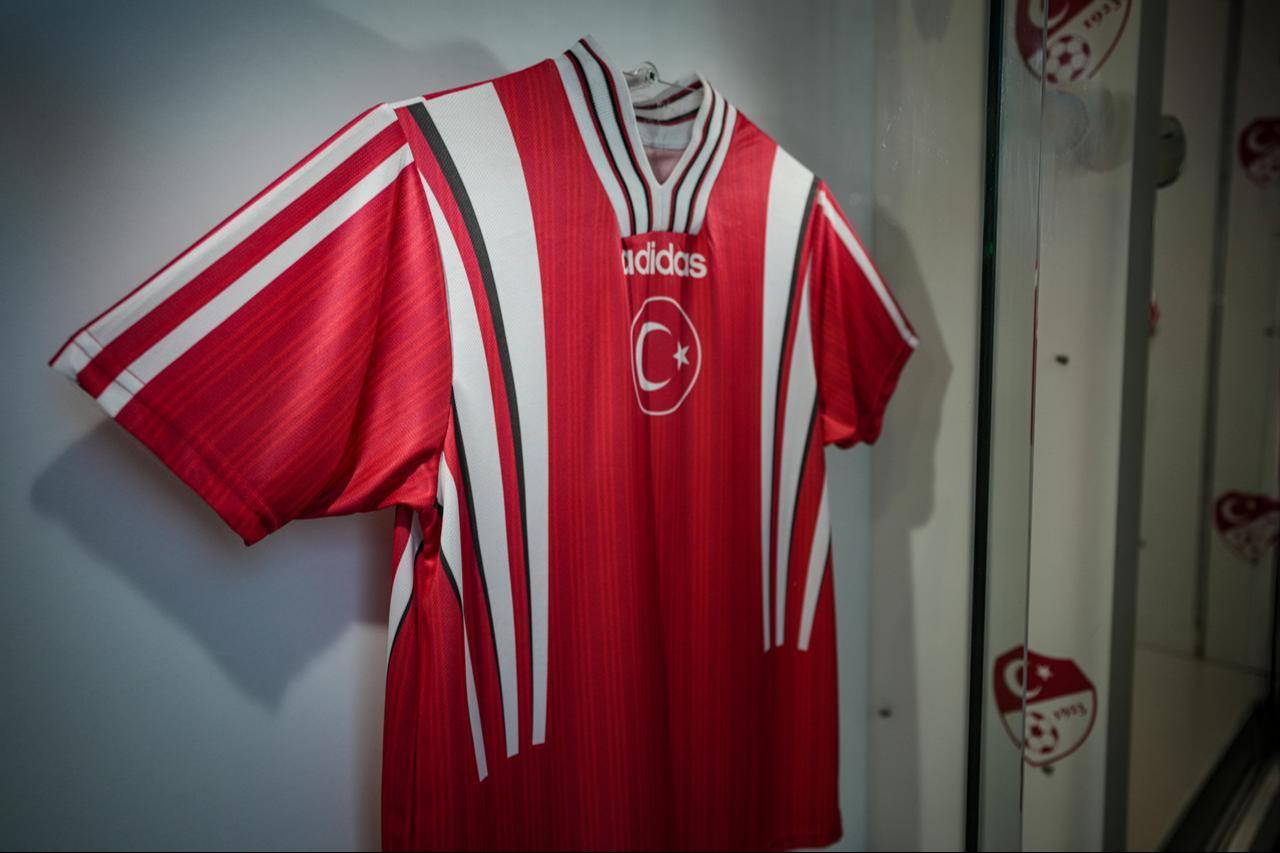
Türkiye made its first European Championship appearance at EURO 1996, where the team faced Portugal, Croatia and Denmark. The tournament also introduced new versions of the national shirt, including a red design with white shield-like details and a white version with red vertical elements.
At EURO 2000, Türkiye moved beyond the group stage for the first time in a major European tournament. The team reached the quarterfinals before losing to Portugal, while wearing red-and-white designs with distinctive collar and band details.
The highest point came at the 2002 World Cup in Japan and South Korea. Türkiye reached the semifinals and finished third, recording the greatest achievement in the country’s football history. The squad wore an all-red shirt with white shoulder stripes, while a white shirt with a thin red band also carried echoes of the early national design.
EURO 2008 became Türkiye’s most successful European Championship campaign, remembered for late comebacks and a run to the semifinals. The tournament also stood out for the use of turquoise shorts and socks, alongside red and white jerseys.
EURO 2016 in France brought disappointment, as Türkiye was eliminated after one win and two defeats in a group with Croatia, Spain and Czechia. The team wore designs featuring turquoise and black pattern details.
EURO 2020, postponed to 2021 because of the coronavirus pandemic, was also difficult for Türkiye. The national team lost all three group matches against Italy, Wales and Switzerland. The classic white shirt with a red band and a plain red jersey appeared in front of largely empty stands.
At EURO 2024 in Germany, Türkiye re-emerged with a young squad and strong support from Turkish communities in Europe. Wearing white shirts with red bands and all-red crescent-and-star designs, the team signaled a new phase before its return to the World Cup.
A classic white Türkiye national team jersey with the red crescent-star band is displayed as part of the national team’s jersey history exhibition. (AA Photo)" data-width="1280" data-height="853" width="1280" height="853">
A classic white Türkiye national team jersey with the red crescent-star band is displayed as part of the national team’s jersey history exhibition. (AA Photo)
From Europe to the World Cup podiumTürkiye made its first European Championship appearance at EURO 1996, where the team faced Portugal, Croatia and Denmark. The tournament also introduced new versions of the national shirt, including a red design with white shield-like details and a white version with red vertical elements.At EURO 2000, Türkiye moved beyond the group stage for the first time in a major European tournament. The team reached the quarterfinals before losing to Portugal, while wearing red-and-white designs with distinctive collar and band details.The highest point came at the 2002 World Cup in Japan and South Korea. Türkiye reached the semifinals and finished third, recording the greatest achievement in the country’s football history. The squad wore an all-red shirt with white shoulder stripes, while a white shirt with a thin red band also carried echoes of the early national design.[{"id":1,"choiceId":1,"groupId":-1,"value":"3221367","label":"Fatih Terim hails Türkiye’s golden generation ahead of 2026 World Cup","active":false,"highlighted":false,"customProperties":{"category":"Sports","categoryUrl":"sports","photoUrl":"/images/2026/6/5/fatih-terim-hails-turkiyes-golden-generation-ahead-of-2026-world-cup-3221367_20260605162514.jpg","url":"/sports/fatih-terim-hails-turkiyes-golden-generation-ahead-of-2026-world-cup-3221367","key":1},"placeholder":false,"keyCode":null},{"id":2,"choiceId":2,"groupId":-1,"value":"3221230","label":"2026 World Cup to feature 1,248 players as expanded format opens up tournament","active":false,"highlighted":false,"customProperties":{"category":"Sports","categoryUrl":"sports","photoUrl":"/images/2026/6/3/2026-world-cup-to-feature-1248-players-as-expanded-format-opens-up-tournament-3221230_20260603162125.jpg","url":"/sports/2026-world-cup-to-feature-1248-players-as-expanded-format-opens-up-tournament-3221230","key":1},"placeholder":false,"keyCode":null},{"id":3,"choiceId":1,"groupId":-1,"value":"3221129","label":"Türkiye names 26-man squad for 2026 FIFA World Cup after final cuts","active":false,"highlighted":false,"customProperties":{"category":"Sports","categoryUrl":"sports","photoUrl":"/images/2026/6/2/turkiye-names-26-man-squad-for-2026-fifa-world-cup-after-final-cuts-3221129_20260602112048_20260602112048.jpg","url":"/sports/turkiye-names-26-man-squad-for-2026-fifa-world-cup-after-final-cuts-3221129","key":1},"placeholder":false,"keyCode":null},{"id":4,"choiceId":1,"groupId":-1,"value":"3221055","label":"Türkiye’s Arizona base under scrutiny before 2026 World Cup","active":true,"highlighted":false,"customProperties":{"category":"Sports","categoryUrl":"sports","photoUrl":"/images/2026/6/1/why-turkiyes-arizona-base-is-under-scrutiny-before-2026-world-cup-3221055_20260601110719.jpg","url":"/sports/turkiyes-arizona-base-under-scrutiny-before-2026-world-cup-3221055","key":1},"placeholder":false,"keyCode":null}]3221367 -> Fatih Terim hails Türkiye’s golden generation ahead of 2026 World Cup3221230 -> 2026 World Cup to feature 1,248 players as expanded format opens up tournament3221129 -> Türkiye names 26-man squad for 2026 FIFA World Cup after final cuts3221055 -> Türkiye’s Arizona base under scrutiny before 2026 World CupComebacks, setbacks and a renewed imageEURO 2008 became Türkiye’s most successful European Championship campaign, remembered for late comebacks and a run to the semifinals. The tournament also stood out for the use of turquoise shorts and socks, alongside red and white jerseys.EURO 2016 in France brought disappointment, as Türkiye was eliminated after one win and two defeats in a group with Croatia, Spain and Czechia. The team wore designs featuring turquoise and black pattern details.EURO 2020, postponed to 2021 because of the coronavirus pandemic, was also difficult for Türkiye. The national team lost all three group matches against Italy, Wales and Switzerland. The classic white shirt with a red band and a plain red jersey appeared in front of largely empty stands.At EURO 2024 in Germany, Türkiye re-emerged with a young squad and strong support from Turkish communities in Europe. Wearing white shirts with red bands and all-red crescent-and-star designs, the team signaled a new phase before its return to the World Cup.
1923-inspired jersey for 2026
Türkiye’s next chapter will continue at the 2026 World Cup, which begins on June 11 across the United States, Mexico and Canada. The national team is scheduled to play its first match on the morning of June 14.
For the tournament, Türkiye will wear red-and-white jerseys inspired by the 1923 design. The shirts include ebru art details, referring to the traditional marbling technique used in Turkish visual culture, while bringing back the classic red band and crescent-and-star identity that began with the country’s first national match.


 Newsletters






 Set as preferred source
 Set as preferred source


 1 min read


 1 min read


