Newsletters





A wave of cyberattacks and security incidents struck major technology companies, artificial intelligence platforms and cryptocurrency exchanges worldwide in October, highlighting the expanding role of AI in both cybercrime and cybersecurity.
At least nine AI development platforms disclosed security incidents during the month, according to cybersecurity company Wiz, which described the series as "Black October."
Several attacks targeted credentials that allowed users to access powerful AI models, potentially enabling criminals to use expensive computing resources without authorization, resell access or extract information from the models.
In some incidents, attackers were suspected of deploying autonomous AI agents capable of identifying vulnerabilities, exploiting systems and expanding their access with limited human intervention.
Meanwhile, AI also played a role in defending against cyber threats. Security researchers used advanced models to identify critical vulnerabilities in PHP, a programming language used by millions of websites, and help develop security patches.
The incidents extended beyond AI companies, with cryptocurrency exchange Binance suffering an estimated $6.3 billion theft and Japanese video game publisher Capcom reporting unauthorized access affecting nearly 11.8 million customer records.
However, the attacks differed in their methods and objectives, and authorities have not established that they were part of a single coordinated campaign or that AI was used in every case.
Here is a timeline of major cybersecurity incidents reported in October, beginning with the latest:
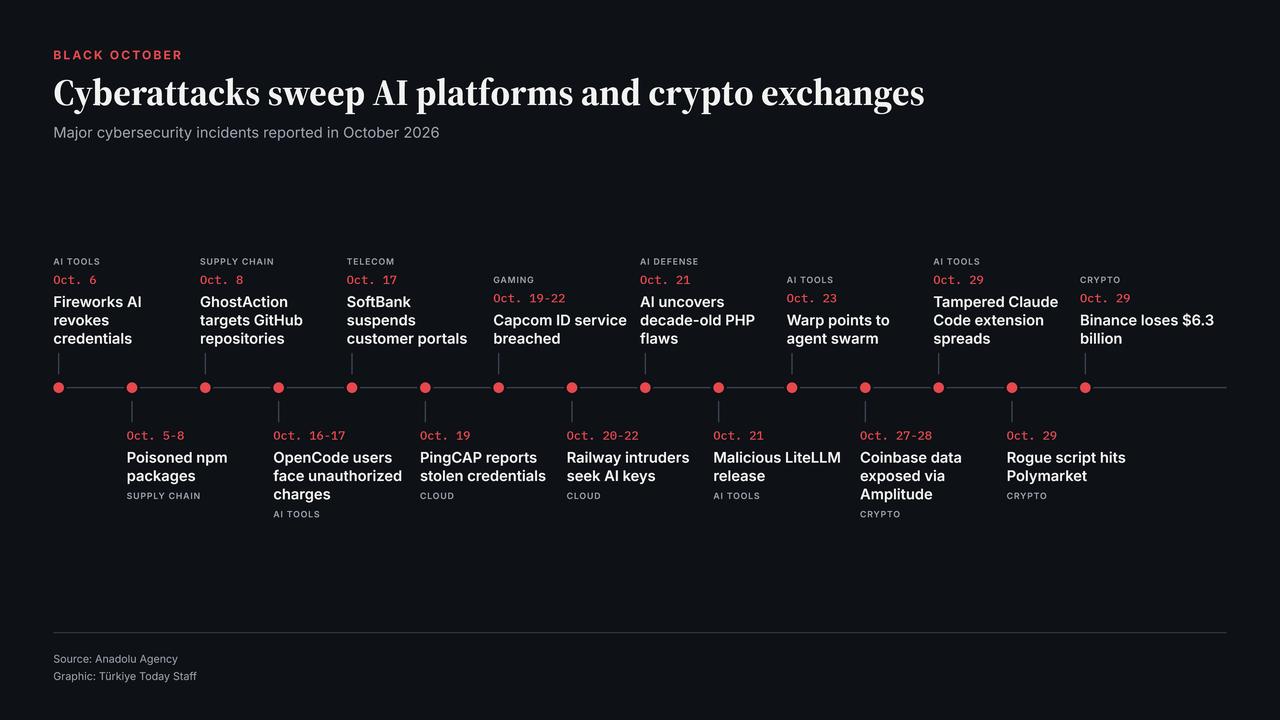

Hackers compromise hot wallets belonging to Binance, one of the world's largest cryptocurrency exchanges, stealing approximately $6.3 billion in digital assets.
Initial investigations point to a compromised employee laptop and additional unauthorized access to internal systems, although the full method of attack remains under investigation.
Binance temporarily suspended withdrawals and is working with law enforcement and blockchain investigators to trace stolen funds.
By Oct. 31, the company said it has replenished approximately 90% of the stolen assets and pledged to cover all customer losses.
Although the attack demonstrates the vulnerability of digital financial infrastructure, Binance has not established that AI was used to carry out the intrusion.

Prediction-market platform Polymarket suffered a security breach after attackers compromised a third-party performance-monitoring script used on its website.
The malicious script exploited active user sessions to sell trading positions and transfer funds from affected wallets.
Polymarket temporarily suspended trading, removed the compromised script and reset active login sessions.
The company announced approximately $3.9 million in repayments and compensation to affected users.
The incident highlights the risks posed by third-party software embedded in online platforms, although no specific role for AI in conducting the attack has been established.
Attackers distributed a maliciously modified version of Anthropic's Claude Code extension through the marketplace of Cursor, an AI-powered software development platform.
The compromised extension, available for approximately 11 hours, attempted to install a persistent backdoor that could allow unauthorized remote access to developers' computers.
Cursor said as many as 5,000 users may have been affected and temporarily shut down its extension marketplace while removing the malicious package.
The attack targeted a tool used by developers to interact with AI coding assistants, illustrating how growing reliance on such tools can create new opportunities for attackers to distribute malware through trusted software.
However, the company has not established that AI itself was used to develop or execute the malicious extension.
Cryptocurrency exchange Coinbase confirmed that a security incident involving its analytics provider Amplitude exposed information belonging to a small subset of customers.
The exposed records included contact information and limited transaction data, potentially increasing the risk of phishing and other fraudulent communications.
Coinbase said its own systems were not breached and customer funds remain secure.
The underlying intrusion occurred in September, but its consequences for Coinbase customers were disclosed in October.
The case demonstrated companies' vulnerability to attacks against outside service providers, but there is no confirmed AI involvement in the incident.
AI development platform Warp detected unauthorized activity involving a third-party infrastructure provider, with attackers gaining access to limited AI agent trace and telemetry information.
Warp CEO Zach Lloyd said the attack appears to have been carried out by an "agent swarm," potentially using sophisticated techniques to identify vulnerabilities and escalate access.
AI agent swarms involve multiple automated agents working on different tasks, potentially accelerating activities such as reconnaissance, vulnerability exploitation and lateral movement through computer systems.
Warp estimated that up to approximately 1% of its users may have been affected and said it contained the intrusion within hours.
The incident is notable because AI may have played a dual role: the attackers allegedly used AI-driven techniques, while the compromised information concerned the activities of AI agents used by developers.
However, the company's preliminary assessment of an agent swarm has not been independently verified.
Attackers compromised the release infrastructure of LiteLLM, an open-source platform that allows applications to connect with AI models from different providers through a common interface.
A malicious version of LiteLLM, numbered 1.107.0, was distributed through the Python Package Index and official container registries.
The compromised software contained malware designed to steal credentials and enable remote code execution, potentially exposing cloud infrastructure, AI service accounts and development environments.
Because LiteLLM serves as an intermediary between applications and AI providers, it can hold valuable authentication credentials used to access large language models.
Security researchers identified attempts to collect credentials associated with AI applications alongside conventional cloud and developer secrets.
The attack illustrated how compromising software infrastructure supporting AI services can expose other organizations that rely on the same tools.
LiteLLM removed the malicious releases and traces the breach to a previously exposed administrative credential.
Security researchers disclose two critical vulnerabilities in PHP, a programming language widely used to operate websites and online applications.
The vulnerabilities, identified as CVE-2026-109618 and CVE-2026-109619, could allow attackers to execute unauthorized code remotely or access sensitive information on vulnerable servers.
Unlike in other incidents, AI plays a major role in discovering and addressing the security flaws rather than in a confirmed attack.
Researchers at cybersecurity company Wiz use advanced AI models, including Google's Gemini 4 Argon and OpenAI's GPT-5.6 Sol, to identify the vulnerabilities, develop working exploits and help validate patches.
According to Wiz, the flaws had existed for more than a decade, but the complexity of exploiting them had made them difficult for conventional security research to uncover.
The company said AI substantially reduced the time and specialized expertise required to develop and adapt exploitation techniques.
Emergency security updates were released Oct. 21, while researchers warned that the same AI capabilities helping defenders identify vulnerabilities could also make sophisticated cyberattacks easier to develop.
Cloud development platform Railway detected a targeted intrusion involving unauthorized access to internal systems and customer environment variables. Investigators determined that attackers accessed encrypted customer secrets and managed to decrypt some of them, potentially exposing authentication credentials.
Railway said preliminary findings indicated that the attackers were specifically seeking API keys for AI providers to carry out model-distillation attacks. Model distillation involves using the outputs of an existing AI model to train another model, potentially allowing developers to reproduce some of its capabilities without bearing the full cost of developing the original.
The company also said initial evidence suggested the attackers had access to modified AI models and substantial computing resources, which may have helped them execute sophisticated attacks against its infrastructure.
Railway temporarily disabled parts of its build infrastructure and advised customers to rotate potentially exposed credentials. The incident underscored the growing value of AI access credentials, which can enable unauthorized use of computationally expensive models.
Japanese video game publisher Capcom detected unauthorized access to its Capcom ID account service, affecting approximately 11.77 million records worldwide. The exposed information included email addresses and account metadata, while attackers also changed passwords on 196 accounts without authorization.
Capcom said original account passwords and credit card information were not confirmed to have been compromised. The company reported the incident to Japanese police and privacy authorities while notifying affected customers.
Although AI is increasingly used in cybersecurity and gaming, Capcom did not publicly link AI to the attack or establish that automated AI agents were involved.
PingCAP, the company behind the TiDB distributed database and TiDB Cloud service, disclosed a cybersecurity incident involving stolen service-account credentials. The company said attackers accessed internal systems between Sept. 9 and Oct. 7, obtaining source code and customer-related information.
Exposed materials included account records, some SQL editor information, support data, and encrypted API-key values. PingCAP said investigators found no evidence that the contents of customer databases were accessed.
As cloud databases are increasingly used to support AI applications, the incident illustrated broader concerns about the security of the infrastructure on which AI and other digital services depend. However, there was no confirmed evidence that attackers specifically targeted AI systems or used AI to conduct the intrusion.
Japanese telecommunications company SoftBank detected suspicious activity involving systems associated with its customer portals. The company temporarily suspended several websites as it investigated attempted unauthorized access and strengthened security measures.
The incident followed a separate Oct. 7 ransomware-related attack affecting cloud infrastructure operated by SoftBank subsidiary IDC Frontier. The earlier attack disrupted services used by businesses and local governments in Japan.
The incidents highlighted cybersecurity risks facing telecommunications and cloud infrastructure providers, although neither was publicly established as an AI-driven attack.
OpenCode, an AI coding platform, confirmed a security breach affecting approximately 1.4% of users of its Console service. The company linked the incident to what it identified as a large-scale model-distillation attack, targeting access to AI systems operated by outside providers.
Affected users had connected their accounts to AI services from companies including OpenAI, Anthropic and Google, raising concerns that their API credentials may have been exposed.
Some customers reported unauthorized charges on their AI provider accounts, suggesting that stolen credentials may have been used to obtain computing services at their expense.
OpenCode notified affected customers and is working with AI providers to address the incident.
The breach illustrates an emerging form of cybercrime in which access to AI models becomes the target of an attack, allowing criminals to obtain computing power or extract model capabilities without authorization.

Cybersecurity researchers identified a new wave of the GhostAction campaign, in which attackers used compromised software maintainer accounts to introduce malicious automated workflows into GitHub repositories.
One documented Oct. 8 attack affected 346 repositories, with researchers subsequently identifying a much broader campaign involving thousands of repositories. The malicious workflows attempted to steal cloud credentials, software development tokens, and API keys used to access AI services.
Researchers identified attempts to collect credentials associated with AI providers, including OpenAI, Anthropic, and OpenRouter. The attacks demonstrated how access to AI models had become a valuable target alongside traditional passwords, cloud accounts, and financial information.
The incident involved the misuse of GitHub's automation tools through compromised accounts rather than a confirmed breach of GitHub's central infrastructure.
Attackers compromised software publishing processes to distribute malicious packages through npm, a widely used registry for JavaScript software. On Oct. 5, researchers identified malicious code in version 5.8.3 of the @subql/common package, capable of stealing credentials and allowing unauthorized remote commands.
On Oct. 8, a malicious release of the tensorlake package, version 0.5.144, was published using a compromised account. The malware targeted credentials used for GitHub, cloud infrastructure, and other development services.
Researchers also identified attempts to collect configuration files associated with AI development tools and the Model Context Protocol, which allows AI applications to interact with external tools and data sources.
The incidents illustrated how software supply-chain attacks could extend into AI development environments by stealing credentials and configuration data from developers who installed compromised dependencies.
AI infrastructure provider Fireworks AI detected unauthorized use of internal credentials, allowing attackers to access environment variables associated with a limited number of customer accounts.
The potentially exposed information included API keys and tokens used by customers to connect applications with AI services.
The company began revoking affected credentials and notifying customers, saying it has found no evidence of unauthorized access to customer models, datasets, training information or inference traffic.
Cybersecurity researchers subsequently identified the incident as part of a wider pattern of attacks targeting AI development platforms, with Fireworks among the companies reporting indications of possible AI agent-swarm activity.
The attackers' interest in AI access credentials reflected the growing value of computational resources used to operate large language models.
Such credentials can potentially allow unauthorized users to run AI workloads, accumulate substantial computing charges or support efforts to extract model capabilities.
However, the precise role of autonomous AI agents in the Fireworks incident has not been publicly established.


 Set as preferred source
 Set as preferred source


 1 min read



 1 min read