Newsletters





Brazilian markets brace for a sharp selloff of up to 30% on Monday after President Luiz Inacio Lula da Silva secured reelection over his rival, right-wing Senator Flavio Bolsonaro, wiping out investor hopes for a more aggressive push to curb public spending and rein in the country’s growing debt.
U.S.-based investment bank Morgan Stanley forecast that Brazilian equities could fall 20%-30%, while the Brazilian real could weaken further if concerns over public finances intensify. The bank also expects government borrowing costs to rise as investors reassess the country’s fiscal outlook.
Morgan Stanley expects the dollar-real exchange rate to test 5.60, potentially reaching 6.00 if concerns over Brazil’s public finances worsen. The bank also projects that Brazilian interbank interest rates will decline in stages by 300 to 400 basis points.
In the coming days, the spread on Brazil’s 10-year sovereign bonds is expected to widen by approximately 50 basis points, while five-year credit default swap spreads are anticipated to expand by about 40 basis points.
The market reaction follows a rally driven by expectations that Bolsonaro, the son of former President Jair Bolsonaro, would defeat Lula and introduce tighter fiscal policies and economic reforms.
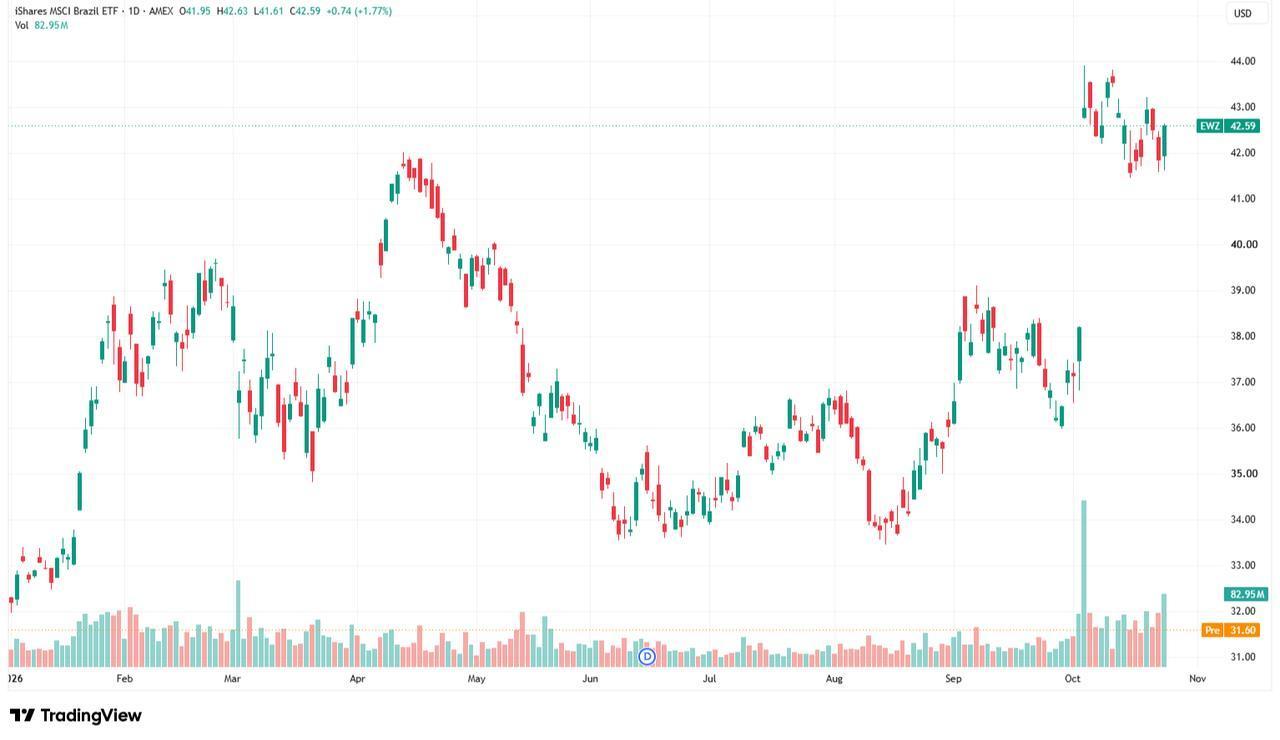
November futures for the Brazilian real were down more than 10% on international markets, while the U.S.-listed iShares MSCI Brazil exchange-traded fund (ETF) fell more than 25% in premarket trading.
Futures contracts tied to Brazil’s benchmark Bovespa stock index plunged 14.84% during the first hour of trading. Yields on two-year Brazilian government bonds also surged by more than 250 basis points to 12.992%.
Petrobras, Brazil’s state-controlled oil giant, plunged roughly 21.8% in premarket trading on the New York Stock Exchange (NYSE) as of 8:13 a.m. EDT. Banking shares also came under heavy pressure, with Itaú Unibanco slipping 26.8%, Banco Bradesco falling 29.4% and Nu declining 25%.
E-commerce company MercadoLibre dropped 14.9%, while Ambev SA slid around 14.5%. Banco Santander lost 3.2%, Vale declined 4.8% and Embraer shed 1.9%.
The selloff spread to European markets, particularly Spain and Portugal, where companies have significant business ties to Latin America. Spain’s IBEX 35 fell 0.3% before recovering its losses, while Portugal’s PSI 20 lost 0.7%, even as other European stock indexes rose.
Shares of Spain’s largest bank, Santander, fell close to 3%, while telecoms group Telefonica dropped 6.2%. AB InBev, whose beer brands are popular across South America, declined 3.6%.

Investors had positioned themselves for a rightward shift in Brazilian politics after Flavio Bolsonaro unexpectedly finished first in the opening round of the presidential election earlier this month.
The senator pledged a 200 billion-real ($39.5 billion) fiscal adjustment, including measures to eliminate government ministries, tackle mismanagement at state-controlled companies and monetize federal real estate assets. He also promised to curb rising public debt without cutting politically sensitive social spending.
Those commitments helped fuel a rally in Brazilian assets. The Bovespa stock index closed Friday nearly 7% above its level before the first round, while the real had strengthened almost 5% against the U.S. dollar.
Interest-rate futures had also reflected expectations that tighter fiscal policy under Bolsonaro would eventually bring borrowing costs down.
Over the next four years, Lula will face the challenge of slowing the growth of Brazil’s debt while protecting social programs and public investment.
His economic team is targeting a primary budget surplus—which excludes interest payments—of about 1.3% of gross domestic product by 2030. The goal is to help cover part of the government’s interest bill and reduce the need for fresh borrowing.
However, public debt already exceeds 82% of GDP, while mandatory spending on pensions and other legally protected programs leaves limited room for cuts.
Investors will look for signs that Lula’s more gradual approach to fiscal consolidation can bring borrowing costs down. Without confidence in his ability to stabilize the debt, lenders could demand higher returns on government bonds, adding to the fiscal burden and making credit more expensive for businesses and households.


 Set as preferred source
 Set as preferred source


 1 min read


 4 min read