Newsletters




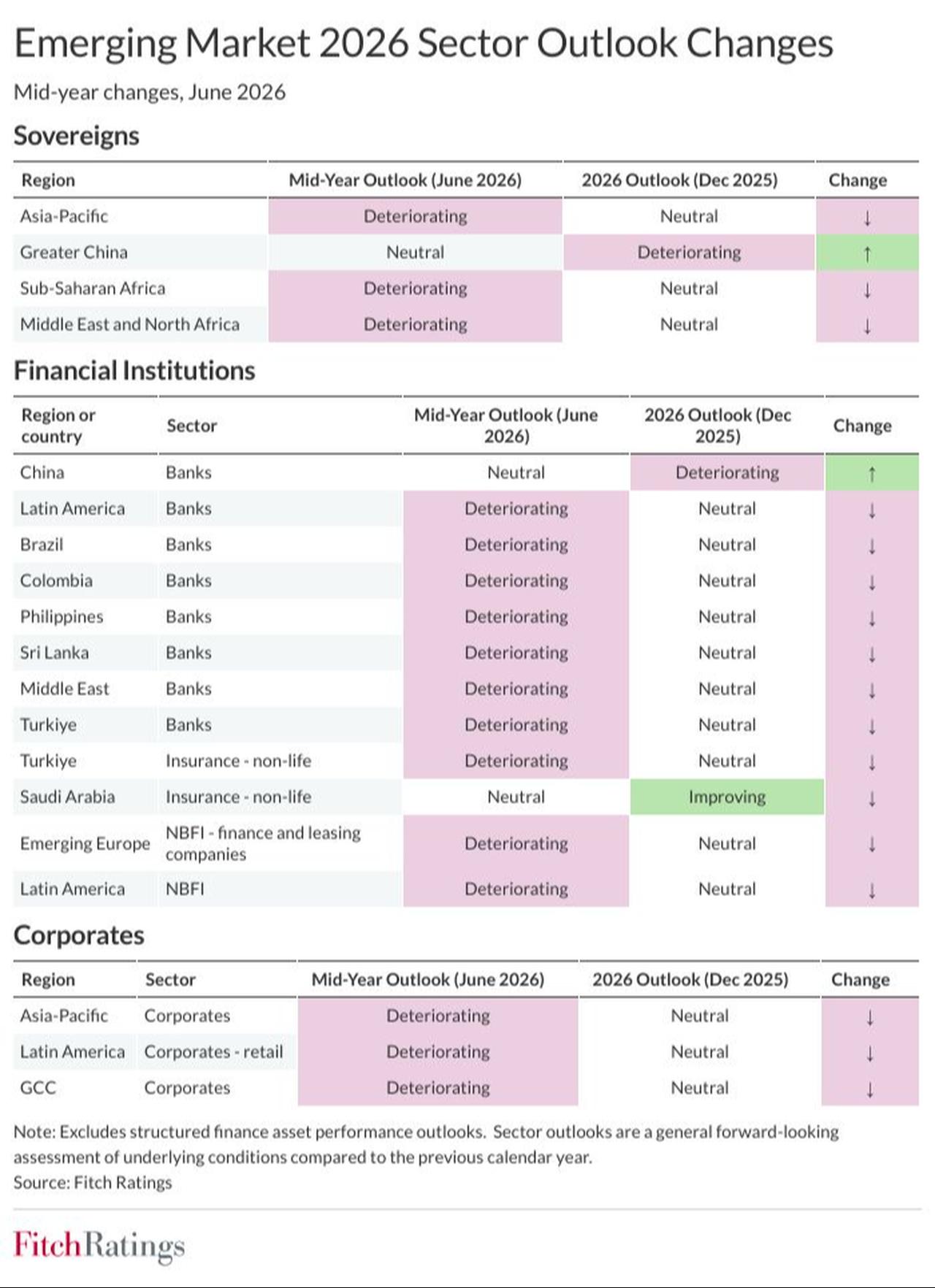
Fitch Ratings has downgraded its outlook for the Turkish banking sector to "deteriorating," alongside those of several other emerging-market economies, warning that the upward risks after the Iran war could weigh on economic growth and put pressure on banks' asset quality and profitability.
The ratings agency said the effects of the conflict are spreading across emerging markets, prompting a broad reassessment of sector conditions for 2026.
Around one-third of Fitch’s emerging market sector outlooks are now classified as "deteriorating," up sharply from 13% in its initial assessment published in December 2025.
Fitch attributed the revision to expectations that slower economic activity could affect lenders' balance sheets and earnings. Despite the downgrade, Fitch noted that financing conditions have remained steadier than initially feared.
"Market access has proven more resilient than initially expected and is likely to remain so," it added. The agency also revised Türkiye's non-life insurance sector assessment to "deteriorating," while Saudi Arabia's equivalent sector was lowered to "neutral."
According to Fitch, governments across several emerging-market regions face spillover effects from the conflict, including slower economic growth, higher inflation, rising bond yields and increased geopolitical uncertainty.
The agency revised sovereign sector assessments for Asia-Pacific, the Middle East and North Africa, and Sub-Saharan Africa to "deteriorating."
China was the only region to register an improvement, moving to "neutral" as export strength continues to support economic activity and deflationary pressures ease. Similar factors prompted Fitch to raise China's banking sector assessment from "deteriorating" to "neutral."
Fitch also cut its assessment of Gulf corporate issuers, citing rising geopolitical tensions, softer tourism and transport activity, higher supply-chain expenses linked to the closure of the Strait of Hormuz and expectations of a cooling property market.
The agency noted, however, that many companies entered the period with solid liquidity positions after securing financing before the conflict intensified.

Fitch stressed that sector outlooks are separate from rating outlooks and reflect operating conditions rather than anticipated rating actions.
While the conflict has slowed positive ratings momentum in some emerging markets, Fitch said credit ratings have generally remained resilient. Negative rating actions among Gulf issuers have been limited, mainly affecting several Qatari entities placed on Rating Watch Negative and three UAE homebuilders.
The agency also upgraded its global oil and gas sector outlook to "improving" from "neutral," citing higher hydrocarbon prices. However, it noted that Gulf producers' ability to benefit depends on whether they can export through routes independent of the Strait of Hormuz or access alternative channels.


 Set as preferred source
 Set as preferred source


 1 min read
 1 min read