Newsletters





Global investment banks are sticking to a cautious outlook on Türkiye's monetary policy after June inflation data, arguing that persistent underlying price pressures leave the central bank with limited room to ease interest rates despite slowing inflation.
U.S-based Citi expects the policy rate to end the year at 35%, while another U.S. bank, Goldman Sachs, does not expect an effective rate cut before the fourth quarter of 2026.
BBVA Research, meanwhile, continues to forecast a gradual easing cycle, warning against any rapid policy loosening.
In a note released on Friday, Citi economists argued that the Central Bank of the Republic of Türkiye (CBRT) has only limited room to lower interest rates in the second half of the year.
The bank pointed to mounting signs of slowing economic activity following weaker-than-expected first-quarter growth of 2.5% year-over-year, suggesting the CBRT may be more inclined to avoid further tightening in the near term, despite its earlier preference for pairing higher interest rates with a more controlled pace of lira depreciation.
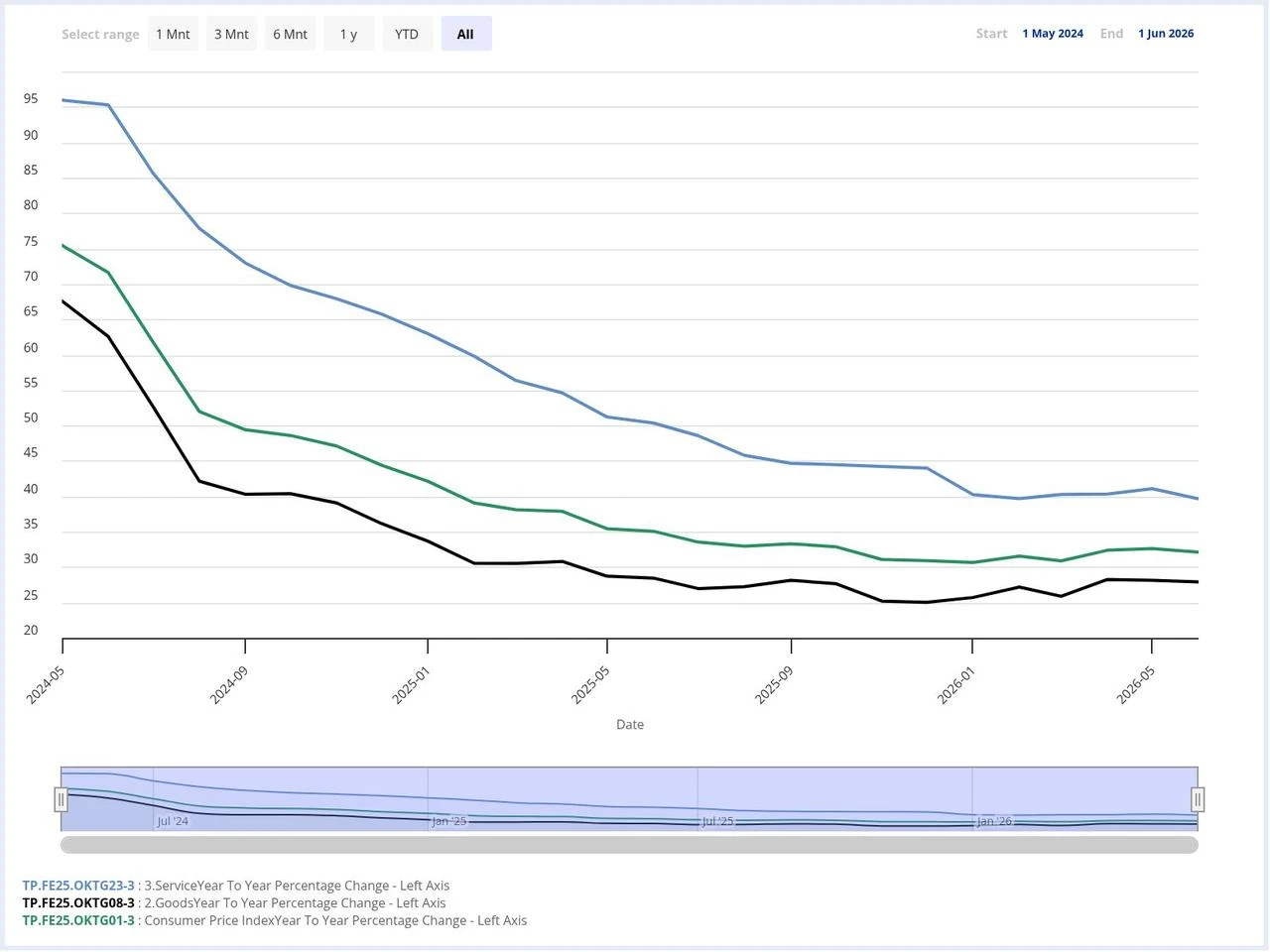
Citi noted that monthly inflation eased to around 1% in June, helped by lower energy costs and stabilizing food prices. Even so, processed food prices rose a stronger-than-expected 2.6% month-on-month, while core inflation remained near 30% and services inflation around 40%.
The bank added that its calculations showed no meaningful improvement in the pace of monthly disinflation in services.
It expects food price uncertainty, possible clothing price increases in September and October, and weakening domestic demand to shape the inflation outlook in the coming months.
Citi maintained its year-end inflation forecast at about 31% but said risks remain skewed to the upside, arguing that the more challenging outlook warrants a cautious monetary policy stance.
The bank added that while the CBRT targets inflation of 24% in 2026 and 15% in 2027, sector-based expectations suggest disinflation could progress more slowly than policymakers anticipate.
It also warned that exchange-rate stability alone may not be enough to re-anchor inflation expectations, despite support from lower energy prices.

Goldman Sachs also adopted a cautious stance after June inflation figures, arguing that deterioration in core inflation indicators continued even as headline inflation eased.
The bank expects the CBRT to refrain from making an effective interest rate cut until the fourth quarter of 2026.
Over the three Monetary Policy Committee (MPC) meetings held during the Iran war, the policymakers kept the benchmark rate at 37% while funding the market through the costlier overnight rate at 40%.
Annual consumer inflation slowed to 32.1% in June from 32.6% in May, slightly above Goldman Sachs' 31.9% forecast and the market expectation of 32%.
Although the Turkish Statistical Institute's (TurkStat) core C index, which excludes energy, food and non-alcoholic beverages, alcoholic beverages, tobacco and gold, slowed to 2.2% month-on-month from 2.4% and to 29.8% year-on-year from 30.4%, Goldman Sachs found that all of its preferred underlying core inflation measures accelerated.
Median inflation also edged up by 0.2 percentage point, lifting the three-month moving average to 2.2% per month, a trend the bank linked to the faster depreciation of the Turkish lira since March.
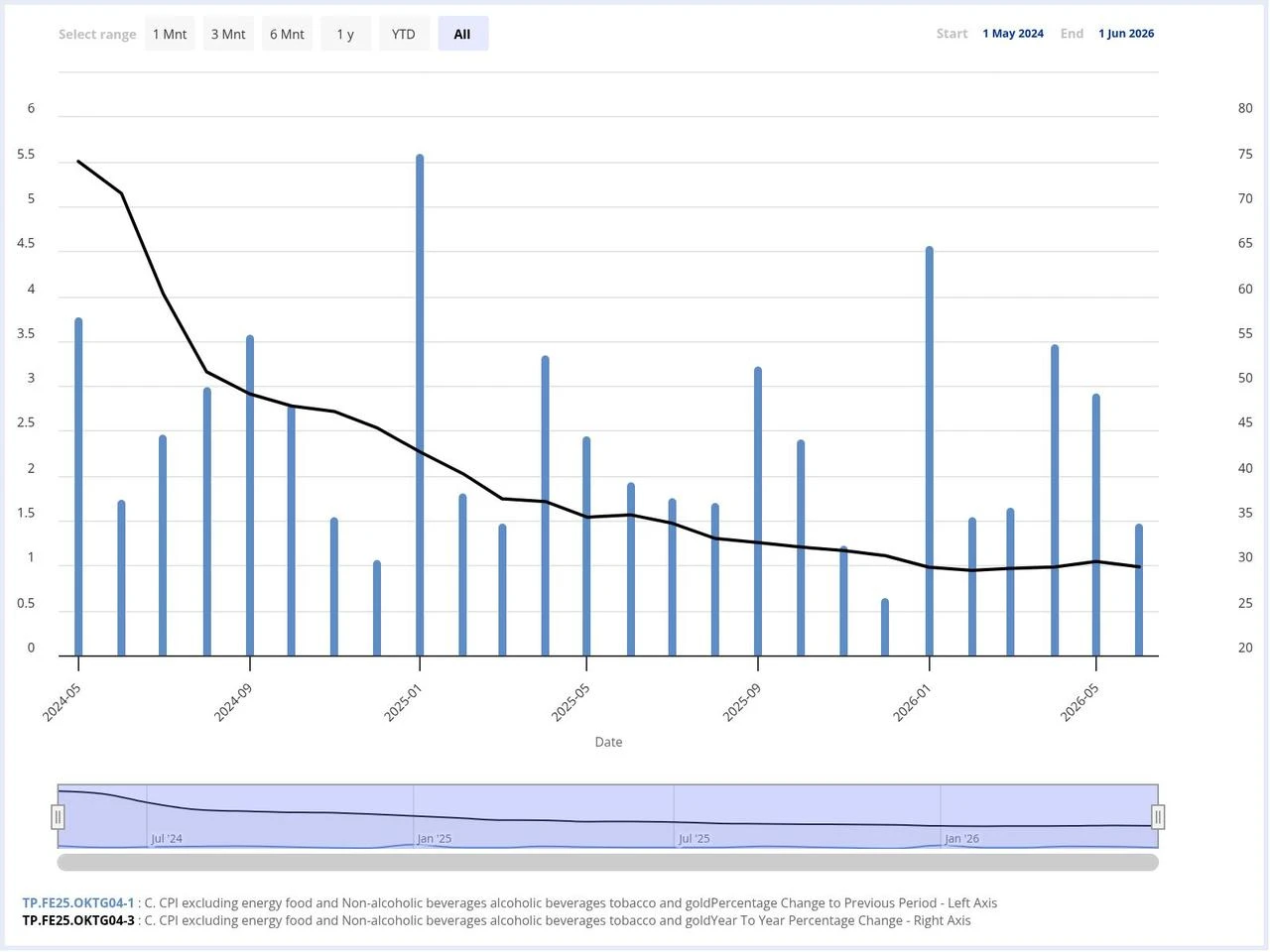
Spanish lender BBVA also found only limited improvement in underlying inflation in June. The bank said the average of six underlying inflation indicators eased to 2% month-on-month from 2.2%, while the three-month average held steady at 2.3%.
Median inflation fell to 1.9%, but its three-month trend remained at 2.1%, the highest since May 2025. Inflation excluding food and energy showed no meaningful change in its distribution.
BBVA said the postponement of fuel excise tax increases and a sharp decline in energy prices had slightly improved the inflation outlook for the second half of 2026.
Even so, it warned that elevated inflation expectations, rigid pricing behavior and persistent core inflation remain major obstacles to disinflation.
The bank estimated that if Brent crude remains in the $70-$75 per barrel range during the second half of the year, year-end consumer inflation could be about 1 percentage point lower, although higher healthcare service prices may offset part of that benefit.
BBVA maintained its year-end inflation forecast at 30% and said risks were slightly tilted to the downside. It also warned that rapid monetary easing could derail disinflation, while continuing to expect the CBRT to lower its funding rate gradually.
Further improvement in inflation, it added, could pose limited downside risk to its 37% year-end policy rate forecast.
The central bank will hold its fifth Monetary Policy Committee (MPC) meeting of the year on July 23, when markets will closely watch for signals on the timing and pace of future rate cuts.


 Set as preferred source
 Set as preferred source


 1 min read

 1 min read