Newsletters




The International Monetary Fund (IMF) cut Türkiye’s growth forecast for 2026 to 2.7%, following a downward revision in July, while keeping its 2027 forecast unchanged at 3.6%.
The further downgrade came after investment fund turmoil hit Turkish capital markets in September, when several portfolio managers failed to meet investor redemption requests. Authorities ordered the liquidation of 131 investment funds with over 455,000 investors and ₺936.3 billion ($19.1 billion) in assets at the time within six months.
The IMF also projected Türkiye’s year-end inflation would reach 31.2% by the end of 2026, up from 29.7% as of September, and 26.5% by the end of 2027.
In its October World Economic Outlook report, the IMF raised its global economic growth forecast for 2026 to 3.1%, up from the 3% projected in July. The fund kept its 2027 forecast at 3.4%.
The global economy had proved more resilient than expected despite prolonged conflict in the Middle East and persistent trade tensions, according to the report.
Economic activity in the first half of 2026 had performed better than anticipated, supported in part by strong investment in artificial intelligence and the resulting boost to technology-related demand.
However, the IMF warned that this resilience remained uneven across countries, while economies had less room to adjust to short-term shocks.
Global headline inflation was expected to rise to 4.7% in 2026, largely due to temporary increases in energy and food prices, before falling to 4.1% in 2027.
Growth in global trade volume was also expected to slow in 2026 and stabilize in 2027, with tariffs, adjustments to production chains and sustained technology-related trade shaping the outlook.
The report warned that prolonged or escalating conflict in the Middle East could keep energy and food prices high and volatile, reignite inflationary pressures, worsen fiscal and external balances, and weigh on economic growth.
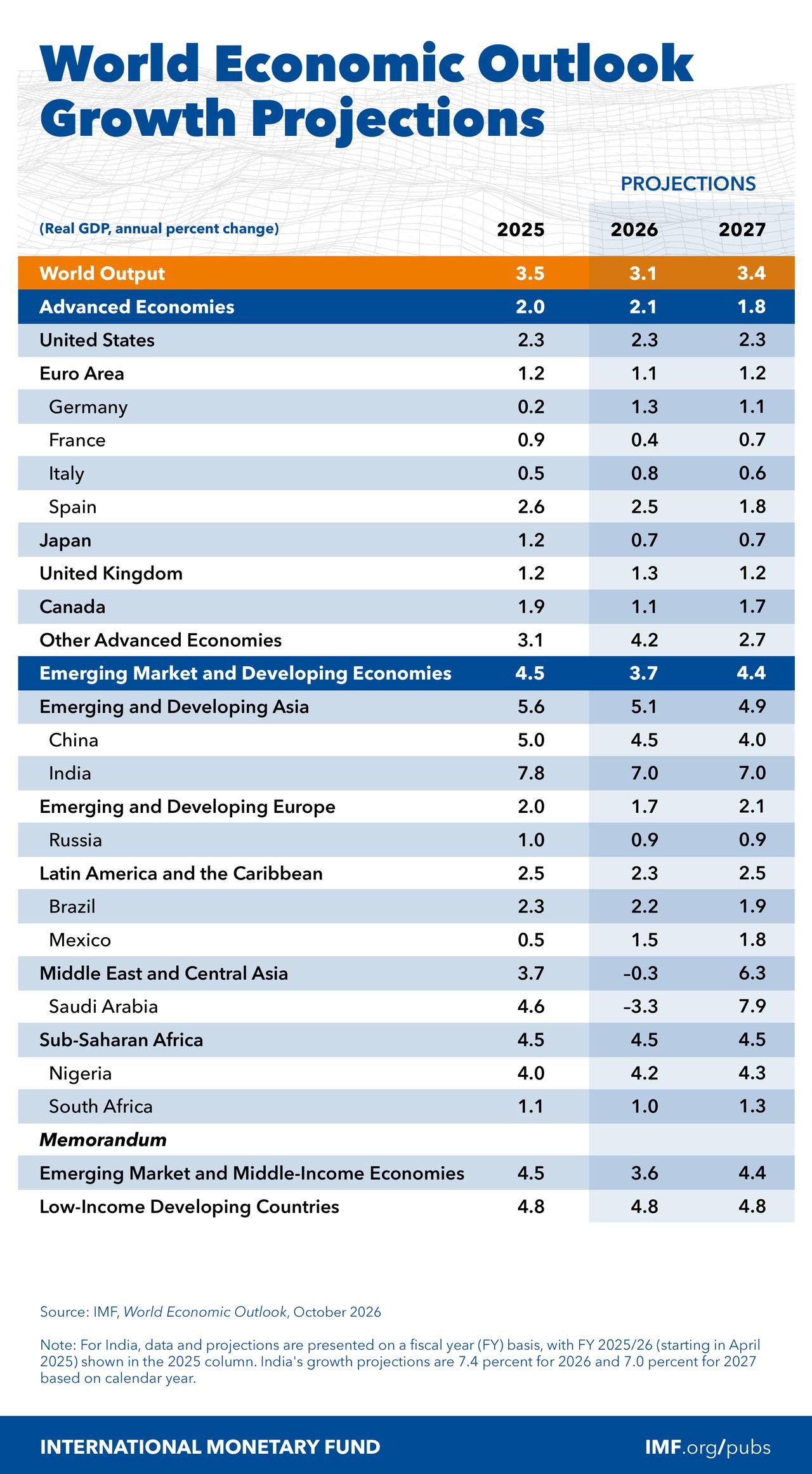

The IMF kept its U.S. growth forecast at 2.3% for 2026 and raised its 2027 projection to 2.3%, from 2.2%. For the euro area, it lifted the 2026 forecast to 1.1%, from 0.9%, while keeping the 2027 outlook at 1.2%.
Germany’s growth forecast rose to 1.3% for 2026 and 1.1% for 2027, while France’s fell to 0.4% and 0.7%, respectively. Italy’s projections increased to 0.8% for 2026 and 0.6% for 2027, while Spain’s 2026 forecast rose to 2.5% and its 2027 outlook remained at 1.8%.
The IMF raised the U.K.’s 2026 forecast to 1.3% but lowered its 2027 projection to 1.2%. Canada’s forecasts stayed at 1.1% for 2026 and 1.7% for 2027, while Japan’s 2026 outlook edged up to 0.7% and its 2027 forecast remained unchanged.
Among emerging markets, China’s growth forecasts fell to 4.5% for 2026 and 4% for 2027. India’s projections rose to 7% for both years, while Russia’s forecasts dropped to 0.9% for 2026 and 2027.


 Set as preferred source
 Set as preferred source


 1 min read

 1 min read