Newsletters





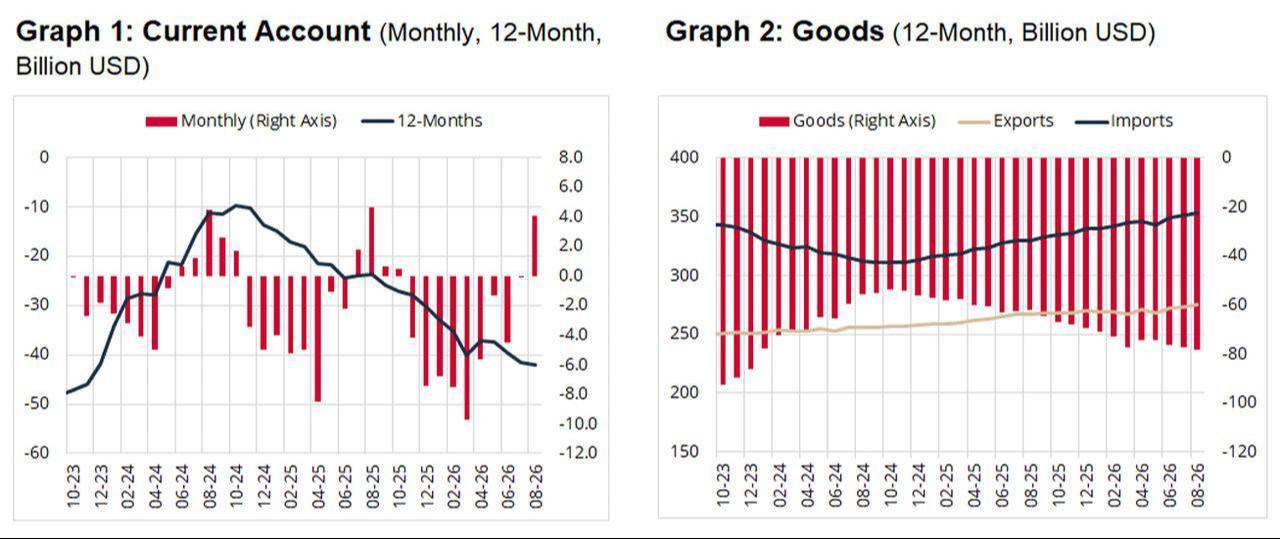
Türkiye's current account balance posted a $4.1 billion surplus in August, supported by rising transport revenues that helped offset energy cost pressures despite a slight decline in tourism income.
The current account balance excluding gold and energy also recorded a surplus of $8.2 billion. On a 12-month rolling basis, however, the current account deficit stood at approximately $42.1 billion in August, while the foreign trade deficit reached $78.4 billion and the services balance posted a surplus of $63.9 billion.
Türkiye's net services surplus rose 3.9% year-on-year to $9.7 billion in August, as net transport revenues jumped 18.9% to $3.3 billion. Net travel income, however, fell 4.4% to $7.3 billion, limiting the overall increase in services earnings.
Net energy imports, meanwhile, rose 39.5% year-on-year to nearly $5 billion in August, reflecting higher oil prices amid shipping disruptions around the Strait of Hormuz linked to the Iran war.
On the financing side, net inflows from direct investments reached $141 million in August. Foreign investors increased their direct investments in Türkiye by $719 million, while Turkish residents raised their direct investments abroad by $578 million.
In real estate, Turkish residents purchased $142 million worth of property abroad, while foreign investors made net property purchases worth $244 million in Türkiye.
The central bank's net foreign exchange reserves fell by $30.1 billion, while net foreign exchange holdings recorded a net increase of $7.1 billion during the month.

The figures came as the Iran war continued to disrupt global energy markets, with restricted shipping through the Strait of Hormuz pushing up oil prices, freight rates and insurance costs.
Central Bank of the Republic of Türkiye (CBRT) Governor Fatih Karahan warned in August that the conflict has kept energy and other commodity prices above pre-war levels, raised import prices and increased the risks surrounding the current account outlook.
The bank has also pointed to continued uncertainty over global growth and volatile portfolio flows to emerging markets amid heightened geopolitical risks.
The Turkish government raised its year-end current account deficit forecast to $47.5 billion, equivalent to 2.6% of GDP, under its newly revised Medium-Term Program for 2027–2029, up from an earlier projection of 1.3% of GDP.
The program also increased its 2026 energy import bill forecast to $71 billion from $63 billion, while cutting its tourism revenue projection to $65 billion from $68 billion, reflecting mounting pressure on the external balance from higher energy costs and a weaker tourism outlook.


 Set as preferred source
 Set as preferred source


 1 min read

 1 min read