Newsletters




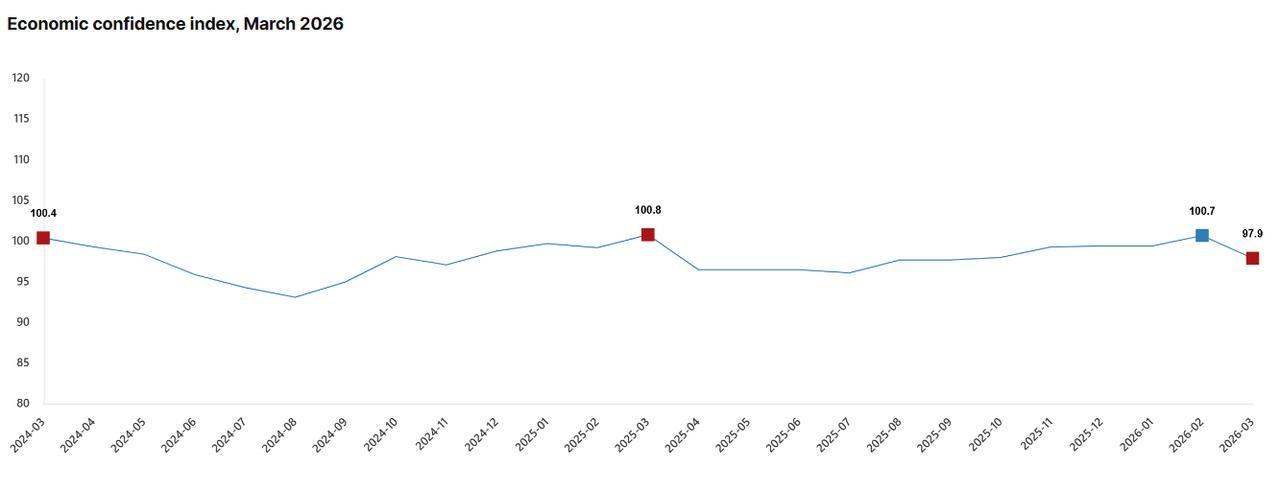
Türkiye’s economic confidence index decreased 2.8% month-on-month to 97.9 in March, slipping back into the pessimistic zone as the energy shock following the Iran war added to ongoing inflationary pressures, official data showed on Monday.
After rising to 100.7 in February, returning to the optimistic zone for the first time since March 2025, it dropped to its lowest level since July 2025.
The index serves as a key gauge of overall economic sentiment, signaling optimism above 100 and pessimism below, and offering insight into growth expectations and the broader business outlook.
All sub-indices posted declines in March, with the real sector confidence index dropping 3.9% to 100. Order books are expected to continue declining, while production and employment also appear to be softening across businesses, and price pressures remain elevated, the central bank's survey showed.
Consumer confidence edged down 0.8% to 85, driven mainly by weaker expectations for the general economic outlook and a slight decline in households’ willingness to spend on durable goods, despite a modest improvement in current financial conditions.
Services confidence fell by 0.5% to 113.2, with weaker demand expectations despite a slight pickup in recent activity, while retail trade dropped 2% to 113.6 amid declining sales and stock levels, and construction fell 3.9% to 80.6.

The deteriorating sentiment echoes rising global inflation concerns as energy flows through the Strait of Hormuz, which normally carries about a fifth of global oil and LNG supply, have been nearly halted following the outbreak of the Iran war.
As the conflict enters its fifth week, both international benchmark Brent crude and U.S. benchmark WTI oil continue to hover above $100 per barrel. As an energy-importing country, Türkiye has long seen rising energy costs as one of the key drivers of inflation, which had already accelerated before the war due to surging food prices in the first two months of the year.
As well as energy concerns, disruptions in the strait are also hindering trade with eight countries—the United Arab Emirates, Iran, Bahrain, Saudi Arabia, Iraq, Oman, Qatar, and Kuwait—that lie at the center of the conflict and accounted for 9% of Türkiye’s exports in 2025.
Concerns over the energy shock have prompted Turkish policymakers to temporarily raise funding costs to 40% in a move to further tighten conditions, while pausing an easing cycle that had continued for five meetings since July, leaving the policy rate at 37%.


 Set as preferred source
 Set as preferred source


 2 min read

 1 min read