Newsletters


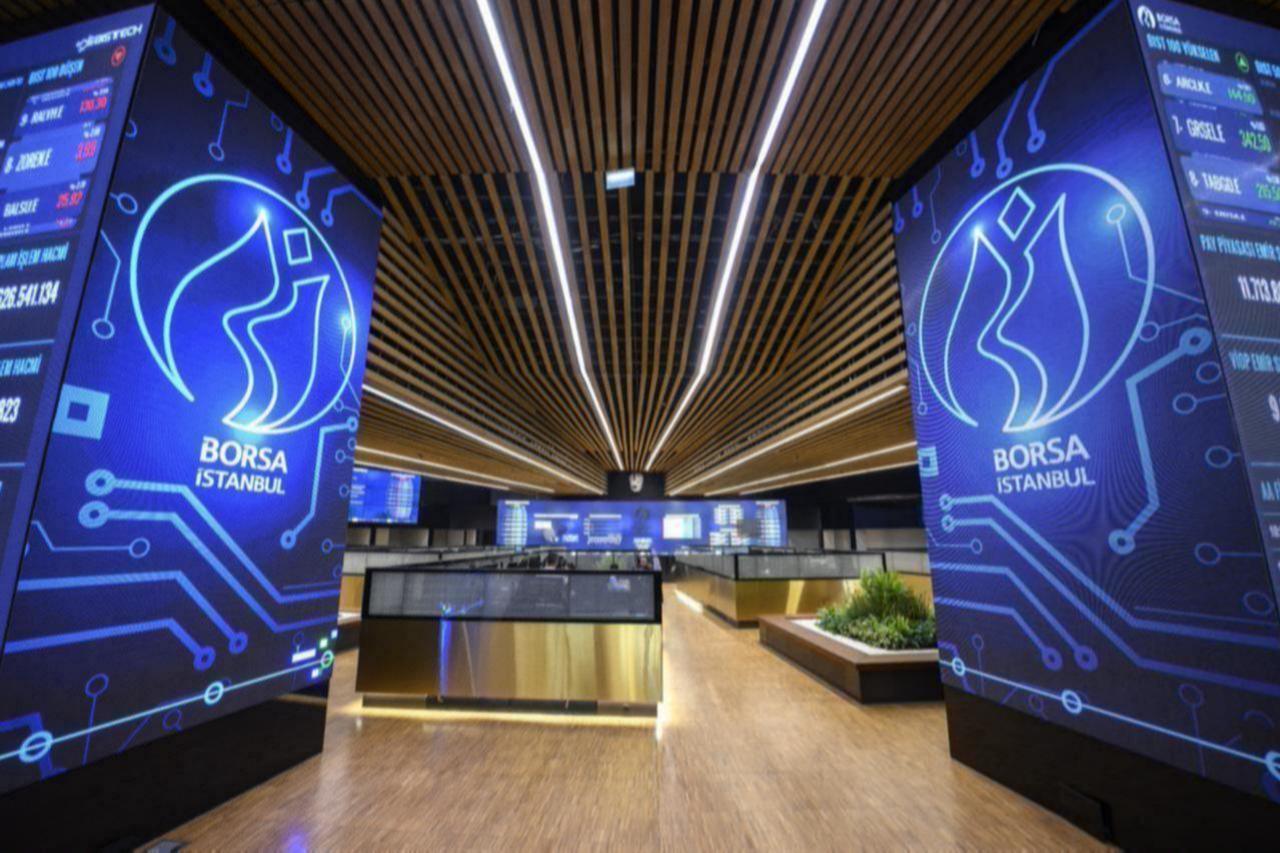


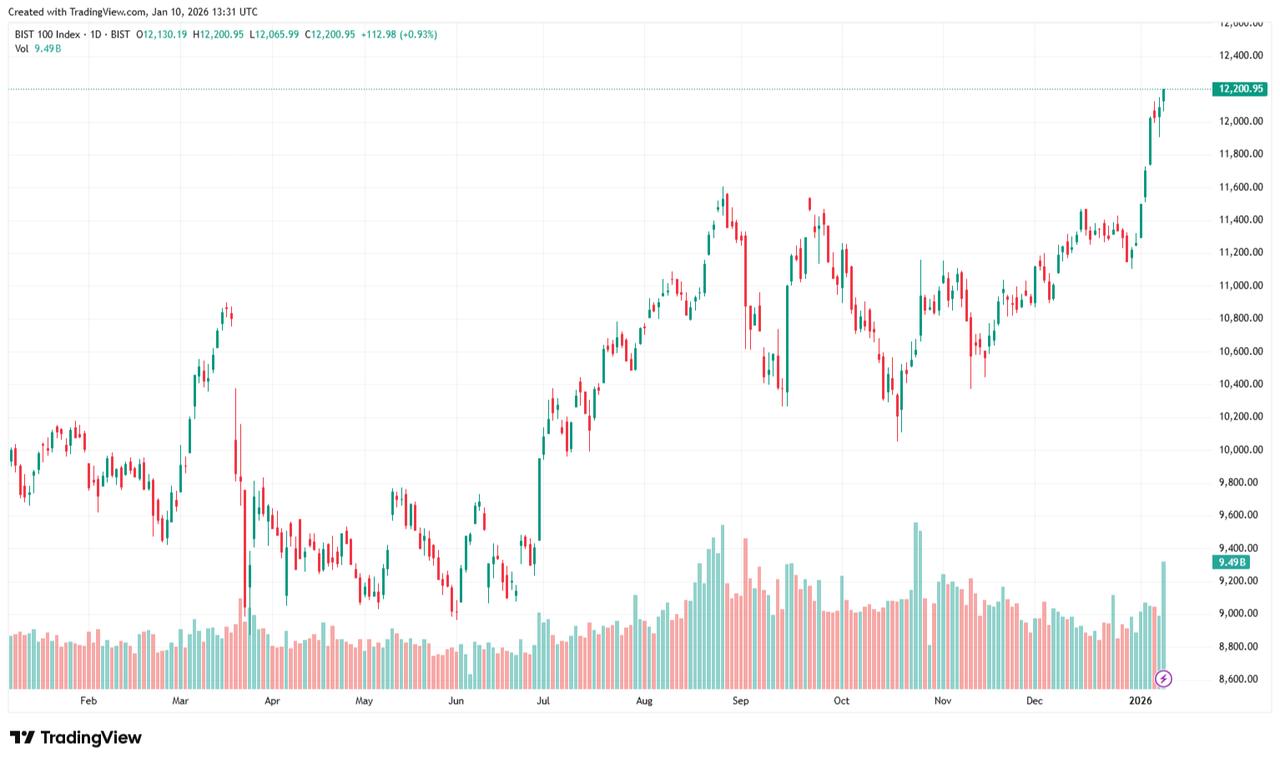
Türkiye’s stock exchange, Borsa Istanbul, opened 2026 on a strong footing as the benchmark BIST 100 index climbed 6.11% this week and 8% since the start of the year, closing at a record high of 12,200.95 points on Friday, supported by improving macroeconomic indicators.
Starting the year at 11,296.52 points, Turkish equities gained momentum after inflation eased more than anticipated in December, with the annual rate falling to 30.89% and the monthly figure to 0.89%, strengthening projections of a 150 basis-point rate cut by the Central Bank of the Republic of Türkiye (CBRT) in January, compared to earlier estimates of 100 basis points.
Alongside the drop in inflation, Türkiye’s five-year credit default swap (CDS) narrowed to 204.5 basis points, the lowest since May 2018, while two-year government bond yields fell as much as 36.4% to 37.05%, signaling reduced borrowing costs for the government and private sector.
Among major sectors, technology shares have led the BIST rally with a rise of 16.37% since Jan. 1. Financial stocks followed with a 6.12% increase, while services added 5.98% and industrials climbed 3.89%.
Sub-sectoral indices also posted strong advances. Financial leasing and factoring companies jumped 15.72%, trade improved by 9.64%, transportation rose 9.02%, and mining strengthened by 8.83%. Tourism and food & beverage added 2.57% and 5.74%, respectively, while insurance edged up 1.38%.
Conversely, textile & leather and sports stocks underperformed, declining 7.01% and 2.94%, respectively.
Among the most heavily weighted stocks in the BIST 100 index, state-owned defense electronics firm Aselsan extended its 2026 rally to 220%, posting a weekly increase of over 20%. Discount retailer BIM rose 12.67%, while private lender Akbank advanced 5.13%.
The banking index as a whole climbed 4.26%, and the holding & investment index performed even better, adding 7.96%.

Global equity markets reflected the optimistic mood, supported by expectations that the U.S. Federal Reserve will deliver further rate cuts in 2026. Confidence was also boosted by easing concerns over high valuations in the tech sector and a recent drop in oil prices, which is seen as helpful in the ongoing fight against inflation.
In Asia, South Korea’s Kospi led regional gains with an 8.36% rise to 4,586.32, driven by technology shares. Japan’s Nikkei 225 rose 1.82% to 51,939.89, Hong Kong’s Hang Seng gained 2% to 26,231.79, and China’s Shanghai Composite advanced 3.35% to 4,120.43.
European markets also opened the year on a strong note. The U.K.’s FTSE 100 increased by 1.95% to 10,124.60, Germany’s DAX 40 climbed 3.11% to 25,261.64, France’s CAC 40 added 2.23% to 8,362.09, and the pan-European Stoxx 600 rose 2.39% to 609.67.
In the U.S., the Dow Jones Industrial Average rose 2.96% to 49,504.07, while the S&P 500 gained 1.14% to 6,966.28. The tech-heavy Nasdaq increased by 0.77% to 23,702.88.


 Set as preferred source
 Set as preferred source


 1 min read

 1 min read