Newsletters





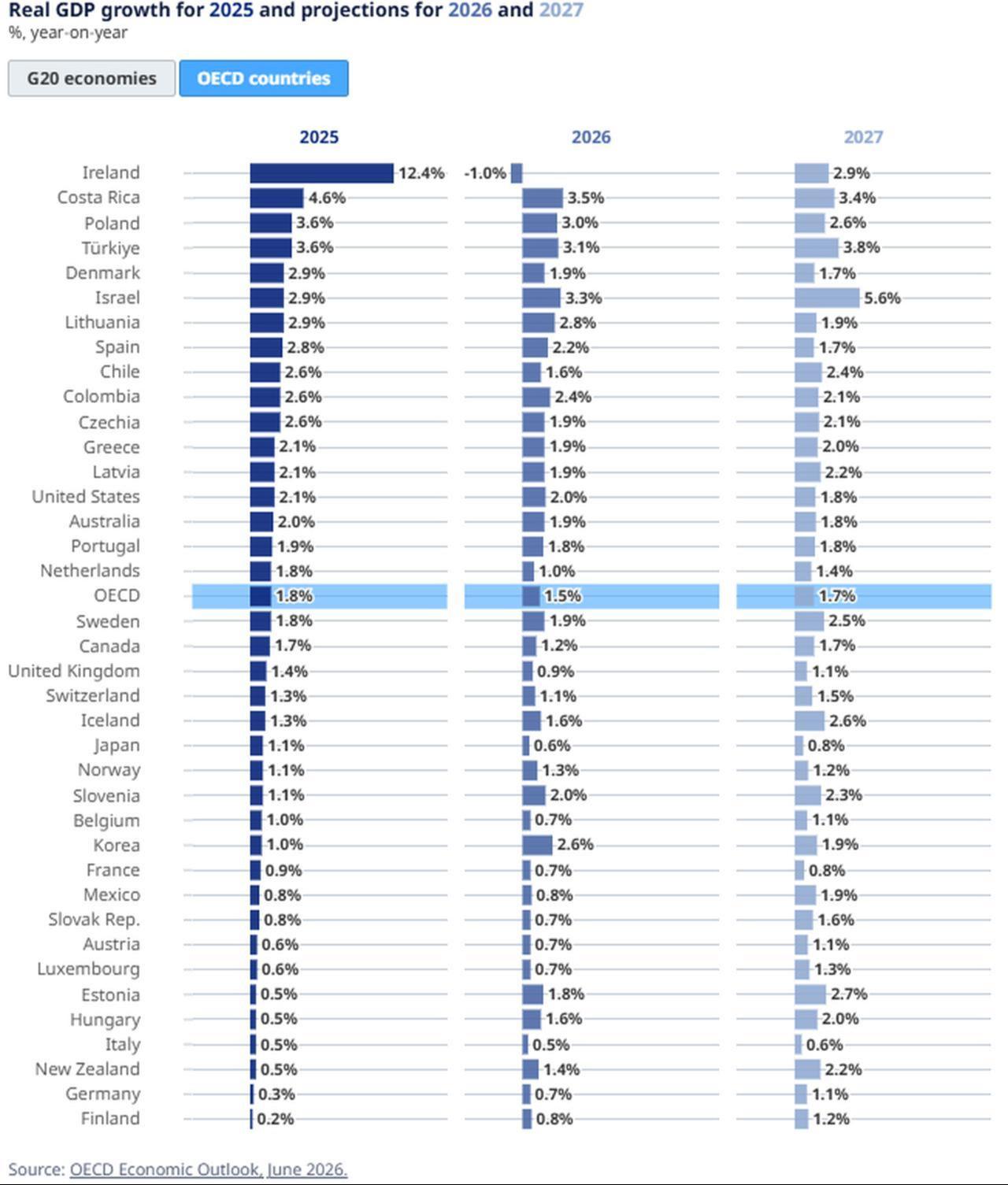
The Organization for Economic Co-operation and Development (OECD) lowered its 2026 growth forecast for Türkiye to 3.1% from 3.3% and projected inflation will fall below 20% in the first half of 2027, as a tight monetary policy continues to cool price pressures despite risks from the Middle East conflict.
In its latest Economic Outlook report, the OECD expected Türkiye's economy to expand by 3.8% in 2027, unchanged from its previous forecast, with improving consumer sentiment and lower interest rates later next year helping to support stronger consumption and investment.
Türkiye's economy grew 2.5% year-over-year in the first quarter of 2026, down from 3.4% in the previous quarter, while quarterly growth remained unchanged at 0.1%.
The OECD attributed the downgrade in Türkiye's growth outlook largely to higher energy and commodity prices, which are dampening domestic demand under tight financial conditions. After an expected soft patch in the first half of 2026, the organization forecasts economic activity to gain momentum as the impact of the regional conflict fades and inflation continues to ease.
"By late 2026, improving consumer sentiment and lower interest rates will underpin stronger consumption and investment," the OECD said, projecting growth of 3.8% in 2027.
More recent indicators nevertheless point to weaker economic momentum, as manufacturing activity became increasingly contractionary and industrial confidence weakened in the early months of 2026, while progress in bringing down inflation lost pace after substantial gains between mid-2024 and mid-2025.
Beyond energy-related risks, the organization highlighted growing pressures on Türkiye's export-driven industries. "Türkiye also remains vulnerable to a slowdown in European demand and competition from China on third markets, notably in manufacturing," the OECD said.

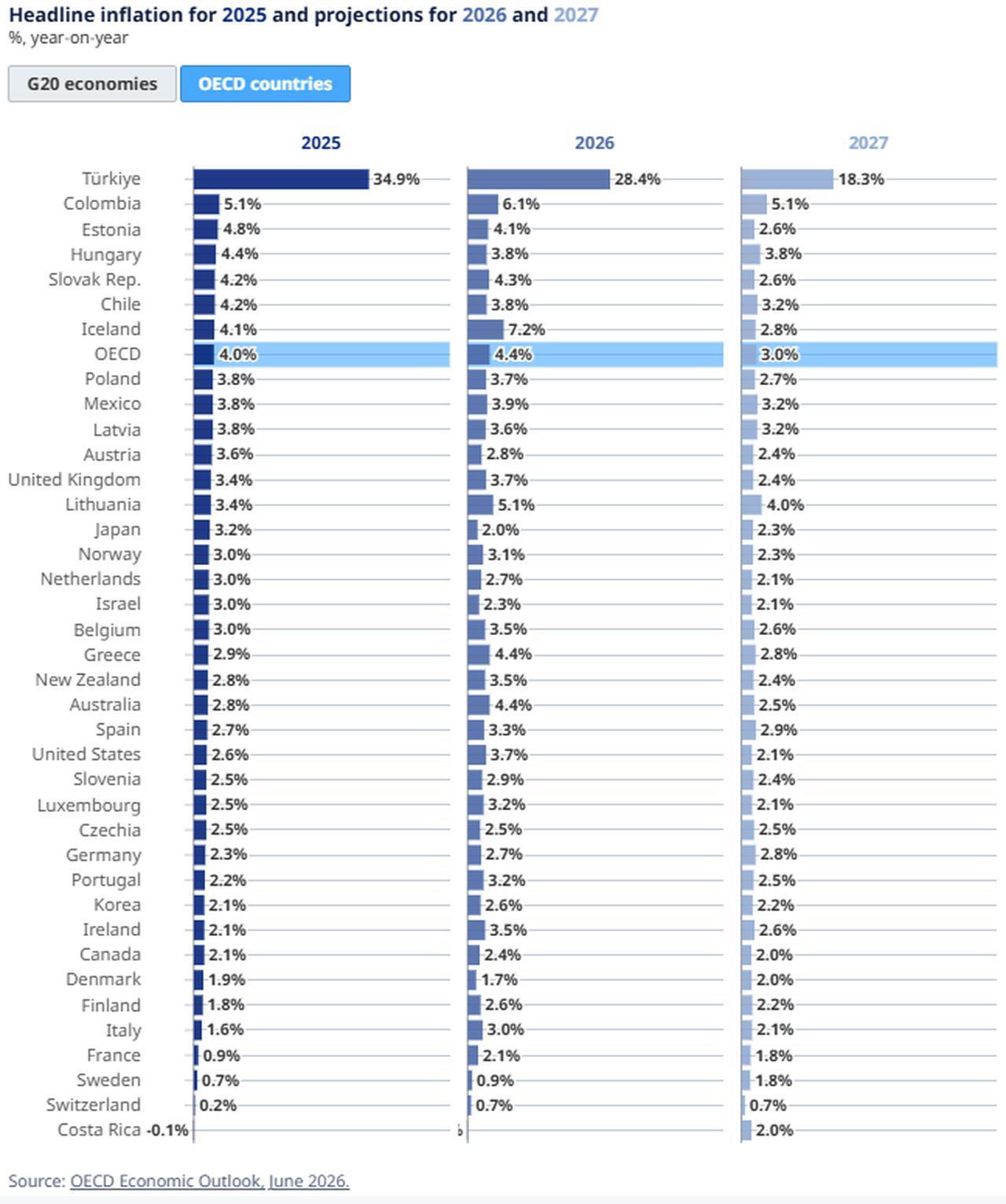
The OECD said Türkiye's disinflation process is set to continue despite recent setbacks, with annual inflation forecast to ease to 15% by the end of 2027.
However, the organization indicated that progress in reducing inflation has slowed in recent months and warned that the resulting price pressures stemming from the Iran war could further delay the disinflation process.
Annual inflation rose to 32.4% in April, compared with 30.7% in January, while core inflation eased only marginally and producer price inflation accelerated.
"Maintaining a tight monetary policy is key to lower inflation expectations, which remain far above the central bank's inflation target," the report said, adding that future rate increases "should not be ruled out."
As a net importer of energy and fertilizer, Türkiye remains exposed to higher commodity prices through both inflation and the current account balance. However, the OECD said direct supply risks are relatively contained because most of the country's oil, natural gas and fertilizer imports originate outside the Persian Gulf.
The OECD cautioned that uncertainty surrounding the Iran war continues to cloud the global economic outlook, with questions remaining over the duration of the conflict, the extent of damage to regional infrastructure and the potential impact on global supply chains.
The organization noted that even after hostilities end, rebuilding transport links and restoring disrupted trade routes could take months, prolonging economic pressures across a range of sectors.
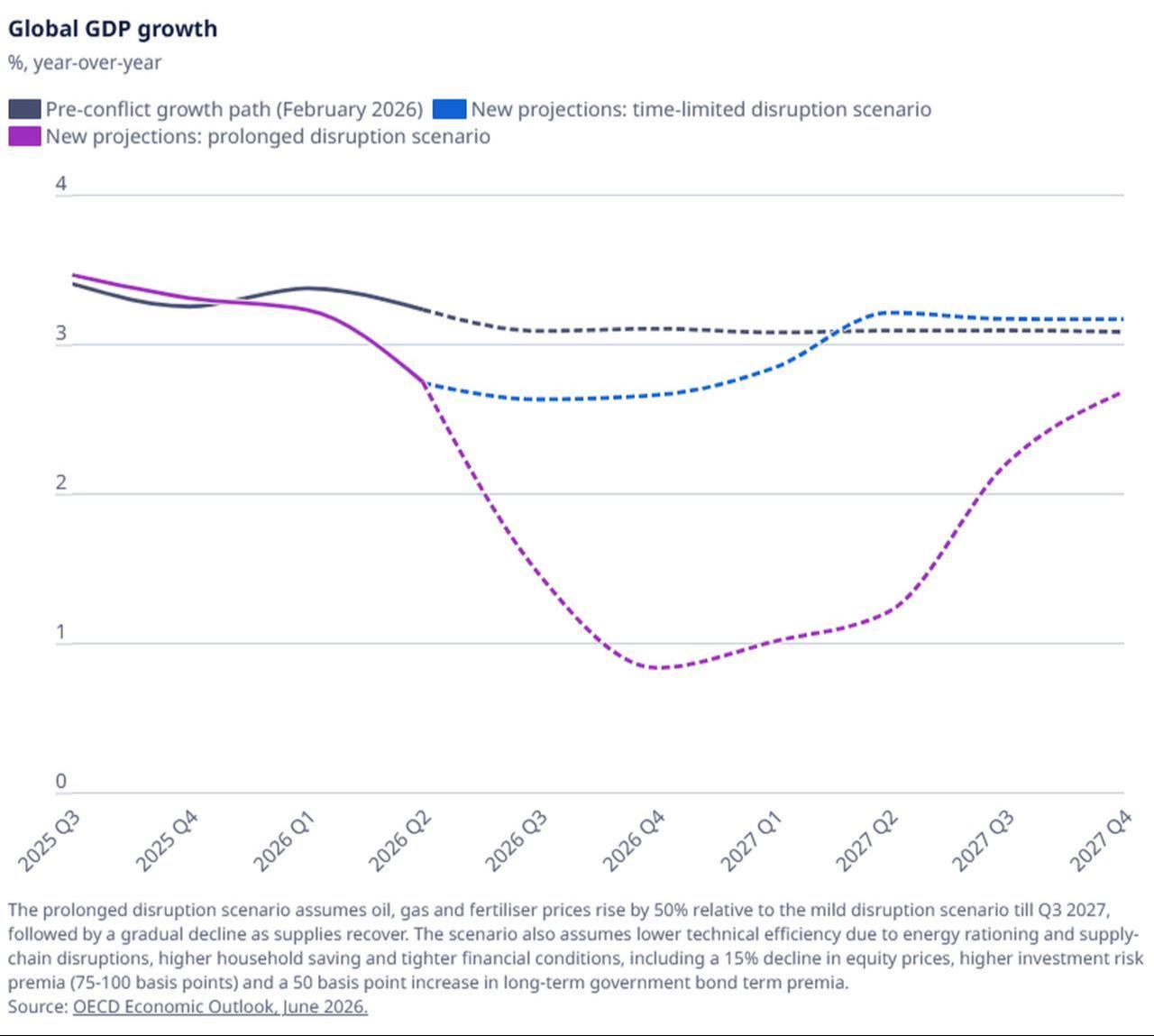
Under its baseline scenario, which assumes disruptions to energy production and trade in the Gulf gradually ease from the third quarter of 2026, the OECD expects global growth to slow from 3.4% in 2025 to 2.8% in 2026 before recovering to 3.1% in 2027.
Inflation across G20 economies is projected to rise from 3.4% in 2025 to 4% in 2026 before easing to 3.1% the following year, as higher energy and commodity prices continue to feed through to broader consumer prices.
The OECD also outlined a more severe scenario in which disruptions to energy production and trade in Gulf economies persist until the second half of 2027. Under that outlook, shortages of energy, agricultural and industrial inputs would become more widespread, potentially weighing on productivity and investment while creating lasting effects on economic output.
Global growth could cool to 2.1% in 2026 and 1.8% in 2027, while higher inflation may force central banks in many countries to keep interest rates elevated for longer or tighten policy further.
Separately, the European Bank for Reconstruction and Development (EBRD) lowered its forecast for Türkiye's economy, projecting growth of 3.5% in 2026 and 4% in 2027, down from its February forecasts of 4% and 4.5%, respectively.
The bank attributed the downgrade to rising energy import costs, persistent inflationary pressures and the potential effects of the Middle East conflict on tourism and manufacturing value chains. According to the report, higher energy prices, capital outflows, weaker tourism revenues and disruptions to industrial supply chains could place additional pressure on inflation and the current account balance.
Despite those risks, the EBRD said strengthened fiscal and external buffers should allow the Turkish economy to absorb external shocks relatively comfortably.
The bank also revised down its outlook for the broader EBRD region, forecasting aggregate growth of 3.1% in 2026, down from 3.4% in 2025, before a recovery to 3.6% in 2027. The latest Regional Economic Prospects report identified the escalation of the conflict in the Middle East as the principal shock weighing on the regional outlook.
Rising oil and gas prices, disruptions to shipping through the Strait of Hormuz and a widening gap between European and U.S. energy costs are expected to weigh on competitiveness and economic activity across the region, while inflation accelerated to 6.4% between February and April, driven largely by higher energy and food prices.


 Set as preferred source
 Set as preferred source


 1 min read

 1 min read