Newsletters


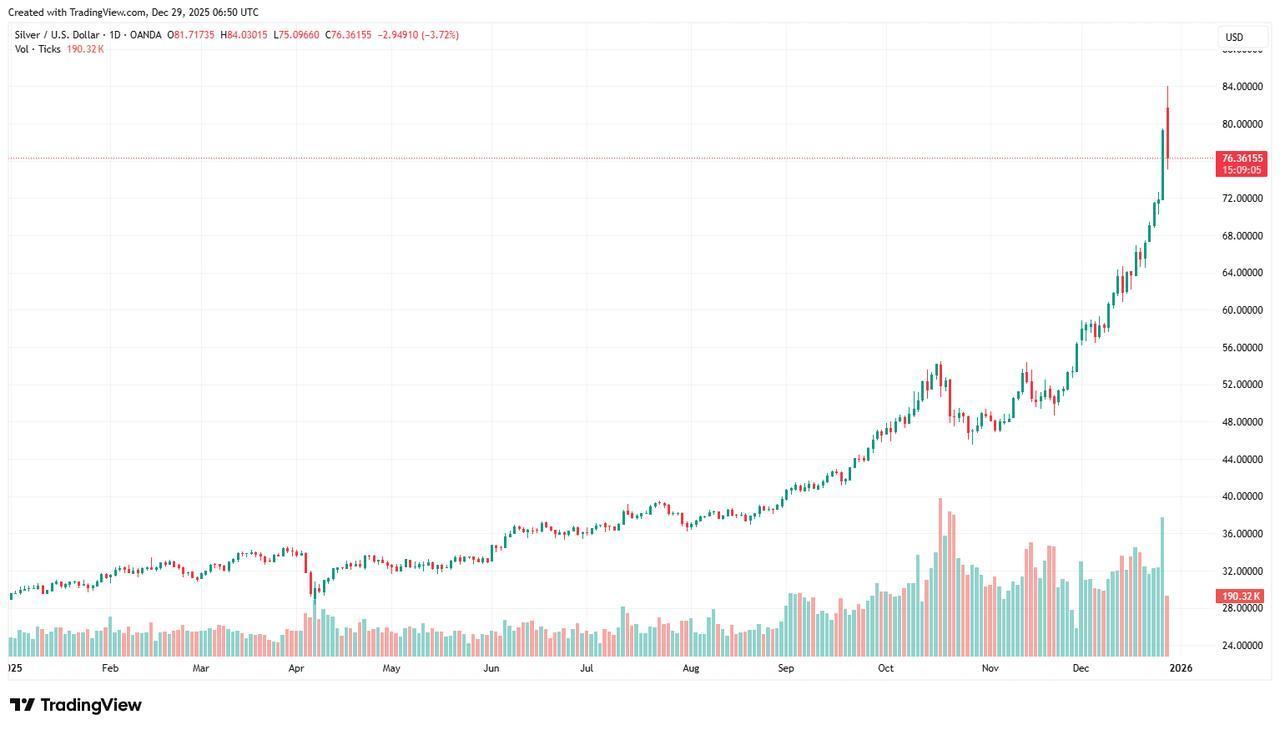
Silver prices surged past $80 per ounce for the first time on Monday, driven by deepening global supply constraints and growing industrial and investment demand.
Spot prices peaked at $83.94 before sharply retreating to $74.98 as of 7:00 a.m. GMT, marking a daily loss of over 5.1%.
The white metal has now gained 181% year-to-date, outperforming gold, fueled by its designation as a critical mineral by the United States, dwindling inventories, and heightened safe-haven buying as the U.S. Federal Reserve pursues a monetary easing cycle expected to extend into 2026.
Market concerns intensified as China, the world’s largest silver producer, prepares to implement sweeping export restrictions starting Jan. 1, 2026.
Under the new rules, silver shipments will require government-issued licenses, replacing the existing quota-based system and significantly limiting the unrestricted export of silver.
The licensing system could functionally operate as a near-ban, given its stringent criteria, potentially removing a sizable portion of tradable silver from global markets, according to the analysts.
China produced approximately 3,300 tons of silver in 2024, according to data from the U.S. Geological Survey (USGS).
Commenting on the measure, Elon Musk, the world’s richest person and owner of electric vehicle maker Tesla, said, "This is not good. Silver is needed in many industrial processes."
Silver plays a key role in several industries due to its high electrical conductivity, corrosion resistance, and thermal properties. It is widely used in electronics, medical equipment, and clean energy technologies, including solar panels.

On the other hand, safe-haven demand eased amid profit-taking following record-breaking levels and signs of easing geopolitical tensions.
Gold, which reached $4,550.11 per ounce last week, moved down 1.6% to $4,463.15 on Monday. Other precious metals also declined, with platinum dropping 7.7% to $2,295.76 and palladium falling over 12.2% to $1,780.56 per ounce.
The moderation came after comments from U.S. President Donald Trump and Ukrainian President Volodymyr Zelensky suggested progress toward a peace deal with Russia.
Trump reportedly spoke with Russian President Vladimir Putin by phone and said negotiators were "getting closer" to an agreement. Additional meetings are expected as early as next week.
Cryptocurrency markets, on the other hand, showed renewed strength after a downturn that began in October, with global market capitalization rebounding 2.3% to over $3 trillion. Bitcoin rose by around 2% to surpass $90,000, while Ethereum climbed 3.3% to exceed $3,000.
 Breaking News, Direct to You.
 Follow Türkiye Today on WhatsApp
for real-time updates and key insights from Türkiye and beyond.
Follow Türkiye Today on WhatsApp
for real-time updates and key insights from Türkiye and beyond.
In energy markets, West Texas Intermediate (WTI) crude rose 1.2% to $57.41 per barrel, while Brent crude gained to $60.93.
The move follows renewed U.S.-Venezuela tensions, including a U.S. naval blockade of Venezuelan oil tankers and threats of military action over alleged drug trafficking ties to President Nicolas Maduro.
Venezuela, home to the world’s largest proven crude oil reserves of over 300 billion barrels, has struggled to translate its resource wealth into production due to long-standing U.S. sanctions, chronic underinvestment, and deteriorating infrastructure.
Nevertheless, its oil production remains between 860,000 and 1,000,000 barrels per day, although export capacity continues to be constrained by limited refining capabilities and logistical bottlenecks.


 Set as preferred source
 Set as preferred source


 1 min read
 1 min read