Newsletters




From the street, the house looks fully lit. Most adults are online, and 5G arrived this spring. Step inside, though, and the OECD’s latest outlook finds most of the rooms shut: fewer than one in 13 firms uses artificial intelligence, one in five uses the cloud, and among people aged 55 to 74, 1.8% have tried generative AI.
The report suggests the doors are not locked by choice. They are stuck on cost, skills and access.
The organization’s Digital Economy and Society Outlook 2026 compares how member countries use cloud computing, data analytics and artificial intelligence, and how their citizens use the internet. Türkiye ranks near the bottom on most of these measures.
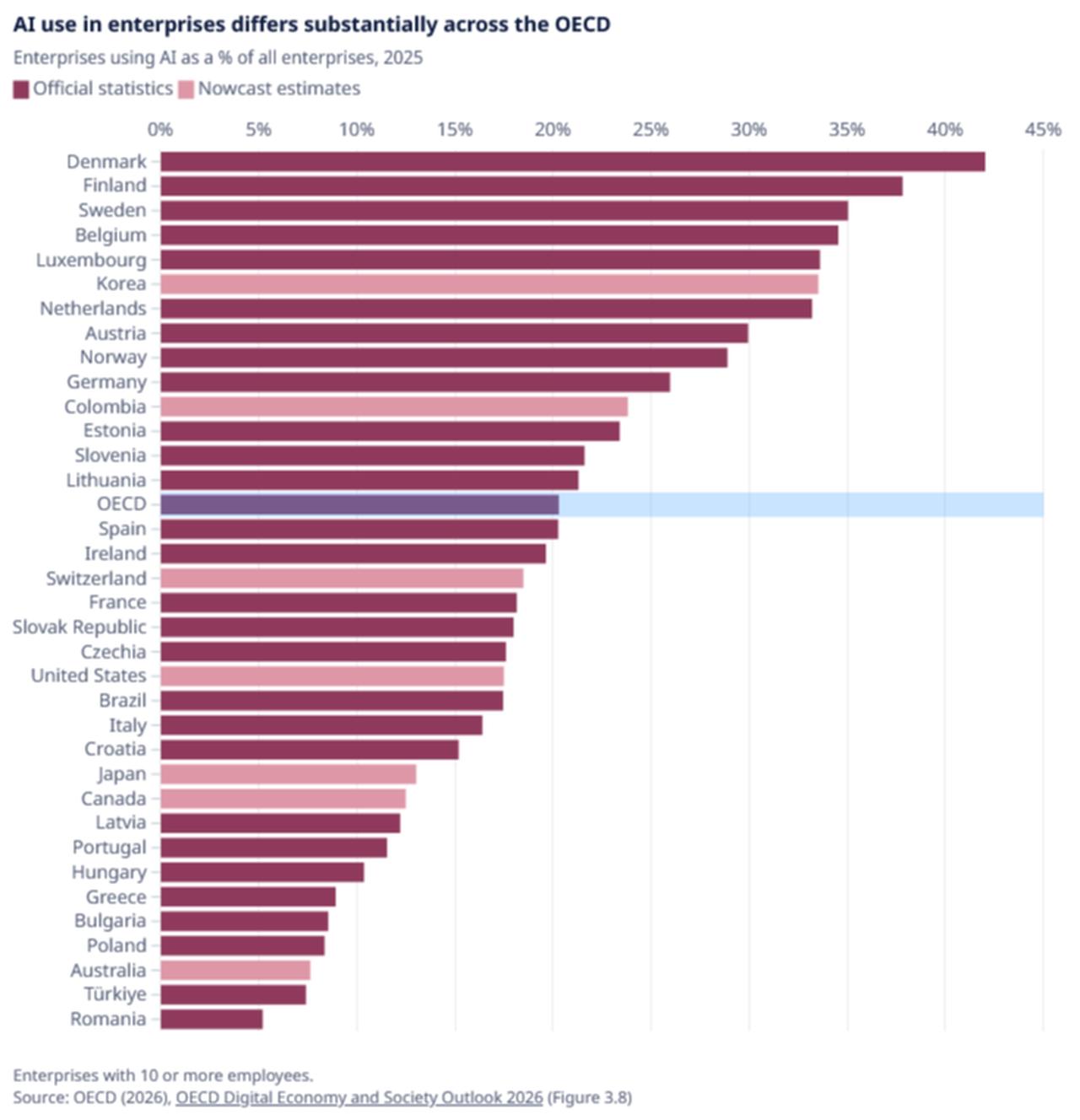
Only 7.4% of Turkish companies with 10 or more employees used artificial intelligence in 2025, according to the report. The average across OECD members is 20.3%. Of the 34 countries with comparable data, only two ranked lower.
The gap is wider for other business technologies. One in five Turkish firms (20.3%) uses cloud computing, compared with 54.6% across the OECD. Bulgaria is the only country in the table with a lower rate. Big data analytics is used by 16.3% of firms in Türkiye, less than half the OECD average of 37.7%.
The report names Türkiye as an example of a country where uptake is limited across all technologies and large firms are far ahead of the rest. Among small firms, 6.6% use AI. Among large firms, the share rises to 23.5%, still less than half the OECD figure of 52.1% for companies of that size.
Turkish information and communication companies come closest to their OECD peers, with 47.1% using AI against an average of 57.5%. Outside that sector, the numbers drop sharply. AI use stands at 7.6% in retail, 7% in manufacturing and 3.9% in construction. One category runs against the trend. Use of autonomous robots, drones and self-driving vehicles is 1.5% in Türkiye, the same as the OECD average.

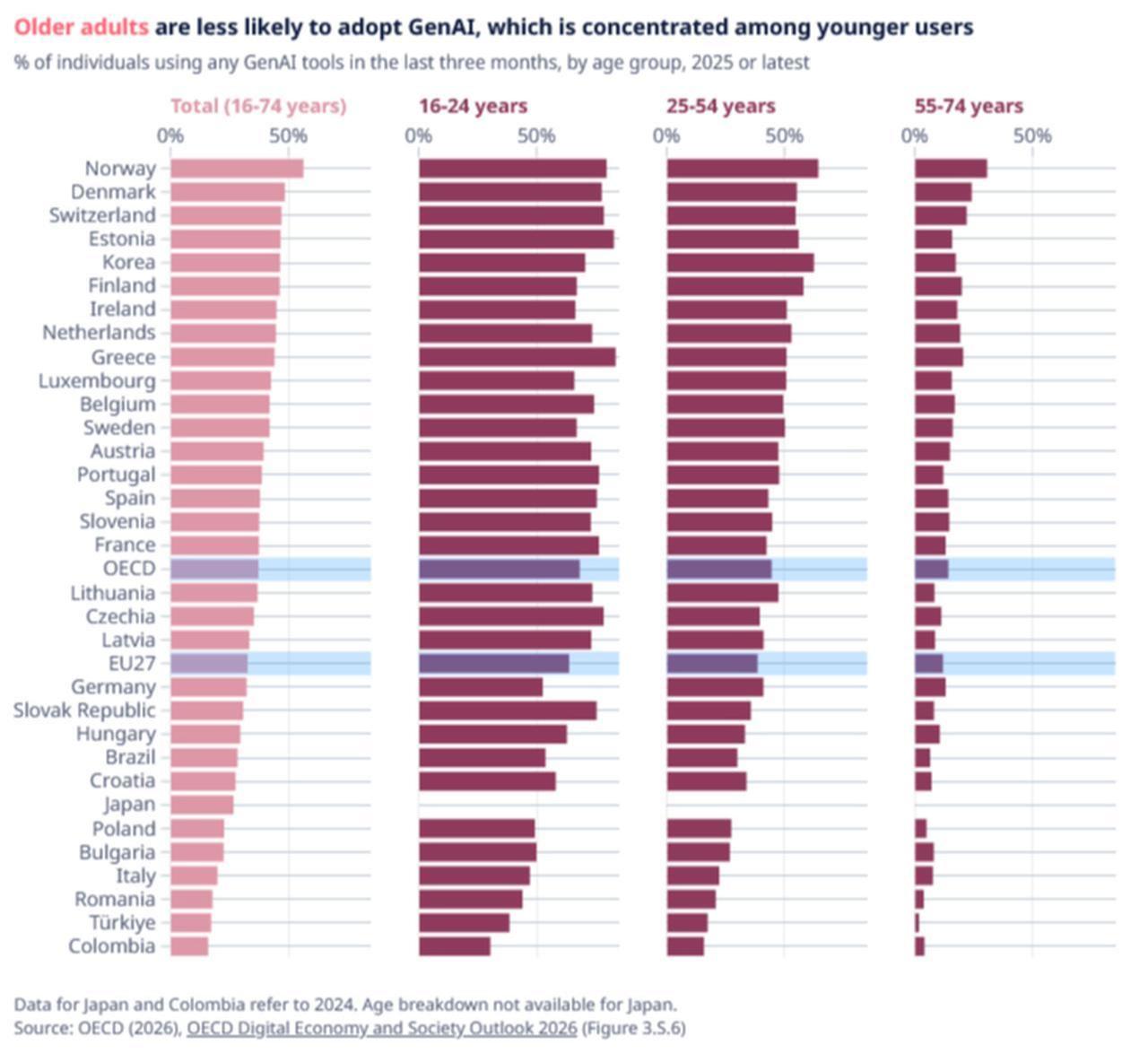
The household data tells a similar story. In 2025, 17.2% of Turkish adults aged 16 to 74 used generative AI tools to create content, compared with 37.2% across the OECD. Türkiye ranked 31st out of 32 countries.
Age is the sharpest dividing line. Among people aged 55 to 74, just 1.8% use generative AI, the lowest rate of any country in the dataset. The OECD average for that age group is 14.2%. Young people are more active, but at 38.5% for those aged 16 to 24, they remain well below the OECD average of 68.3%.
Education and income also matter a great deal. Generative AI use is 6.4% among adults with low education levels and 35.8% among university graduates. In the lowest income group, the rate is 6.9%. In the highest income group, it is 29.3%, barely above the OECD average for the poorest group (28.4%).
The gender gap is small. Usage stands at 16.4% among women and 18% among men. Use for work purposes is low overall: 5.8% of Turkish adults use generative AI for their jobs, against 19% across the OECD.
Older people have moved online quickly over the past decade. In 2015, just over one in 10 people aged 55 to 74 used the internet. By 2025, the share was around two-thirds. That growth has not carried over to public services. About three-quarters of Turkish adults use the internet to deal with government services, but among older adults the share is below half. The OECD singles out Türkiye for this age gap, which it puts at more than 30 percentage points.
In purchasing power terms, Turkish broadband prices are below the OECD average. A 1 gigabit per second (Gbps) fixed package costs $56.3 a month, against an average of $62.4. Basic mobile plans are also cheaper, while high-data packages cost more. These comparisons adjust for price levels but not for incomes, so they do not show how much of a household budget a monthly bill takes up in Türkiye.
Türkiye launched 5G only in April 2026, after a spectrum auction that finished in October 2025. That was too late for the country to appear in the report’s 5G coverage and speed charts.
The report cites the Information and Communications Technologies Authority (BTK) for one consumer protection measure. After reviewing fixed-term contracts, the regulator ruled that some inflation-linked price clauses were unfair and required operators to state future price increases clearly in contracts. The OECD presents this as an example alongside a similar measure by Britain’s Ofcom.
Close to 30% of Turkish 15-year-olds play video games for more than three hours on a typical school day, compared with about a quarter across the OECD. The share is close to 40% among boys and a little over 20% among girls. The report estimates that the link between weekday gaming and test scores turns negative after a little over an hour a day, with sharper declines beyond three hours.
The OECD figures point to barriers rather than reluctance. The report links slow uptake among smaller firms in countries like Türkiye to limited access to finance, digital infrastructure and digital skills. Use of new tools also falls with age, education and income, which suggests that cost and skills play a large part in deciding who gets access.
The digital policies Türkiye reported to the OECD focus mainly on innovation and trust. Few of them address the barriers that keep small businesses, older adults and lower-income households from using these tools.


 Set as preferred source
 Set as preferred source


 1 min read


 1 min read