Newsletters




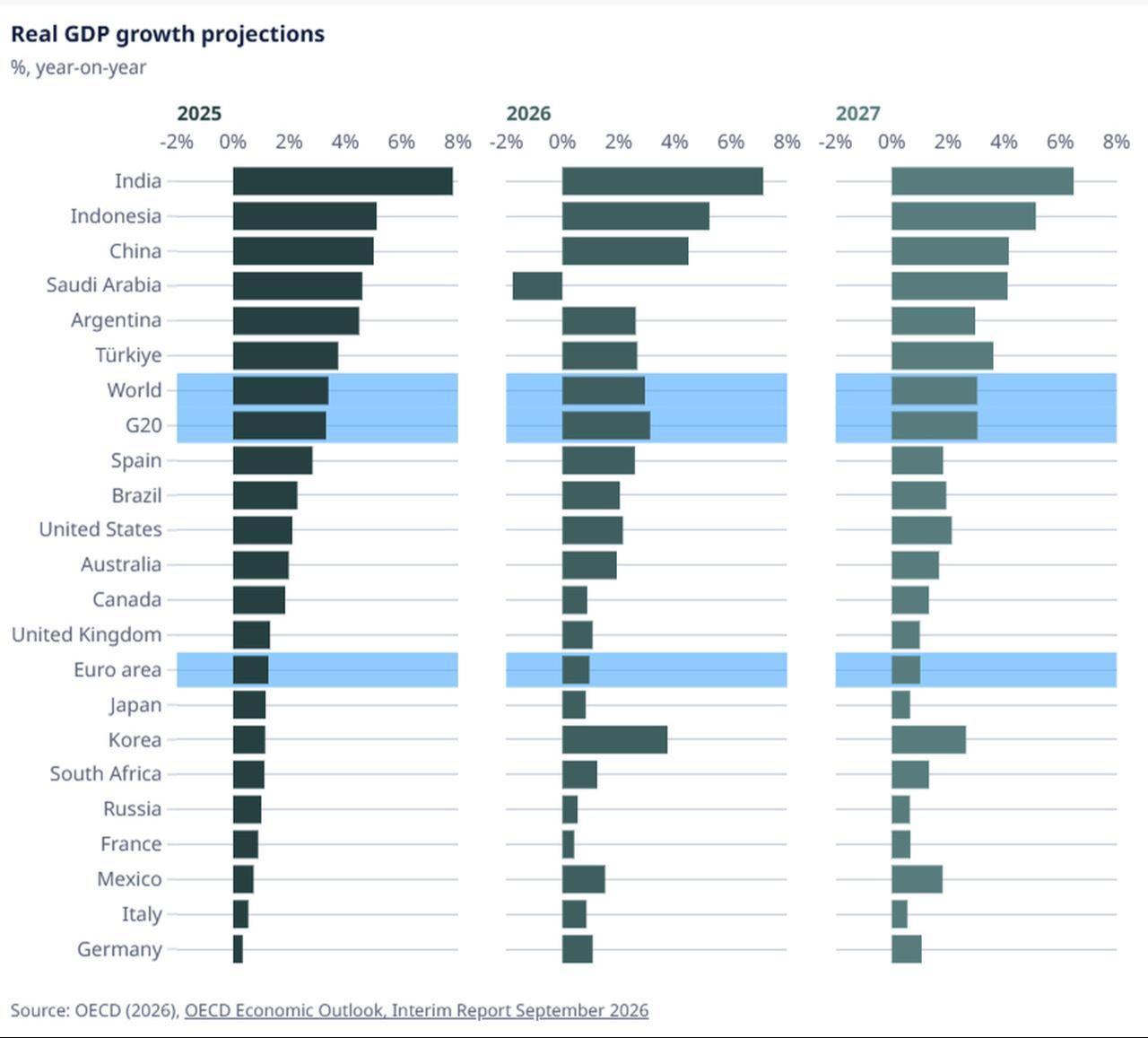
The OECD forecasts Türkiye’s economy to grow 2.7% in 2026, below the 3% threshold and its lowest growth rate since 2020, revising down its previous projection as the economic effects of the Iran war and higher energy and fertilizer prices weigh on the outlook.
The organization, which released its interim Economic Outlook titled “Weathering Successive Shocks,” also lowered its 2027 growth forecast for Türkiye to 3.6%. In its previous forecast, the OECD had projected 2026 growth at 3.1% and 2027 growth at 3.8%.
However, despite pressure from higher energy and fertilizer prices, the OECD expects Türkiye’s disinflation process to continue, with inflation at 31.5% in 2026 and 24.7% in 2027. As disinflation continues, monetary policy easing in emerging economies such as Türkiye and Brazil is expected to support economic growth, it added.
The OECD projected global economic growth at 2.9% in 2026, up 0.1 percentage points from its June forecast, after the global economy grew 3.4% in 2025.
Growth slowed during the first half of 2026, although many economies remained resilient despite geopolitical risks in the Middle East. Continued strength in artificial intelligence also supported investment, production and trade.
The OECD forecast U.S. growth at 2.2% in 2026 and 2.1% in 2027. Growth in the euro area was projected at 1% in both years, while China's economy was expected to expand 4.5% in 2026 and 4.2% in 2027. India was projected to post the highest growth rate this year at 7.8%, followed by Indonesia at 5.2%.
Saudi Arabia was expected to record the largest contraction, at minus 1.8%. The forecast represented a 5-percentage-point downward revision from the OECD's June projection, with lower oil production and exports after the war playing a key role in the expected contraction.

The OECD warned that the global outlook remained heavily dependent on whether a lasting resolution could be reached to the war in the Middle East.
Production bottlenecks pushed refinery margins higher, adding upward pressure on consumer prices and business costs. Energy prices also remained elevated, while some agricultural prices stayed high as extreme weather disrupted supplies.
Ongoing changes in trade policy, including tariffs and export restrictions, further increased uncertainty and contributed to supply disruptions.
The OECD projected that global inflation would accelerate in the short term as higher commodity prices filtered through to consumer prices, before gradually easing in 2027 as energy prices moderated and tighter monetary policy helped contain broader price pressures.
The organization warned of "significant uncertainty" around its projections, particularly over developments in energy markets. Oil and natural gas prices were expected to depend heavily on the duration of supply disruptions, producers’ and consumers’ ability to adjust, and geopolitical developments.
A faster normalization of energy markets could ease inflationary pressure and support economic activity, while renewed or prolonged disruptions could push inflation higher and weigh on growth.


 Set as preferred source
 Set as preferred source


 1 min read

 1 min read