Newsletters





Türkiye’s current account balance posted a $7.5 billion deficit in February, pushing the annualized gap to $35.4 billion, according to data released by the Central Bank of the Republic of Türkiye (CBRT) on Monday.
The deterioration was largely driven by the goods account, which recorded a $7.5 billion deficit in February. By contrast, the services sector continued to offset part of the pressure, generating a $2 billion surplus.
Excluding gold and energy, the current account showed a more moderate deficit of $1.5 billion.
On an annualized basis, the goods deficit climbed to $73.2 billion. Services maintained a strong performance with a net surplus of $62.6 billion, while primary and secondary income balances posted deficits of $24 billion and $0.9 billion, respectively.
Financing of the deficit leaned heavily on capital inflows. Direct investment brought in a net $2.6 billion, while portfolio investments contributed $2.4 billion. Loans stood out with a substantial $38 billion net inflow, alongside $1.3 billion in trade credits.
Foreign direct investment into Türkiye rose by $780 million, while domestic investors increased their overseas investments by $918 million. Real estate transactions remained balanced, with residents purchasing $225 million worth of property abroad and non-residents acquiring $230 million in Türkiye.
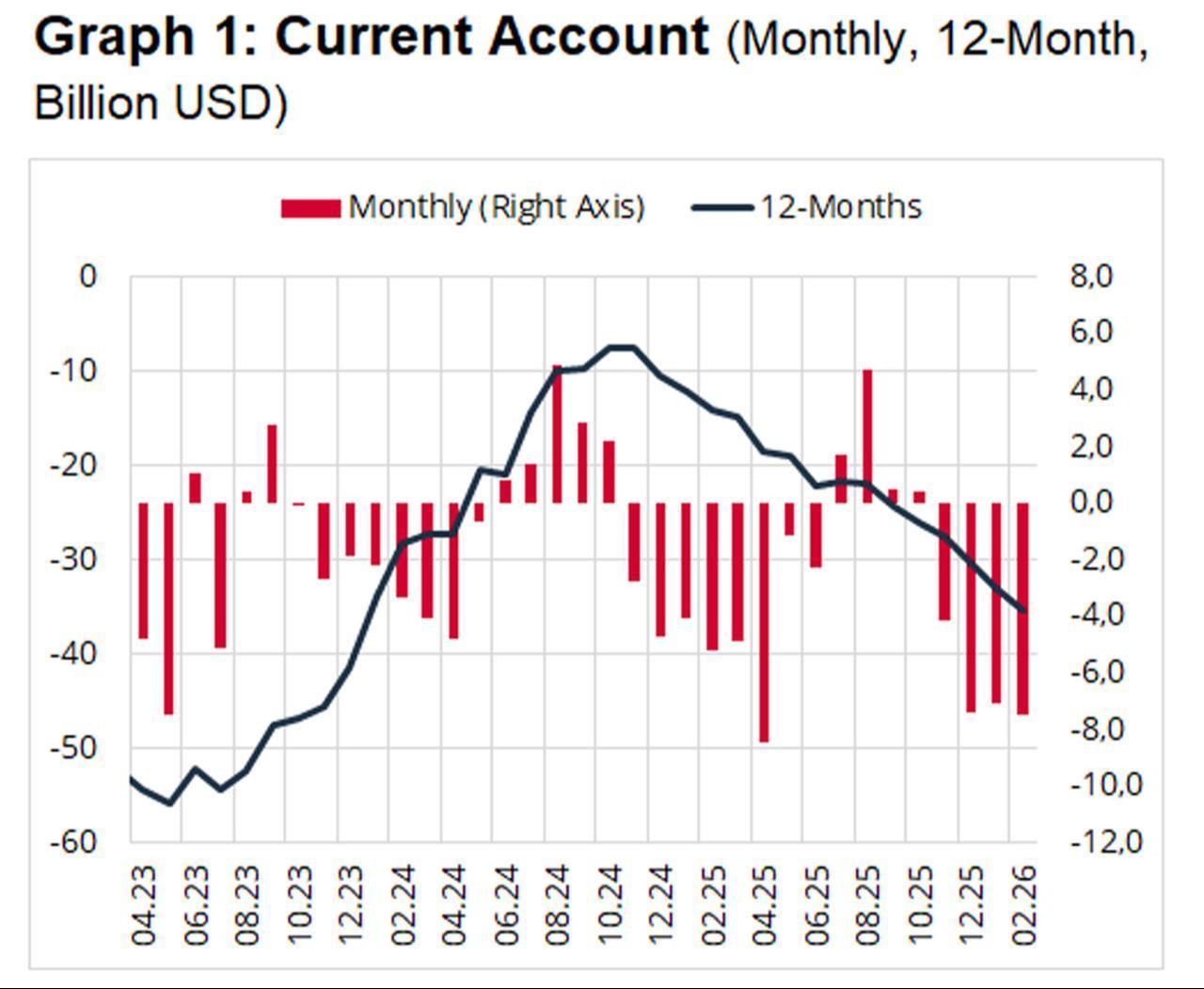

The monthly deficit reached a 10-month high, prolonging the widening trend to six consecutive months.
In its assessment, ING Global stressed that the figure exceeded market expectations of $7.1 billion and warned of further deterioration, citing preliminary Trade Ministry data showing the foreign trade deficit widened by more than $4 billion year-on-year in March. This trend, the institution noted, suggests the current account may remain under strain in the near term.
Rising energy prices tied to the Iran conflict, a potential slowdown in tourism revenues, and increasing gold imports are expected to keep upward pressure on the deficit.
The outlook on the capital account also carries risks. Prolonged geopolitical uncertainty could lift Türkiye’s risk premium, potentially accelerating portfolio outflows and complicating external financing conditions, ING warned.
Trade Minister Omer Bolat also flagged potential risks while emphasizing structural advantages that could limit further deterioration.
“While global conditions in 2026 may create additional pressure on the current account, Türkiye’s diversified export structure, expanding product range, and improving technological capacity will help keep potential deterioration under control and risks at manageable levels,” the minister said.
"As the Trade Ministry, we continue our work to limit the risks posed by geopolitical volatility on our foreign trade and to capitalize on emerging opportunities."


 Set as preferred source
 Set as preferred source


 1 min read
 1 min read