Newsletters





Türkiye’s price level index for actual individual consumption stood at 51 in 2024, meaning that a €100 ($117.09) basket in the EU could be purchased for just €51 worth of Turkish lira in Türkiye, according to the latest Purchasing Power Parity data released by Eurostat.
In other words, Türkiye remains relatively inexpensive for both local consumers and foreign visitors when prices are compared on a purchasing power parity (PPP) basis.
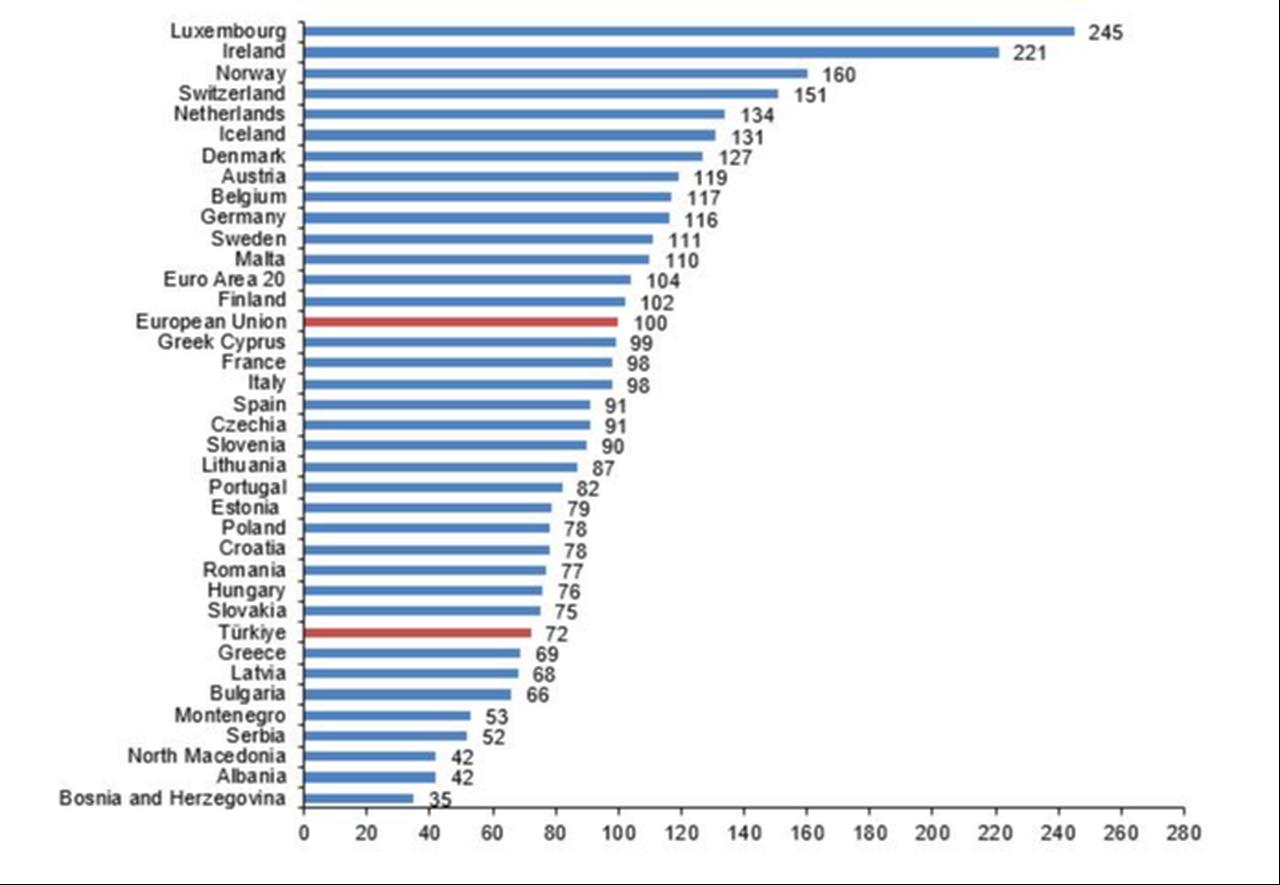
However, measured in terms of gross domestic product (GDP) per capita adjusted for PPP, commonly used to compare economic development across countries, Türkiye’s index value reached 72 in 2024, indicating that the economic output per person in Türkiye remains 28% below the EU mean when adjusted for cost-of-living differences and currency exchange rates.
Among the 36 countries surveyed, Luxembourg topped the list with a GDP per capita index of 245, more than twice the EU average, while Bosnia and Herzegovina recorded the lowest score at 35.
Türkiye’s position places it above several non-EU economies but still behind most EU member states, ranking 27th out of 34 individual countries in the comparison.
It stands ahead of seven countries: Slovakia, Greece, Latvia, Bulgaria, Montenegro, Serbia, North Macedonia, Albania, and Bosnia and Herzegovina.

Beyond GDP, Eurostat also publishes figures on actual individual consumption (AIC) per capita, which many economists view as a better indicator of personal well-being.
The measure accounts not only for goods and services purchased by individuals but also for those provided by the government or non-profit institutions, such as education and healthcare.
Türkiye’s AIC index stood at 71 in 2024, which is 29% below the EU average of 100. The country ranked 28th out of 34 nations, ahead of only five: Montenegro, Serbia, North Macedonia, Albania and Bosnia and Herzegovina.
Although the economy has expanded, these figures show that average consumption in Türkiye remains considerably lower than in most European countries.
Luxembourg topped the list with a score of 146, while Bosnia and Herzegovina recorded the lowest at 42.


 Set as preferred source
 Set as preferred source


 1 min read
 1 min read