Newsletters




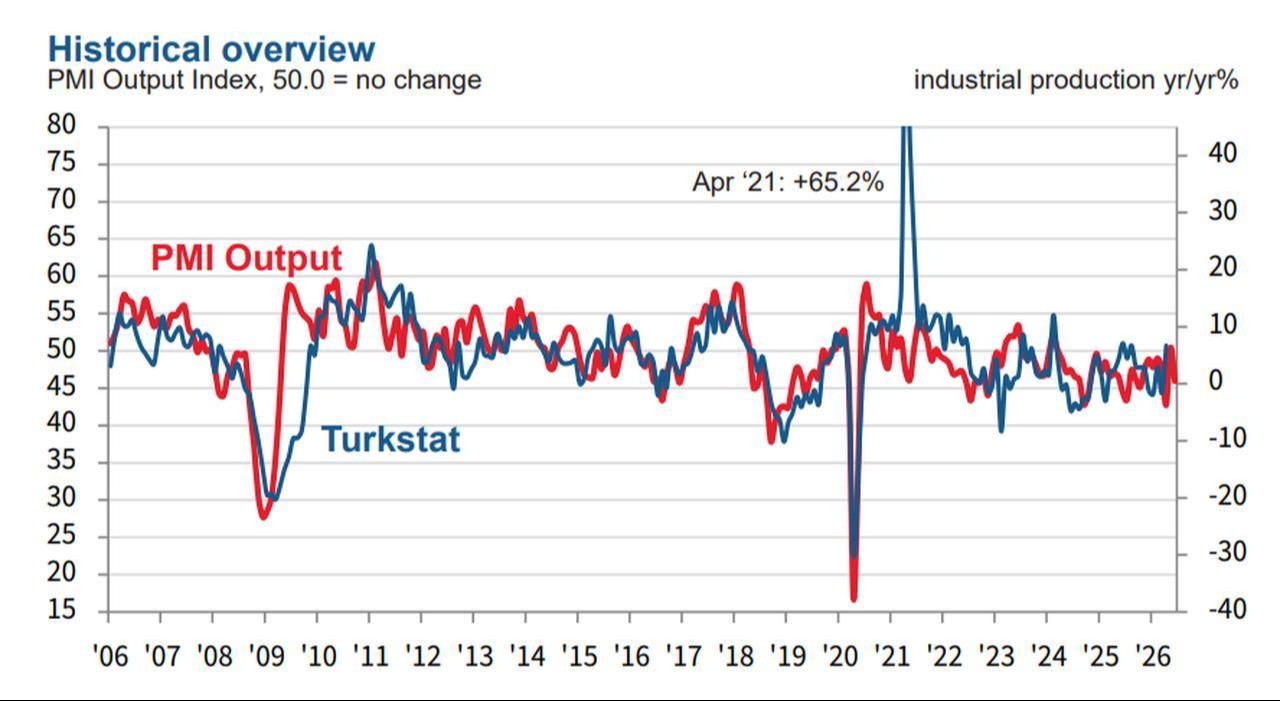
Türkiye's manufacturing sector lost momentum in June, with the headline Purchasing Managers' Index (PMI) falling to 47.1 from 49.8 in May as softer demand and uncertainty surrounding the conflict in the Middle East weighed on factory output and new orders.
The latest survey by the Istanbul Chamber of Industry (ISO) showed manufacturing activity slipping further below the neutral 50.0 threshold, extending the sector's contraction to 27 consecutive months.
Production slipped back into contraction after a modest increase in May as domestic and export demand weakened, prompting firms to scale back purchasing, trim staffing and reduce inventories.
Only two of the 10 sectors tracked by ISO expanded in June, led by chemicals, plastics and rubber products and land and sea vehicles. Chemicals, plastics and rubber products also became the only sector to report stronger new orders, ending a five-month downturn.
Food products, meanwhile, recorded the sharpest output decline since July 2025, while textiles saw the steepest drop in demand.
Input cost inflation eased to its weakest level since November last year despite higher oil and raw material costs linked to the regional conflict, while output price inflation moderated to its lowest level of the year.
Across sectors, cost pressures eased everywhere except land and sea vehicles. Electrical and electronic products recorded the fastest increases in both input costs and selling prices, while machinery and metal products saw the slowest rise in input costs. Clothing and leather products registered the mildest increase in output prices.
Supplier performance deteriorated most in the electrical and electronics sector, where delivery times lengthened at the fastest pace since August 2024.
By contrast, wood and paper products recorded the strongest improvement in delivery times since the survey began in January 2016. Employment increased in only three of the 10 sectors monitored during the month.

Commenting on the data, Andrew Harker, economics director at S&P Global Market Intelligence, said weak new orders continued to weigh on production, while the conflict in the Middle East remained the biggest challenge facing manufacturers.
"Therefore, it is hoped that the more positive news surrounding the conflict in recent weeks will help improve business conditions in the coming months," he added.
Local brokerage Info Yatirim said the recovery driven by external demand in May gave way to weaker orders and geopolitical uncertainty in June, while a second straight month of slower input and output price inflation pointed to easing cost pressures.
Pusula Yatirim took a similarly cautious view, saying "leading indicators point to a challenging third quarter" and that "volatility is expected to persist for some time."
It also noted that despite early signs of improvement in a handful of sectors, demand remained broadly weak.


 Set as preferred source
 Set as preferred source


 1 min read
 1 min read