Newsletters


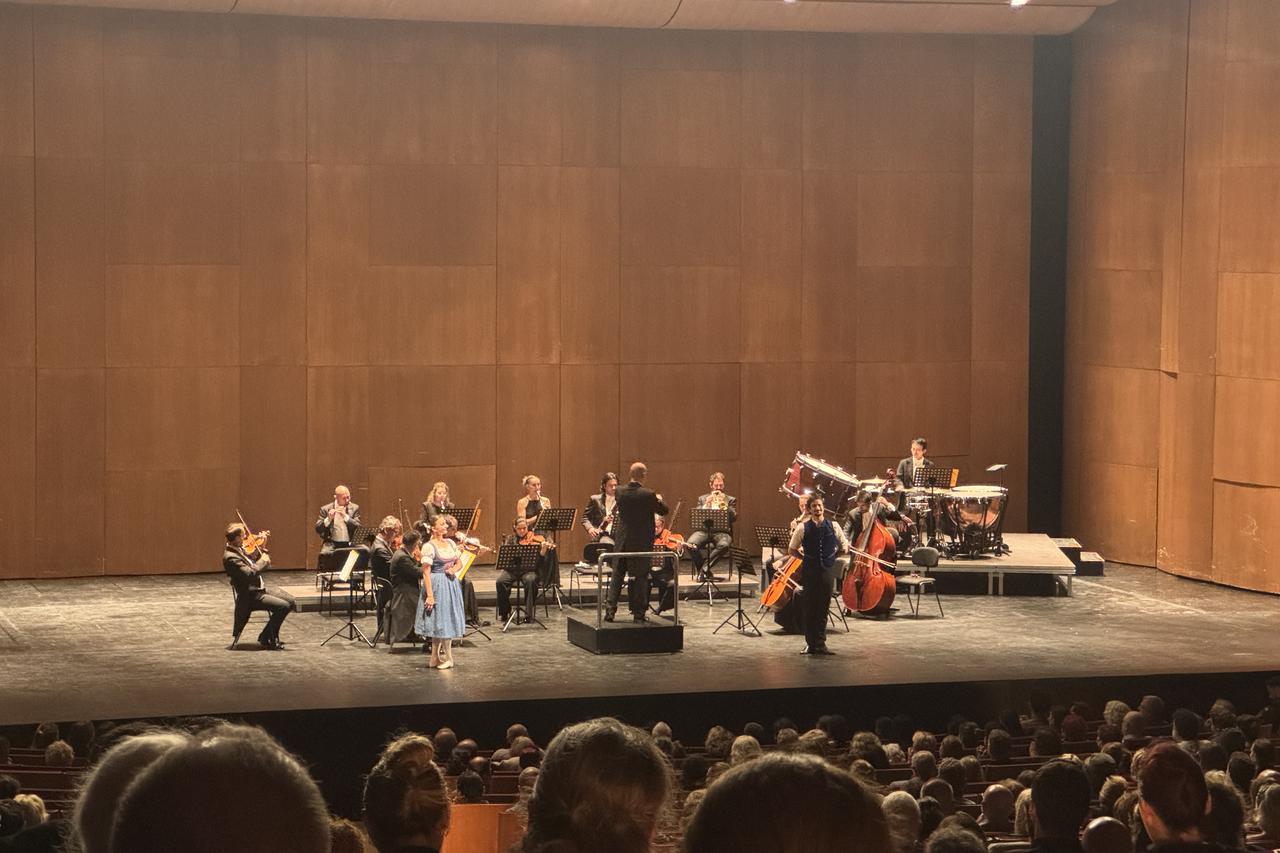


Strauss Philharmonie brought the spirit of Viennese classical music to Istanbul with its "Strauss Concert Show," combining orchestral performances, theatrical elements and audience participation at the Ataturk Cultural Center (AKM).
Organized by Musicarium and Y Kultur Sanat, the concert took place at AKM's Turk Telekom Opera Hall, where 15 musicians and a soprano performed under the direction of Brazilian conductor Vinicius Kattah.
The program featured works by Johann Strauss, widely known as the "Waltz King," including "The Blue Danube" and the "Radetzky March," alongside compositions by Wolfgang Amadeus Mozart, Emmerich Kalman, Julius Fucik and Franz Lehar.
Dressed in traditional concert costumes, the orchestra brought Viennese musical traditions to the stage, while the soprano performed selections from the city's classical repertoire.
A presenter also shared stories and anecdotes from music history, encouraging audiences to engage with the performances rather than simply listen.
Speaking to Anadolu Agency (AA), Kattah, artistic director and conductor of the Mozart Group, explained that the production aims to introduce classical music to audiences of different ages by bringing together orchestral performance, entertainment and direct audience interaction.
Originally from Brazil, Kattah has lived in Vienna for 17 years and described Johann Strauss as a figure whose popularity during his lifetime resembled that of contemporary pop stars.
"Strauss was just like a pop musician. To give an example from today, he was almost like Tarkan," Kattah said, referring to the internationally known Turkish pop singer.
He explained that audiences attended Strauss concerts not only to enjoy the music but also to dance, sing and clap along, making the performances a shared social experience.
Kattah said the Strauss Concert Show follows a similar approach by encouraging spectators to take part throughout the evening, adding that the production brings together musicians from Vienna with theatrical elements and opportunities for the audience to sing, applaud and even pick up a little German.
Kattah also highlighted the enduring cultural significance of Strauss' "The Blue Danube," describing the composition as much more than a traditional waltz.
"We like to call it the unofficial Austrian national anthem," he said, explaining that the piece reflects Vienna's musical traditions and the Austrian approach to celebrating life through music.
He also pointed to the Danube River's geographical connection with Türkiye, noting that it flows through several European countries before reaching the Black Sea.
According to Kattah, the memories and cultural identity associated with the river have helped the composition retain its importance across generations.
Reflecting on his experiences performing in Türkiye, Kattah praised Turkish audiences for their enthusiasm and willingness to participate, comparing their response to that of Latin American concertgoers.
"I come from Brazil, so I can easily say that Turkish people are very similar to Latin Americans. They love music, have fun, laugh and sing along with us. Their applause is wonderful," he said.
Strauss Philharmonie, which has performed in various European cities, also stages productions at Vienna's Musikverein concert hall and the Mirage venue in Prater.
Following its Istanbul performance, the ensemble is scheduled to appear in Lisbon, Portugal, and Greece before returning to Türkiye in January 2027.
The upcoming Turkish performances are scheduled for Izmir on Jan. 7, Ankara on Jan. 9, and Istanbul on Jan. 10.
Kattah emphasized that the show's repertoire brings together classical music with elements of pop, jazz and rock and roll, aiming to challenge the perception that classical concerts are necessarily formal or difficult to enjoy.
"I'm sure that if they come and watch, they will never say classical music is boring again in their lives," he said.


 Set as preferred source
 Set as preferred source


 1 min read
 1 min read