Newsletters


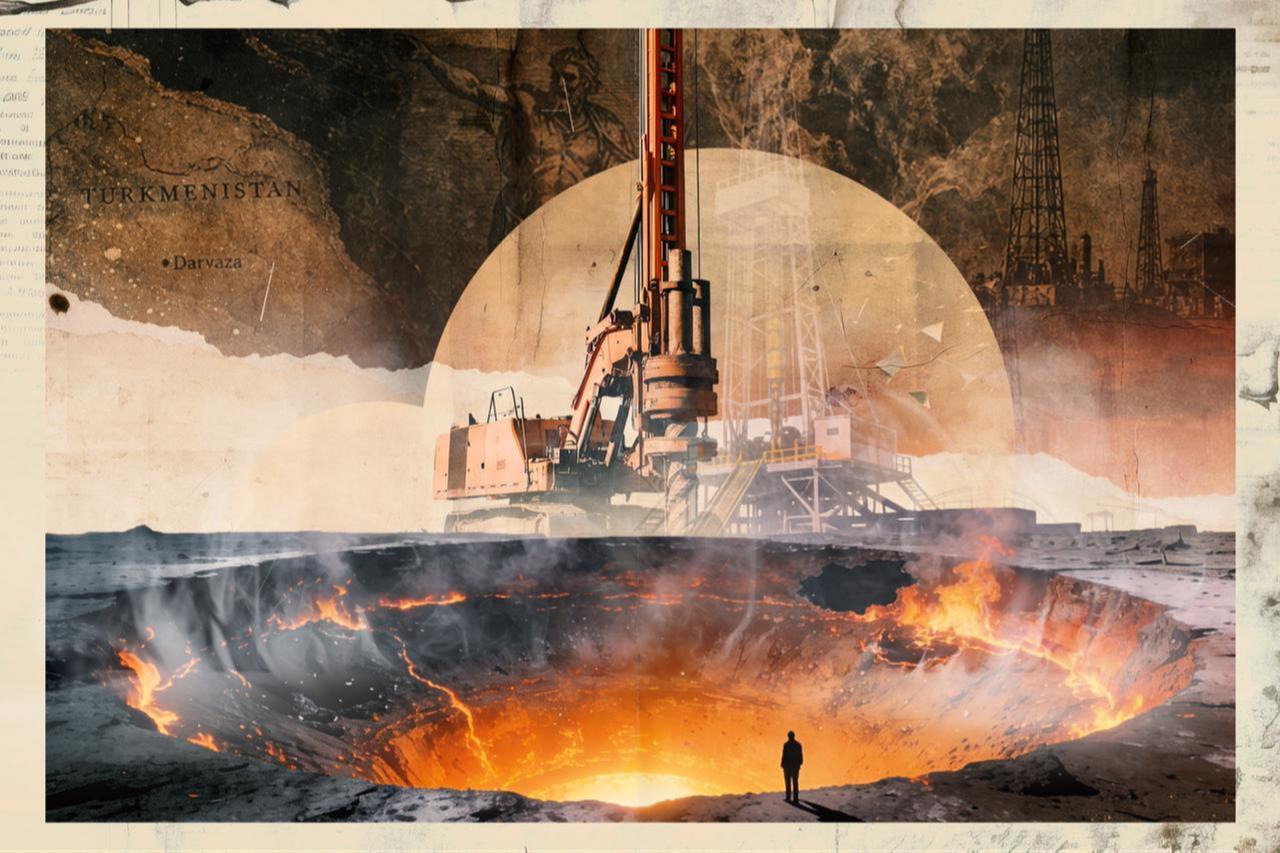


There are nights when the earth itself seems to have indigestion.
You stand there, boots sinking into a crust that feels like it might cough, and stare into a hole that should not exist—a flaming, wheezing sore on the face of geology.
The Darvaza crater. The so-called Gates to Hell. A tourist attraction for the brave, the bored, and the chemically unhinged, 11,500 kilometers east as Air Force One flies from Mar-a-Lago.
A recent Hellmouth report by Jenny Gross triggered memories of July 1987, when I was stationed in Moscow and decided to report on a flaming hole in Turkmenistan instead of Donald Trump’s visit to the Soviet Union.
At the time, leaving Trump behind for the Shining of Karakum was a no-brainer.
Picture it: a soccer-field-sized maw, glowing like a devil’s fondue pot in a place where even the wind looks dehydrated. A bureaucratic accident, they say. Soviet engineers poked the ground, the ground poked back, and someone—perhaps with a cigarette dangling from the lip—lit it on fire, expecting a brief flare.
A tidy burn-off. A geological burp.
Instead, the thing kept going.
Years turned to decades. The crater became legend, then curiosity, then content. Presidents filmed themselves near it, as if proximity to hellfire could boost approval ratings. As Gross reports, “backpackers came to toast marshmallows” over methane and brew coffee over fissures like caffeinated alchemists.
Scientists scratched their heads. Influencers squinted into the glow.
And now—now! The flames are faltering.
Infrared imaging suggests the inferno has lost its appetite. Heat intensity has decreased by more than 75% in three years.
A dragon with asthma. A bonfire that forgot its lines. The great, roaring spectacle was reduced to something like a campfire with ambition but no stamina.
Naturally, the official story arrives wearing a pressed suit. Wells were drilled nearby. Gas extracted. Progress, control, competence. The state has tamed the beast, they say. But the data whispers otherwise: the flames may have begun their decline before the drills bit into the earth. A mystery, still smoking.
And here is where the whole affair tilts into myth.
Because every civilization has its hole in the ground.
The Greeks had Tartarus, a pit deeper than dread itself.
The Norse imagined Muspelheim, a realm of fire licking at the roots of reality.
Dante mapped hell in concentric circles, each more unpleasant than the last.
Indeed, some 570 kilometers south of the Türkiye Today's newsroom is Pamukkale, the passageway to Pluto’s Gate and, according to the ancient Greek geographer Strabo, well worth a visit. “Any animal that passes inside meets instant death,” Strabo warned. “I threw in sparrows and they immediately breathed their last and fell.”
Yikes!
We humans love a good abyss. We assign it flames. We give it names. We point and say, "There! That is where things go wrong."
The Darvaza crater was our modern edition. Not metaphor, but methane. Not allegory, but geology gone feral.
And yet, what if its dimming is not a loss but a signal?
Now, before we start dancing in the dunes, understand the chemistry. The flames, grotesque as they are, perform a kind of accidental environmental service. They burn methane—1,300 kilograms per hour on average in recent years, spiking to nearly 2,000.
Methane, a gas with a temper.
A greenhouse villain far more potent in the short term than carbon dioxide.
So the fire, in its infernal way, acts like a translator. It converts something worse into something merely bad. Extinguish the flames entirely, and you risk unleashing raw methane into the atmosphere like an invisible riot.
Which means the dying fire is not a simple victory. It’s a riddle wrapped in smoke.
And riddles are the currency of myth.
Consider the phoenix, that flamboyant bird with a flair for self-destruction. It burns, yes—but only to rise again, refreshed, renewed, suspiciously well-rested. Fire, in that story, is not an end but a transition. A necessary violence on the way to something better.
Or Prometheus, who stole fire for humanity and paid for it with an eternity of liver-related regret. Fire as a gift. Fire as a burden. Fire as the thing that makes us human and threatens to unmake us.
Now look again at the crater.
A wound we accidentally inflicted on the planet, left to burn as a crude solution to a complex problem.
A spectacle we turned into a destination. A hazard that doubled as a curiosity. And now, without a clear cause, it is quieting down.
Not gone. Not safe. But changing.
The roaring red rascal that once bellowed “Behold!” now mutters “Perhaps.” The flames that leapt 5 or 6 feet high now flicker like uncertain thoughts.
At a time when the world feels like a collection of simultaneous blazes—literal wildfires, political infernos, social media dumpster fires—the idea that one long-burning catastrophe might simply diminish carries a strange comfort.
Not because the problem is solved. The methane still seeps. The emissions still matter. Turkmenistan remains a significant contributor to global methane output. The crater itself accounts for only a sliver—about 0.2%—of that total.
But symbols are not about percentages. They are about perception.
In mythological terms, it’s the moment when the gods look away, and the storm subsides—not because of intervention, but because even chaos has limits.
So yes, the science is messy. The implications are mixed. The environmental calculus is not as cheerful as a headline might suggest.
But if this stubborn, decades-long, hellfire can fade, then perhaps other incendiary passions can too.
Not by magic. Not by myth. But by the same strange combination of accident, intervention and time.
And in a world that often feels like it’s one spark away from another inferno, that’s a flicker of hope, dancing on the edge of a hole that once promised only heat.


 Set as preferred source
 Set as preferred source



 7 min read