Newsletters


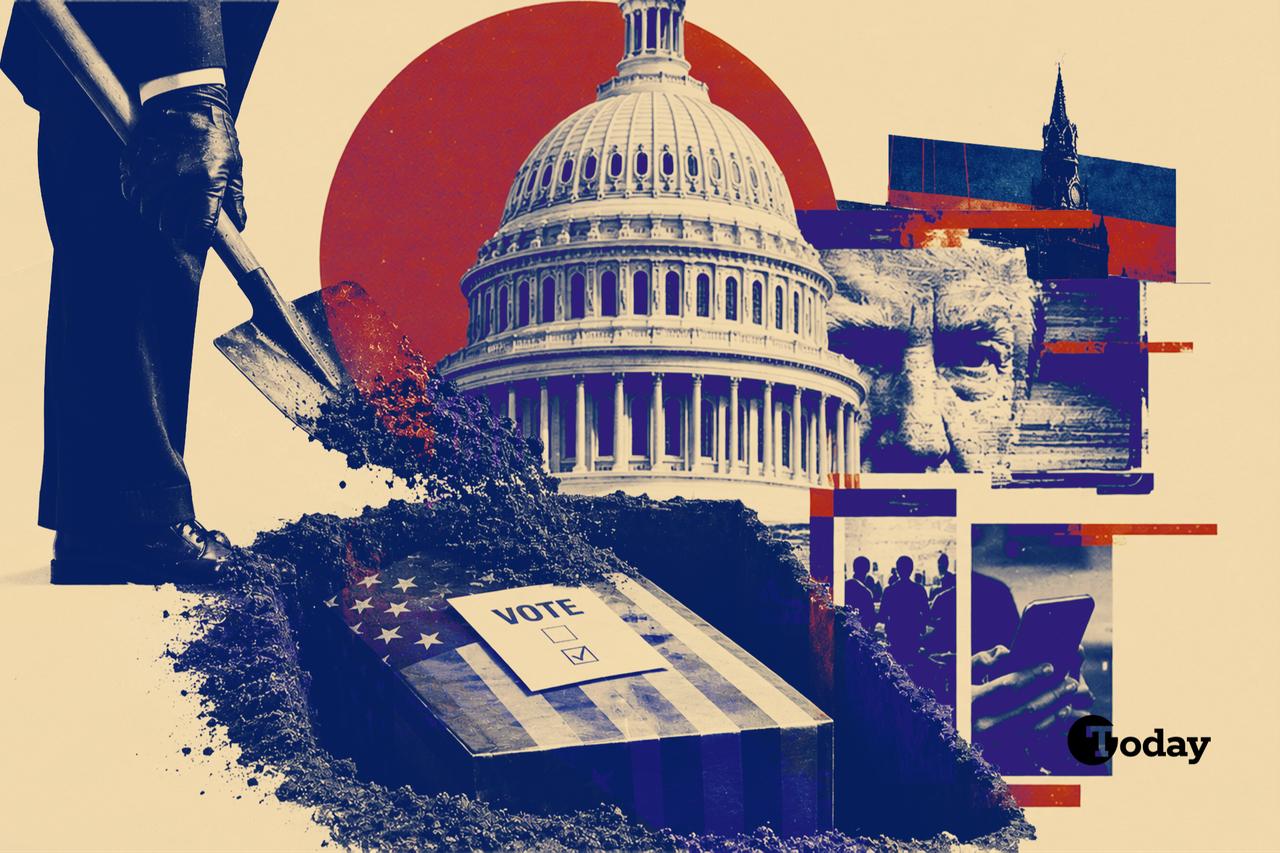


The French have an old expression for the undertaker: croque-mort, the man who bites the dead. Legend has it that he gnawed the toes of the departed to make certain they were truly gone before dumping them into the grave.
Across the Atlantic, America has acquired its own croque-morts, men who stand over the still-breathing body of democracy, impatient to pronounce it dead.
With November's midterm elections approaching, they are sharpening their knives, polishing shovels and discussing martial law as though it were a reasonable alternative to counting votes.
And now the corpse is naming its own murderers.
Utah’s Republican lieutenant governor, Deidre Henderson, says the threats to American elections have crossed a threshold so foul that even the most hardened cynics can no longer dismiss the stench.
“In the past two elections that I oversaw as lieutenant governor, the threats were all external,” Henderson told the CBS News program Sixty Minutes, vowing to fight Trump and his MAGA trespassers.
“Non-state actors, cybersecurity threats, and other things. But now we also have threats coming from within our own government."
Once, the danger came from outside: hackers, freelance saboteurs, and the usual collection of democratic grave robbers.
Now it comes from inside the federal government, from the very institutions charged with keeping the republic alive
Think about that. An American election official must now treat her own federal government as a potential enemy of the ballot box. The croque-morts have breached the cemetery gates. They are fitting the living for coffins.
The Russians, watching from afar, have brought their own poison to the wake: a fresh supply of lies for a nation already choking on them.
There is something particularly American about the business of digging a grave before the occupant has died. The country has always possessed a juicy appetite for catastrophe, a willingness to imagine its own destruction with the enthusiasm other peoples reserve for harvest festivals.
Now that craving has acquired a name: a second Civil War.
It is spoken of in television studios, whispered across kitchen tables, celebrated in the fetid swamps of the internet. Some fear it. Others seem almost to welcome it.
And between these two camps stands a republic whose citizens are being taught that losing an election is not democracy functioning but democracy betrayed.
Enter Peter Ticktin, a childhood friend of Donald Trump and attorney for election activist Tina Peters. Ticktin recently declared that "there would have to be martial law" in the event of another supposedly rigged election.
He subsequently suggested that ballots and election equipment might need to be commandeered.
There is no credible evidence that November's elections are rigged. Yet the accusation is being prepared before the first vote is counted, like a coffin ordered for a patient who has not yet fallen ill.
Gregory Stenstrom, another election activist, has proposed pausing the election over security concerns or invoking emergency powers to compel states to alter their procedures. Peters advocates paper ballots and hand recounts.
These are not identical propositions.
Paper ballots and audits can strengthen election security. Suspending an election or placing its machinery under military authority is something altogether different.
And here the law remains stubbornly clear.
"Emergency powers are not just a blank check for the president to go do whatever they want," says Derek Tisler of the Brennan Center for Justice.
Congress establishes the timing of federal elections. States administer them within constitutional and statutory limits.
Neither a presidential emergency declaration nor martial law grants Trump the authority to cancel the midterms or seize control of the count.
The likelihood of a lawful presidential imposition of martial law to control the election is therefore exceedingly remote.
The danger lies instead in an attempted assertion of unlawful power, and in the confusion, intimidation and institutional confrontation such an attempt could produce.
But democracy can be injured without a soldier appearing in the street.
In New York, an artificial-intelligence campaign advertisement manufactured a cheerful encounter between Mayor Zohran Mamdani and Governor Kathy Hochul, selling an imaginary "political delusion pill." Neither encounter nor pharmaceutical existed.
Researchers at the Wesleyan Media Project identified more than 220 political videos employing artificial intelligence, over 80% produced by Republican campaigns or allied groups.
Other fabrications depicted political candidates embracing enemies, celebrating terrorism or consorting with foreign villains.
The machinery of falsehood has become so efficient that reality itself is treated as an inconvenience.
Travis Ridout of the Wesleyan Media Project reckons that Democrats face greater “reputational risk” from using a technology their own supporters want regulated. But the manufacture of political falsehoods is no longer merely a domestic enterprise.
Beyond America’s borders, another set of undertakers has been busy, exploiting the nation’s divisions and supplying fresh lies to a country already drowning in its own.
Russian-linked influence operations, including Doppelgänger and Matryoshka, have flooded social media with fabricated stories, counterfeit news sites and invented personalities. Their purpose is not to change a ballot. It is to poison the mind that casts it.
Russia's propagandists understand something fundamental about a divided people: hatred travels faster than evidence.
The tsars had Fabergé to fashion their jeweled Easter eggs. Vladimir Putin has his digital craftsmen, who gather America's grievances, coat them in the glitter of conspiracy and send them back as precious revelations.
Break the shell, and the only treasure inside is a lie.
Princeton University professor Zeynep Tufekci, a Turkish-born sociologist who deep-dives into digital propaganda, has warned that modern censorship need not conceal the truth.
It can simply bury it beneath so much dubious information that truth loses its meaning. The Kremlin has made an art of this confusion, and America has supplied the raw material.
“It's not that the relevant information isn't out there,” Tufekci mused with remarkable prescience at Columbia University's School of Journalism in 2019. “But it is buried in so much information of suspect credibility that it doesn't mean anything.”
Why bother hacking a voting machine when you can crawl inside the skull of the voter? The internet has made lying a cheap and filthy business, a vast sewer of outrage where a well-placed falsehood can do more damage than an army of computer hackers.
And once enough people swallow the poison, the Russians needn't steal a single vote. They have already accomplished something far more sinister: convincing Americans that no election can be trusted, no defeat accepted and no truth believed.
Jean le Roux, a former investigator with the Atlantic Council's Digital Forensic Research Lab, now works for Graphika, a New York-based intelligence firm that has spent years exposing the machinery of foreign propaganda. His findings point to a familiar political preference: Kremlin-linked disinformation campaigns are directing their fire at Democrats, not Republicans in the same way.
The asymmetry is the giveaway. The Kremlin's men are not distributing their poison evenly: Democrats take the blows, while Republicans are spared comparable attacks in the operations examined. No voting machines need to be hacked, no ballot boxes stuffed. The object is to make the election itself look fraudulent. America's political embalmers can do the rest.
Abraham Lincoln is the medicine American politicians prescribe for every sickness of the republic, though few seem inclined to swallow it. In 1838, he warned that Americans could become the authors of their own destruction. Twenty years later: "A house divided against itself cannot stand."
Lincoln knew the disease. Civil war begins when neighbors become enemies, defeat becomes conspiracy, and the ballot loses its authority.
Trump and his apostles of the stolen-election gospel insist that "every legal vote must count." Democracy asks something harder: accepting the votes that send them from power.
And so the croque-mort waits beside the American republic, shovel in hand, listening for its final breath. But democracy does not die because one side loses an election. It dies when one side decides it must never lose.


 Set as preferred source
 Set as preferred source


 1 min read
 1 min read