Newsletters


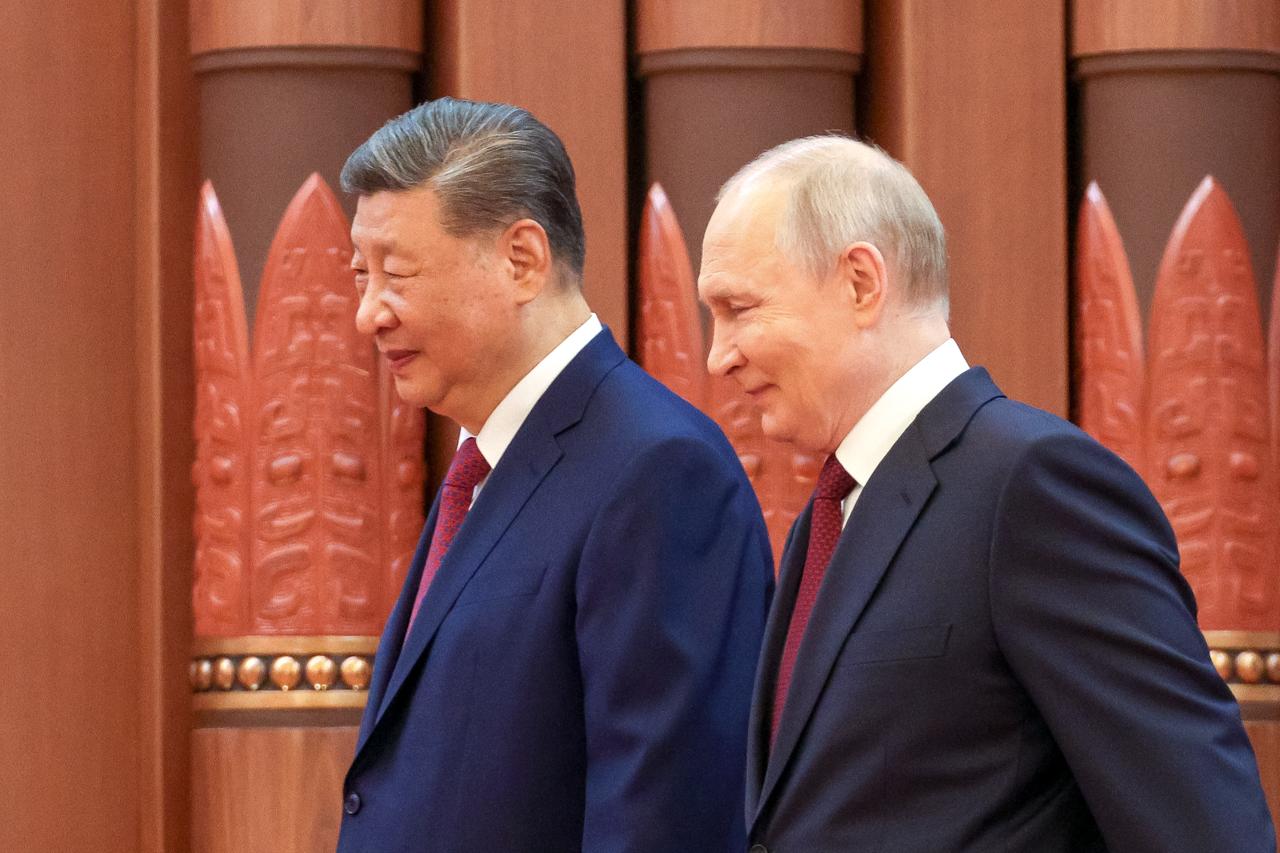


Although Vladimir Putin’s recent visit to Xi Jinping was wrapped in familiar, friendly rhetoric and shared ambitions to rewrite the global order away from the U.S.-led one, the pageantry could not mask a stark reality: the meeting yielded nothing of substance for Moscow.
Since Russia’s full-scale invasion of Ukraine in 2022, the emphasis on their strong friendship has come primarily from President Putin, reflecting Russia’s steadily increasing dependence on China.
The bold "no limits" rhetoric declared in their joint February 2022 statement—just three weeks before the invasion of Ukraine—has not been repeated by China with the same intensity since.
In 2022, the Biden administration took a hard line against the East: it boycotted the Beijing Winter Olympics over human rights violations in Xinjiang, supported Ukraine’s NATO ambitions, and pledged to defend both Ukraine and Taiwan. In response to this pressure, Xi prioritized forming a united front with Putin against the West.
In their joint statement, without explicitly naming the West or the United States, they accused Western nations of interfering in their internal affairs and those of other states, while voicing opposition to both NATO expansion and the U.S. Indo-Pacific strategy.
Today, however, the United States has ended military assistance to Ukraine and fallen short of its expected results in the trade war with China. Furthermore, Washington supports a peace settlement favorable to Russian interests and violates the rules-based order in a manner similar to Putin and Xi.
While prioritizing American interests and gradually scaling back intervention outside the Asia-Pacific and Western Hemisphere, Washington can, as the recent Trump–Xi meeting demonstrated, sideline Taiwan when necessary.
Furthermore, China faces a U.S. administration with populist and authoritarian tendencies that also shows little concern for human rights and minority rights. Therefore, China, which at the same time would like to develop stable and constructive relations with the U.S., may no longer feel the same urgency to emphasize its friendship with Russia.
The two partners who once met on the basis of shared interests now have unequal levels of interdependence. Over the past four years, Russia has become increasingly dependent on China and has become a client state, a subordinate actor that must satisfy its patron.
Following Russia’s full-scale invasion of Ukraine in 2022, increased Western sanctions and Russia’s large-scale economic decoupling from the West turned China into an economic lifeline for Russia, and dependence on China has grown steadily.
Total bilateral trade, which stood at around $147 billion in 2021, increased to $244 billion in 2024. In 2021, China exported goods worth $72.6 billion to Russia and its imports from Russia were $68.6 billion.
By 2024, these figures had respectively risen to $115.4 billion and $129.3 billion, marking a 58% increase in Chinese exports and 88% increase in Russian exports.
In terms of total trade share, Russia accounted for about 2.5% of China’s total trade in 2021, rising to 4% in 2024. Conversely, China’s share in Russia’s total trade surged from 18% in 2021 to around 40% in 2024, making up 34% of Russian exports and more than 55% of Russian imports.
Although China is Russia’s top trading partner, Moscow still accounts for only a small portion of Beijing’s overall trade. Trade between China and Russia remains significantly smaller than China’s trade with the United States ($582.9 billion in 2024) and the European Union ($739 billion in 2023). These figures clearly show the growing dependence of Russia’s economy on China after 2022.
Beyond trade volumes, the structure of imports is also important. After sanctions on Russia, the number of countries capable of supplying Russia with advanced goods such as machinery, electronics, and automobiles is limited.
Chinese brands accounted for nearly 60% of the Russian car market in 2024, up from just 7% in 2021. Furthermore, while China denies supplying lethal weapons to Russia, it exports large quantities of dual-use goods that are critical for the Russian military industry, including semiconductor chips, navigation equipment, and jet parts.
In 2024, U.S. officials revealed that 70% of all machine tools and 90% of microelectronics imported by Russia and used in the production of missiles, tanks, aircraft, and other weaponry came from China.
Officials also stated that China supports Russia in the production of drones, space-based capabilities, and supplies machine tools essential for ballistic missile production.
According to a recent report, Russia imports more than 90% of its sanctioned technology from China, a 10% increase from the previous year. In addition, in certain areas, the Chinese yuan and China’s financial infrastructure have replaced the Western financial system for Moscow, reducing dependence on the West.
Through its trade with China, Russia has significantly mitigated the effects of Western sanctions. According to U.S. officials, Russia would have difficulty sustaining the war in Ukraine without technological and industrial support from China. Therefore, Russian officials consider relations with China as their top foreign policy priority.
Despite rising trade, China has remained cautious in its relations with Russia, both to avoid potential sanctions from the United States or Europe and to preserve its trade relations with the EU.
Since 2022, no large-scale joint cooperation projects have been announced. This includes the long-discussed Power of Siberia 2 gas pipeline, which Russia has sought to advance for some time. Russia expected energy instability caused by the Middle East conflict to push China to reconsider its position and increase interest in additional pipeline gas imports.
Before he visited Beijing, Putin stated that Russia was very close to reaching an agreement with China on oil and gas cooperation and expressed hope that these could be finalized during the visit; however, no concrete progress was made on the pipeline project during the visit.
China appears hesitant to commit to the planned $94 billion in investments in this project and prefers to diversify its energy imports, keeping Russia’s share capped at around 30% for gas and 20% for oil imports.
Since 2022, China has become the largest buyer of Russian oil, purchasing nearly 33% of Russia’s total energy exports. Without increased Chinese imports, Russia would likely have had to cut production more sharply, reducing revenues and weakening an energy sector that accounts for about 20% of its gross domestic product (GDP).
Nevertheless, the war in Iran has provided momentum to bilateral relations. In fact, the conflict in Iran serves the interests of both Russia and China. It increases Russia’s resources while diverting Western attention away from the war in Ukraine. For China, it shifts American focus and resources that might otherwise be directed toward the Asia-Pacific to the Middle East.
The disruption of the maritime trade through the Strait of Hormuz has led China to increase its purchases of Russian oil and gas. As a result, bilateral trade increased by 20% in the first four months of this year and the Russian oil flowing to China by 35%.
Both rising oil prices and increased Russian oil and gas exports have placed Russia among the winners of the Iran war. The conflict has also reinforced China’s view of Russia as a reliable energy supplier. Just as Russia economically depends on China, China also values Russia as a provider of cheap and reliable energy supplies.
Reducing China–Russia relations solely to economic and energy dependence would be misleading. Russia’s transformation into a junior partner is largely a result of its wartime circumstances over the past few years.
Nevertheless, Sino-Russian relations—anchored by the close personal alignment between Xi Jinping and Vladimir Putin—have developed into a potent strategic partnership over more than a decade. Driven by a shared opposition to Washington and the U.S.-led global order, both nations aim to reduce their reliance on the dollar, bypass the rules-based system, and counter liberal international institutions.
Ultimately, they seek to transition the global architecture into a multipolar system—one that curtails U.S. influence and allows major powers to dominate their respective spheres of interest. Consequently, Moscow and Beijing have drawn closer not only economically, but also diplomatically and militarily.
Since 2015, Russia has strengthened military ties with China through providing advanced weapons such as Su-35 combat aircraft and S-400 air defense systems, along with technology and joint military cooperation, including 15 joint military exercises conducted between 2022 and 2024.
China and Russia are also expanding cooperation in the Arctic through joint security, shipping, and coast guard operations, including their first joint patrol near key shipping routes in 2024. China has not opposed Russia’s invasion of Ukraine but has instead carried out limited mediation efforts that have not produced results, while Russia has supported China’s claims regarding Taiwan.
Within Global South multilateral organizations such as BRICS and the Shanghai Cooperation Organization, the two countries advocate for a less Western-dependent international order and coordinate economic and security policies. In the United Nations Security Council, they have supported each other on many issues and have similarly used their veto to block resolutions.
The Russia–China bloc that has developed over the years is undoubtedly one of the United States’ main strategic competitors within the framework of great-power competition. Today, two of the world’s leading powers are significantly closer to each other and act in coordination on many issues.
Moreover, Beijing and Moscow frequently align and cooperate with states like Iran and North Korea. While their relationship stops short of a formal treaty, the absence of a military alliance does not diminish the strength of their cooperation.
Instead, within today’s shifting global landscape, they have forged a flexible partnership—one that avoids rigid commitments while enabling deep strategic coordination whenever their interests align.
Ultimately, what began as a strategic partnership has evolved into an increasingly asymmetric relationship shaped by post-2022 realities, where Russia’s growing dependence on China defines the limits of their “no limits” alignment.


 Set as preferred source
 Set as preferred source


 7 min read