Newsletters




The louche republic had never looked so prosperous—or so cheap.
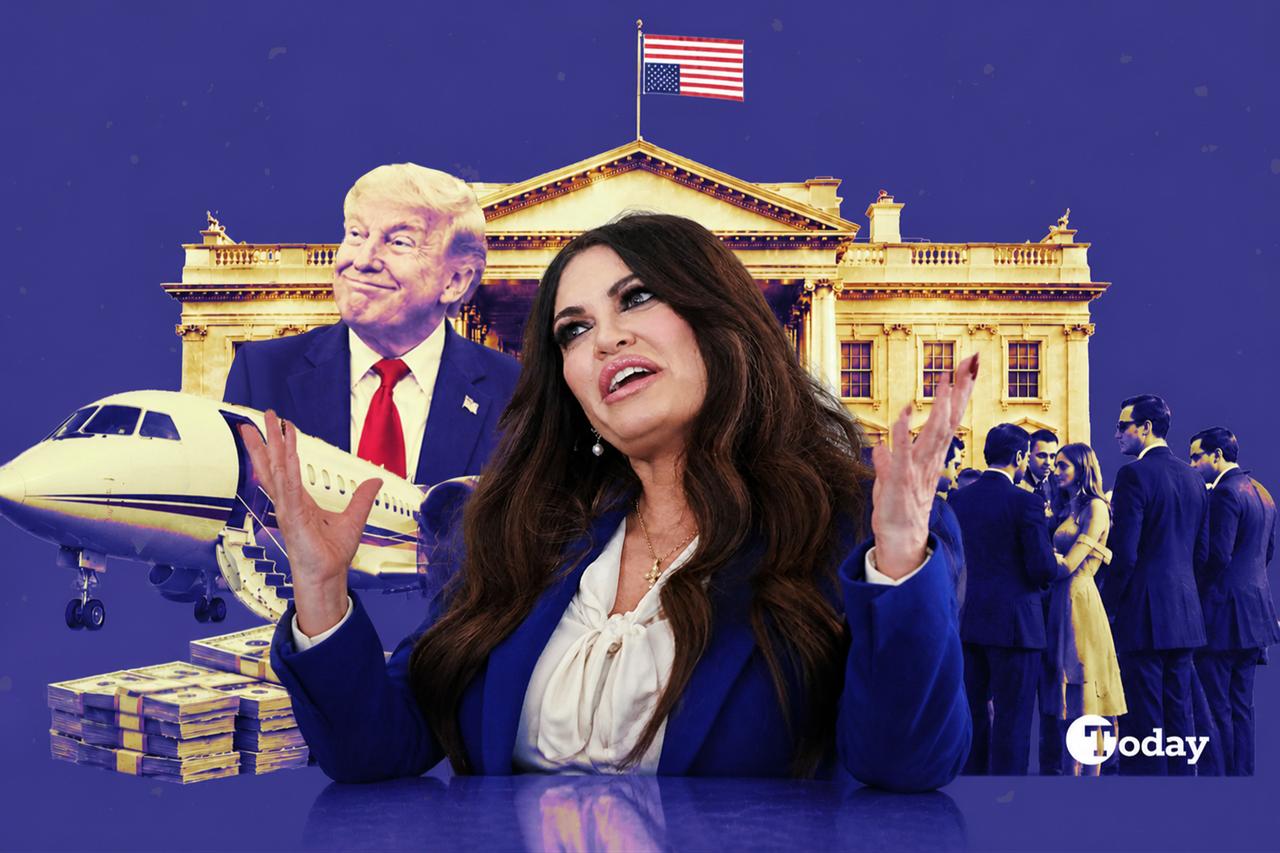
Private jets. Greek billionaires. Swiss ski resorts. Plunging MAGA décolletage. The sweet stench of money and influence. And an American ambassador allegedly dangling her political connections before a wealthy businessman, promising to make him “a lot of f—ing money.”
Welcome to the Land of the Fee and the Home of the Grift, where the Constitution is sacred, the expense account is bottomless, and the national motto might as well be In God We Trust—All Others Pay Cash.
Take a bow, Kimberly Guilfoyle, former television personality, one-time fiancée of Donald Trump Jr., and American ambassador to Greece. According to The Wall Street Journal, she reportedly arrived at the 2026 World Economic Forum in Davos aboard a private jet belonging to a Greek construction executive whose commercial interests she had reportedly encouraged foreign governments to embrace.
There, she confronted the supreme humiliation of the international influence-peddling class: Her name wasn't on the dinner list.
Not just any dinner. An Eric Trump dinner.
The ambassador was incandescent.
“She should be kissing my f—ing ass,” she reportedly said of the organizer. To an American businessman who might secure her admission, she offered a more seductive proposition: “I’m going to make you a lot of f—ing money.”
There it was. The American political economy reduced to its elemental components: money, access, grievance and a seating chart.
The reported conduct remains under scrutiny, not judicially established corruption. Her representatives dispute key allegations, and the U.S. Embassy maintains she followed ethics rules. But the spectacle belongs to a distinctly American tradition.
The grift didn't arrive with Donald Trump. It practically stowed away aboard the Mayflower.
The word "grift" crawled out of the American underworld around the turn of the 20th century, an illicit offspring of "graft," the older slang for dishonest profits.
By 1906, it was circulating in the vocabulary of carnival hustlers, crooked gamblers, and confidence men—who knew the easiest way to separate a sucker from his money was to make him believe he was getting something for nothing.
But the grift’s spiritual birthplace was the frontier, where land was plentiful, oversight scarce, and a scoundrel could sell the same acreage to three fools before breakfast.
By the 1840s, New York had produced the archetypal confidence man: William Thompson, who approached strangers, cultivated their trust, and persuaded them to surrender valuables on the strength of his charm.
Thompson’s genius was psychological. The mark wasn't merely robbed. He was recruited into his own deception.
American showman P. T. Barnum industrialized the principle. His exhibitions blurred entertainment, exaggeration, and outright humbug, proving that the public would pay to be fooled, provided the spectacle was magnificent.
Then came the Civil War profiteers, railroad speculators, and Gilded Age robber barons.
The Crédit Mobilier scandal turned railroad construction into a private gold mine, with politicians offered sweetheart stock deals. The Whiskey Ring looted federal liquor taxes, while Tammany Hall’s William “Boss” Tweed turned New York City Hall into a municipal cash machine for crooks and cronies.
The machinery changed. The operating principle didn't.
In the 1920s, Charles Ponzi, a con man whose name became synonymous with predatory investment schemes, perfected another American innovation: turning financial impossibility into irresistible opportunity. His promised returns depended not on sustainable profits but on money supplied by successive investors.
Ponzi collapsed. The business model thrived.
Decades later, American financier and con artist Bernie Madoff dressed the same deception in the reassuring costume of Wall Street respectability. His fraud demonstrated that fine tailoring, exclusive clientele, and grand Manhattan offices could disguise an empty vault.
Political grift, however, was always more sophisticated.
The 29th U.S. President Warren Harding's administration delivered Teapot Dome, in which Interior Secretary Albert Fall secretly leased federal oil reserves to private companies and received illicit payments. Fall went to prison.
Richard Nixon's era supplied influence brokers, secret campaign money, and the unforgettable spectacle of Attorney General John Mitchell eventually going to prison for his role in Watergate.
By the late 20th century, Washington had developed an elaborate vocabulary for activities earlier generations might have called buying influence.
Consulting. Strategic advisory. Government relations. Access facilitation.
The vocabulary mattered. A bribe was criminal. A consulting fee could be perfectly legal. The distinction depended on facts, intent, disclosure, and statutory boundaries—not simply the size of the check.
And then came the celebrity-industrial complex.
American politics ceased merely to tolerate show business. It absorbed its commercial architecture: personal branding, premium access, lucrative appearances, and the relentless monetization of proximity to fame.
Trump didn't invent this transformation. He understood its possibilities better than most.
His political ascent fused populist rebellion with penthouse capitalism. Gold fixtures, grievance politics and billionaires promising to destroy the establishment while presiding over a court of donors, supplicants and aspiring insiders.
Meanwhile, the grift had acquired a diplomatic passport.
Ambassador Guilfoyle’s reported itinerary included a Greek shipping magnate, Christmas holidays in Gstaad, and a Parisian stay at the Four Seasons George V, reportedly paid for by her wealthy companion.
The Journal also reported that she sought $100,000 in credit-card relief from a Trump donor while offering assistance with his legal and tax problems. Her lawyer disputed the authenticity of the text messages.
The State Department inspector general was reportedly busy investigating the possibility of eventually doing something, while congressional Democrats mounted another furious assault on the problem with their deadliest weapon: the strongly worded letter.
No conviction. No verdict. Just the familiar stench of money swirling around public office, with the taxpayers left wondering who owns the franchise.
An American ambassadorship isn't supposed to be a platinum membership in some floating casino of billionaires, private jets, and political IOUs. It's a public trust. Or it was, before Washington discovered that everything sacred could be repackaged as a premium service.
And that's the dirty little secret of the American grift.
The real money isn't in picking pockets. That's amateur hour. The serious operators sell the illusion that they can pick up the telephone and make the machinery of government dance.
From Boss Tweed’s courthouse to Davos’s private-jet terminal, the scenery has improved, but the racket remains the same. They sell access, influence, and the intoxicating promise that the rules are for other people.
The hustle is eternal. The champagne is cold, the private jet is waiting, and the chumps in the cheap seats are picking up the tab.


 Set as preferred source
 Set as preferred source


 1 min read
 1 min read