Newsletters




If you’ve ever attended a performance of Shakespeare’s “The Comedy of Errors”—gleefully translated into more than 100 languages—you know it involves mistaken identities, slamming doors, and the general sense that everyone would benefit from festooning a Post-it of themselves on their forehead.
Played out on thousands of stages from Broadway to Cihangir, the slapstick is widely considered Shakespeare’s fluffiest work, meaning nobody important dies and the audience leaves without needing therapy or an analysis from the U.N. Security Council.
But watching U.S. Secretary of War Née Defense Pete Hegseth’s crying havoc about Operation Epic Fury obliges a reappraisal of the Bard’s most famous farce. Specifically, let slip the dogs of global anxiety.
In short, "The Comedy of Terrors."
To be sure, three hellish weeks into the U.S.-Israeli war on Iran and Lebanon, and just about everyone else in the Gulf region, is the time to start thinking about how to best smile through the apocalypse. So take a deep breath and reimagine a production not set in ancient Ephesus but as a satyr play on the coral outcrop of Kharg Island.
Because at some point in every war—or near-war, or heavily implied war—there's a moment when reality becomes so absurd, so tangled in its own contradictions, that only Shakespeare has the structural integrity to contain it. His plays remind us that confusion is not new, that power has always been theatrical, and that humans have a long history of mistaking noise for meaning.
And Kharg Island is the backdrop, certain to make the audience deeply uncomfortable while also Googling, “Where is Kharg Island, and should I be worried?” The place (which Iran’s Islamic Revolutionary Guard Corps, fortunately for us, labels Forbidden Island) is a strategically significant oil terminal. Theatergoers know the depot better as Chekhov's refinery. If it’s there in Act I, something is definitely going to explode by Act III.
Now, Shakespeare was very big on the “fourth wall,” which is the imaginary barrier separating the actors from the audience. In comedies, characters occasionally break this wall to share a joke. In tragedies, they break it to share existential despair. In modern geopolitics, the fourth wall does not merely break—it's vaporized by a combination of live-streamed speeches, social media posts, attacking Iranian drones, and what experts refer to as “guys saying things they really should not say out loud.”
This brings us to the casting.
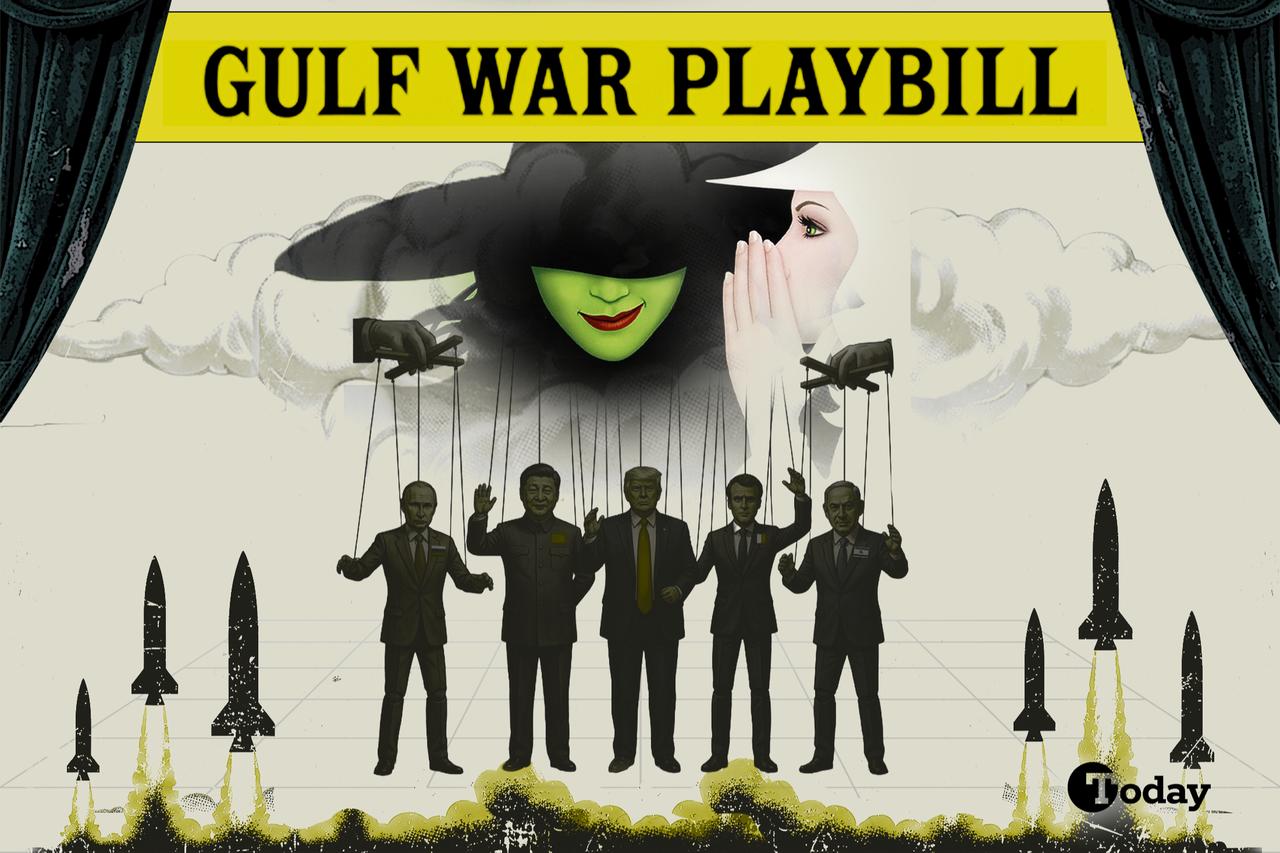
In “The Comedy of Terrors,” the four central roles are played not by identical twins but by four world leaders who, while not identical, have demonstrated a remarkable ability to generate confusion, tension, and headlines arguably written by an improv troupe of ayatollahs fighting insomnia.
We begin with Chinese President Xi Jinping, who in this version serves as the calm, inscrutable figure who always seems to know more than he is saying, which is everything. He speaks in ancient proverbs that take a dozen Washington-based research institutes to interpret incorrectly.
Opposite him is Russian President Vladimir Putin, who enters every scene as though he has just finished jackbooting a bear. His lines are short, direct, and delivered with the confidence that suggests he has already planned Act V.
Then we have U.S. President Donald Trump, who, in keeping with the spirit of Shakespearean comedy, communicates primarily through declarations, misunderstandings, and what appear to be improvised soliloquies addressed not to the other characters but directly to the audience and occasionally a nearby seagull. He breaks the fourth wall so often that eventually there is no wall, only a light breeze and a Greek chorus of NATO leaders more confused than goats on Astroturf.
Israeli Prime Minister Bibi Netanyahu rounds out the cast as the character who is constantly navigating alliances, rivalries, and the theatrical equivalent of being handed a script that changes mid-scene. His dialogue is sharp, strategic, and frequently interrupted by bombing Tehran and bullying the other three characters, who are also trying to control the plot.
The storyline’s tempo is “a presto,” because if you blink, someone has issued a statement, retracted it, clarified it, and then denied ever having made it.
Act I opens with all four leaders arriving on Kharg Island for what is described as a “routine discussion,” which in theatrical terms means absolutely nothing about this is routine. Through a series of misunderstandings—some linguistic, some diplomatic, and some caused by an errant Iranian missile barrage—they each come to believe that the others are secretly plotting something.
Xi suspects he’s attending a negotiation. Putin believes he’s joining a demonstration of strength. Trump is certain he’s hosting the newly appointed Iranian leader Shah Reza Pahlavi. Netanyahu orders gunships to strafe every halal grocery store south of the Litani River.
Already, we have confusion, which is the lifeblood of any comedy, though in this case, the audience is laughing in the way people laugh when they are not entirely sure this is a comedy.
Act II introduces the first major breaking of the fourth wall. Trump addresses the audience directly, hallucinating the situation in terms of the Epstein Files and former President Joe Biden’s plan to breed $8 million worth of transgender mice.
Putin then also turns to the audience, but instead of explaining, he simply eats the bear’s gallbladder, which somehow conveys even more information.
Xi refuses to break the fourth wall at all, which makes it even more unsettling when the wall begins to crack anyway.
Netanyahu attempts to restore order by launching a cocktail-hour missile barrage on Beirut.
By Act III, the refinery—remember Chekhov’s refinery—becomes central to the plot. Each character believes the others intend to use it as leverage, a bargaining chip, or possibly a Trump-branded tourist destination.
Miscommunications escalate into declarations, declarations escalate into actions, and actions escalate into what the playbill delicately refers to as “a significant theatrical event involving fire.”
This is where the fourth wall is not just broken but exploded. The audience is no longer separate from the action; they are part of it, checking their phones, refreshing CNN and BBC news feeds, and wondering whether Iranian missiles dropping on Dubai will cancel intermission.
In “The Comedy of Terrors,” Shakespeare’s essential invisible hand guides the chaos toward something resembling resolution. Not a neat resolution (remember, this is entertainment), but a recognition that the players are, in fact, characters. They are part of a narrative that has been unfolding for centuries, one in which ambition, fear, and misunderstanding play leading roles.
Act IV lurches into deranged détente—not because anyone suddenly got wise, but because the whole damned cast realizes they’re stumbling blind through the same fog, each one as clueless as the next.
No strategy, no clarity, just a shared, twitchy awareness that nobody’s driving the bus. And somehow, in that mutual incompetence, you get the nearest thing to harmony the Middle Eastern circus ever produces.
There’s no tidy wedding at the end of Act V, no neat little bow to reassure the ticket holders. Instead, the play coughs up a question and leaves it bleeding on the stage: what happens when the joke curdles, when the laughter dies in your throat and refuses to come back? Nobody answers. The characters drift off like hobgoblins. The lights sink into a dim, uneasy glow. And the refinery—looming, obscene—still stands there, untouched, which feels less like good fortune and more like a warning shot. Maybe it’s just the market whispering about oil prices going feral.
By the time the audience staggers out, they find themselves craving the old comforts of mistaken identities, swapped trinkets, and the innocent machinery of farce.
But there’s something else clawing at the edges of their minds: the realization that even in the ugliest, most unhinged chaos, there’s this stubborn filament of absurdity that refuses to snap.
And that’s the play’s real payload. That’s what turns Operation Epic Fury into a blood-slick comedy of terror. Equal parts nightmare and punchline are guaranteed, with nobody quite sure which is supposed to land first.


 Set as preferred source
 Set as preferred source


 4 min read